These stories highlight how diverse events on a single date can deeply impact culture and scientific understanding, challenging our views on art and nature.
What do a global uproar over controversial cartoons and a breakthrough in marine science have in common? Well, they both happened on a 30th of September, albeit one year apart. Join me as I dive into contrasting tales of protests and oceanic wonders, which remind us that history is as unpredictable as ever.
Cartoons and Chaos
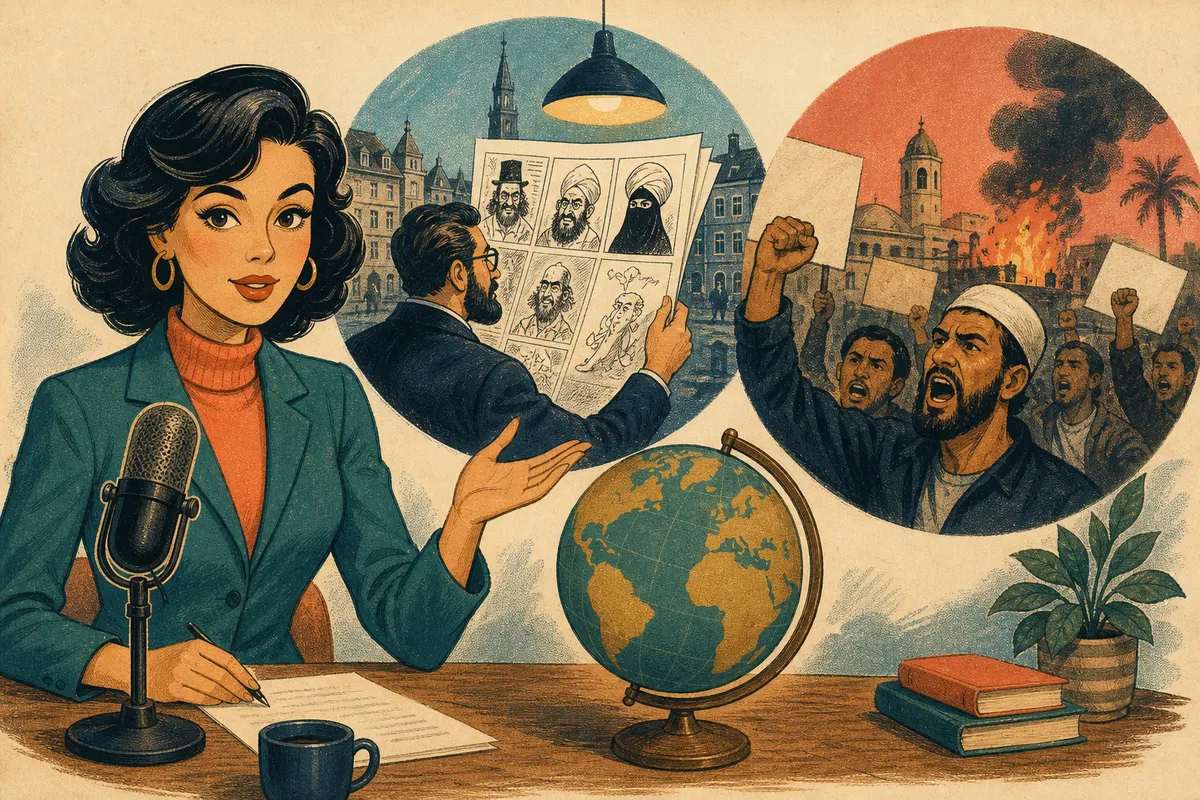
On the 30th of September 2005, the Danish newspaper Jyllands-Posten published cartoons depicting Prophet Muhammad. Far more than just ink on paper, these images ignited an international storm. The controversy was less about artistic merit and more a fierce battle between freedom of expression and the respect for religious sensitivities.
The cartoons resulted in global protests and a great deal of soul-searching about where the line should be drawn. Should newspapers have the liberty to depict religious figures in any manner they see fit, or does such freedom come with a responsibility to respect diverse beliefs? The ripples of this debate have shaped discussions about media responsibility and religious expression ever since, creating a cultural and political dialogue that continues to evolve.
Giant Squid
The year before Jyllands-Posten’s cartoons took centre stage, 30 September 2004 marked a significant milestone in oceanic exploration. Japanese researchers Tsunemi Kubodera and Kyoichi Mori succeeded in capturing the first photographs of a living giant squid in its natural environment. This was not your average day at the office.
For centuries, the giant squid was the stuff of legend: tales of enormous tentacled beasts lurking in the ocean depths were the fodder of sailors’ nightmares and myth makers’ dreams. With this discovery, our understanding of deep-sea creatures and their behaviours took a giant leap forward. It underscored the vastness of the ocean and hinted at how much there still is to explore beneath the waves.
These two vastly different stories, separated by a mere 365 days, serve as a reminder of the unpredictable nature of history. One day presents a lens into human society and expression, while another opens a window into the natural world. As you listen, consider how such events continue to shape our understanding of both art and nature.