On this day · 24 September 2026

The Salad Bar Bioterror Attack That Changed America

· 12 min

The Salad Bar Bioterror Attack That Changed America

Listen to this episode

12 min

This strange tale highlights how easily public health systems can be exploited, shaping how we view and prepare for bioterror threats today.

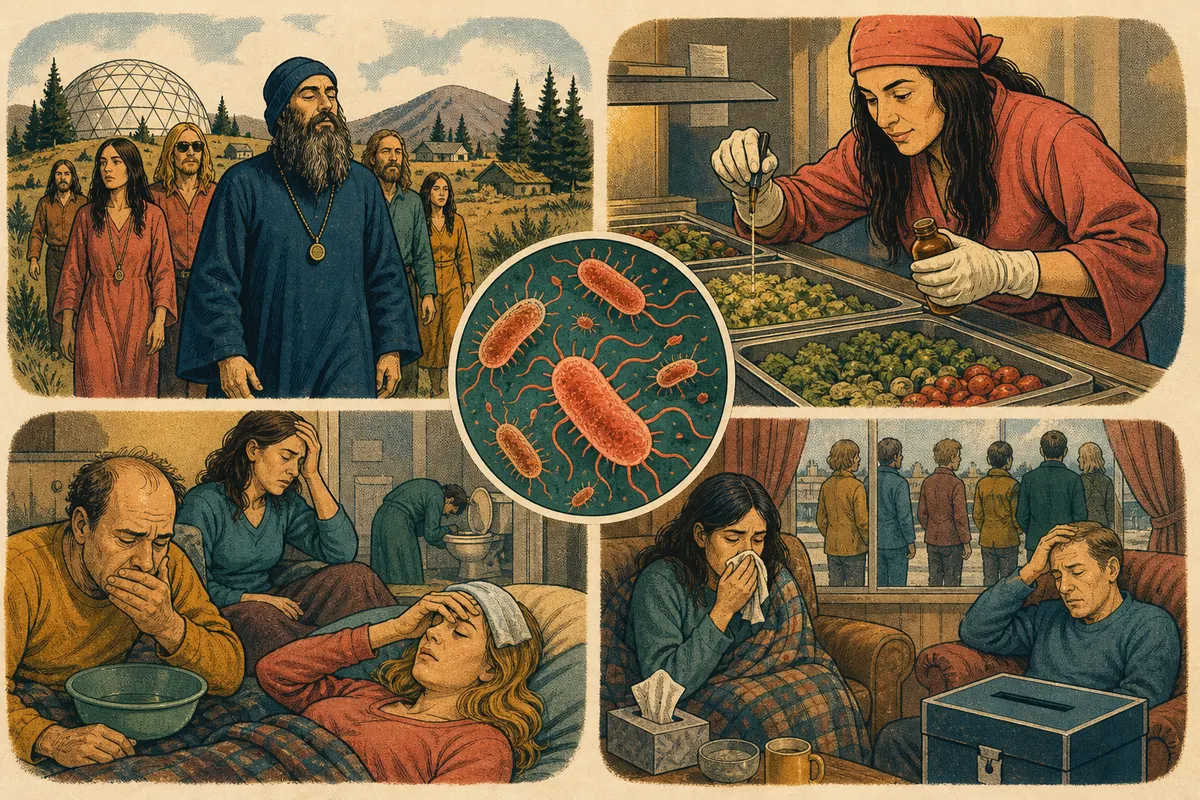
In the annals of election interference, a bizarre chapter was written in 1984 in Oregon, not via dubious emails or hacked databases, but through an undermined public salad bar. Residents of The Dalles, Oregon, were unwitting diners in the largest bioterrorist attack on American soil. The perpetrators? Members of the Rajneeshpuram commune, who, in a surreal twist on democracy, dosed local salad bars with Salmonella in an effort to sway a local election by incapacitating the populace.

The motive was straightforward, if alarming: reduce voter turnout among those unlikely to support their political ambitions. Over several weeks, 751 residents fell ill. Though initially a mystery, the truth was dramatically unearthed over a year later when internal feuds prompted confessions and an FBI investigation. The incident carved a cautionary tale into the history of bioterrorism while exposing vulnerabilities in public health defences.

Echoes Across Time

Such audacious manipulation underscores a significant point: systems meant to protect us are sometimes susceptible to unconventional threats. This preposterous plot has informed how we approach and understand the potential for bioterrorism today. Labels like “salad-based political interference” might stir a chuckle now, but they underscore a crucial vulnerability deserving of attention.

But let’s turn now from subversive salads to buried treasure. On 24 September 2009, Terry Herbert struck archaeological gold in Staffordshire, literally. His metal detector unveiled the largest Anglo-Saxon gold hoard ever found in British history, thus thrilling the hearts of treasure hunters and historians alike. Then, in 1852, Henri Giffard made history—and possibly a few bystanders dizzy—with the first powered, steerable airship flight from Paris.

Finally, for a dash of aviation misdirection, we have Japan Airlines Flight 472. It famously mistook its destination in 1972, landing at the wrong Bombay airport: classic human error meets logistical conundrum.

These stories, ranging from the sinister to the serendipitous, remind us of the quirky dimensions of our past. Whether it’s a local election compromised by salad or an unexpected gold haul, each narrative invites us to look differently at our shared human history. Curious to delve deeper? Have a listen to today’s episode of The Daily Time Drop.

In this episode

  • Introduction A hook about bioterrorism, salad bars, and a religious commune in Oregon with unusual campaign tactics.
  • The Rajneeshee Salad Bar Poisonings How members of the Rajneeshpuram commune contaminated restaurant salad bars in The Dalles, Oregon, sickening 751 people in an attempt to influence a local election. The attack went undetected as deliberate for over a year, until internal commune conflict led to confessions and FBI investigation.
  • The Staffordshire Hoard Terry Herbert’s 2009 discovery of over five kilograms of Anglo-Saxon gold in a Staffordshire field. The hoard was officially declared treasure on 24 September 2009 and became the largest find of its kind in British history.
  • Giffard’s Dirigible Henri Giffard’s successful flight of the first powered, steerable airship on 24 September 1852, travelling seventeen miles from Paris to Trappes at six miles per hour.
  • Japan Airlines Flight 472 The 1972 incident in which a Japan Airlines flight landed at the wrong airport in Bombay, overrunning the shorter runway at Juhu Aerodrome and injuring eleven people.
  • Outro Closing reflections on the day’s collection of human miscalculation, discovery, and ambition.

Sources

More from the archive

5 min

The Unending Hunt for the Golden Owl

Explore the captivating tale of The Hunt for the Golden Owl, a treasure hunt that spanned over thirty years, initiated by French author Max Valentin and artist Michel Becker in 1993. Discover the extraordinary story of a bronze owl and a grand prize of a golden owl adorned with diamonds. Despite Valentin’s cryptic style and the frustrations faced by treasure hunters, the hunt concluded in 2024, yet its legacy lingers. Delve into the significance of Gaecheonjeol in South Korea, where the mythical descent of Hwanung is celebrated. Examine the impact of the O. J. Simpson acquittal on popular culture and the explosive revelations of the Pandora Papers in 2021, which unveiled the hidden wealth of the world’s elite, sparking debates on financial transparency. Join Clara Vale as she navigates these compelling narratives in The Daily Time Drop.

Read & listen →
4 min

The Nottingham Cheese Riot and Beyond

In this episode of The Daily Time Drop, Clara Vale delves into a peculiar chapter of history: the Nottingham Cheese Riot of 1766. What began as an ordinary day at Nottingham’s Goose Fair transformed into a chaotic scene due to soaring cheese prices. Locals, outraged by the cost hike, took matters—and cheese—into their own hands, resulting in a riot quelled only by militia intervention. Clara then shifts focus to a 2023 event involving the US Federal Communications Commission’s action against Dish Network for neglecting space debris, marking a significant step in tackling space pollution. Next, we look forward to a celestial spectacle: the solar eclipse in Patagonia in 2024. Finally, Clara reflects on the origins of parkrun in 2004, a small initiative that evolved into a global movement championing community fitness. Each story illustrates unique instances of human behaviour, from passionate protests to inspiring initiatives.

Read & listen →
4 min

Milestone Moments: Breaking Barriers and Reshaping History

On today’s episode of The Daily Time Drop, host Clara Vale delves into a day rich with historical significance and cultural milestones. We explore how Claudia Sheinbaum made history in 2024 as Mexico’s first female president and the country’s first president of Jewish heritage. This groundbreaking moment challenges conventions and inspires a new generation. We also highlight Karolina Styczyńska’s remarkable journey as she became Japan’s first non-Japanese professional shogi player in 2015, breaking long-standing cultural barriers. Additionally, we recount the United States’ return to UNESCO in 2023, a sign of shifting diplomatic ties. Lastly, we touch upon Koromogae, Japan’s charming tradition of changing wardrobes with the seasons. Each story offers a glimpse into how everyday events and extraordinary accomplishments shape our world.

Read & listen →