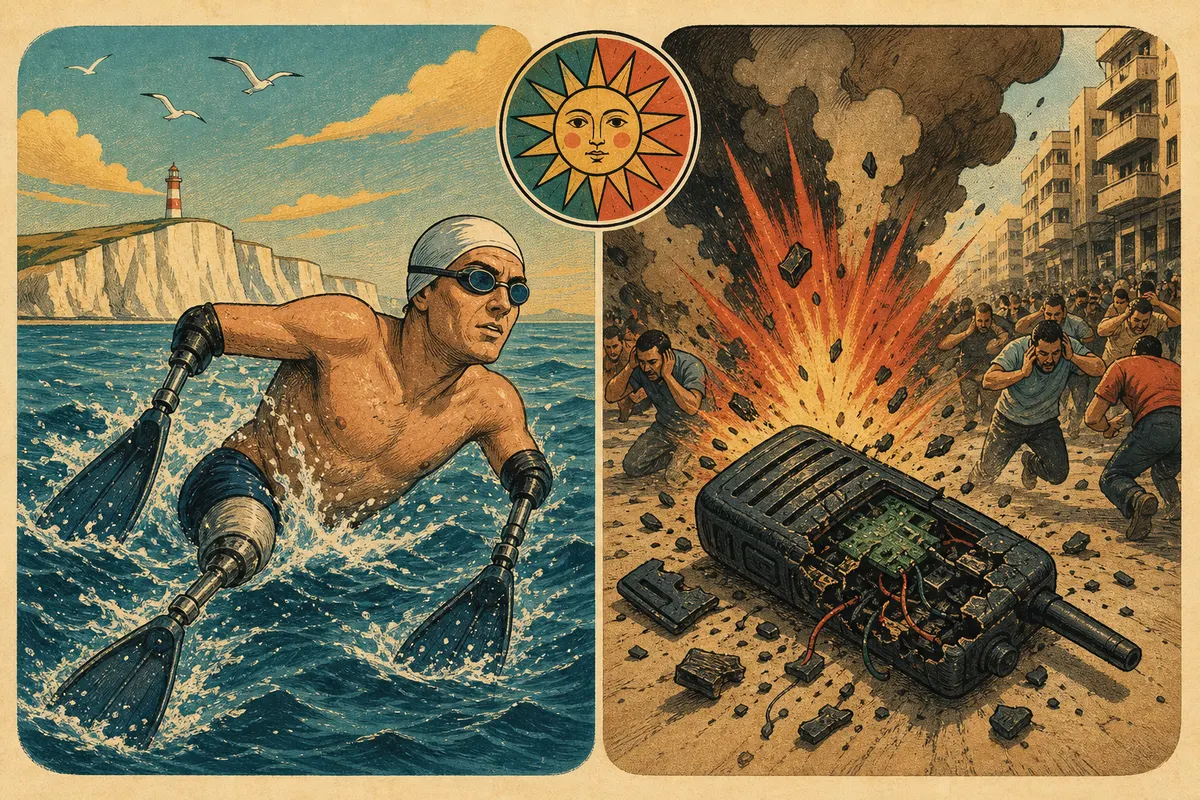
Philippe Croizon's Channel crossing is still one of the more quietly astonishing things a human being has done in recent decades, and it began with a 1994 accident that left him with nothing obvious to build on. The Lebanon walkie-talkie attacks raised questions about supply chain security and the vulnerability of communication infrastructure that have not gone away.
Somewhere in the Channel, on a September morning in 2010, a man with no arms and no legs was swimming to England.
Philippe Croizon lost all four limbs in an electrical accident in 1994. The years that followed were, by any reasonable measure, brutal: depression, adjustment, and then, at some point, a decision to do something that most people with four working limbs would sensibly decline. He trained with prosthetic fins, using core propulsion to move through the water, and he got very good at it.
On 18 September 2010, Croizon completed the English Channel crossing in thirteen hours and twenty-six minutes, becoming the first quadruple amputee to do so. He later went on to swim straits between four continents in 2012. This episode lingers, rightly, on the part before the cameras turned up: the years of training, the unglamorous daily work of becoming someone who could do that.
The Other Drops from 18 September
The date has form for eventfulness.
In 2024, walkie-talkie devices used by Hezbollah exploded across Lebanon, killing fourteen people and wounding four hundred and fifty. The devices appear to have been intercepted and modified before delivery, turning ordinary communication tools into weapons in a sophisticated intelligence operation widely attributed to Israel. It is not a comfortable story, and it is not meant to be.
In 2017, Toys R Us filed for bankruptcy protection in the United States and Canada, carrying five billion dollars in debt from a 2005 leveraged buyout. It could not compete with online retail and could not find the money to transform itself. The last US stores closed in 2018. The debt structure, more than any rival, is arguably the honest villain of that particular story.
And in 1997, the Zeppelin NT took its maiden flight over Lake Constance in Germany, sixty years after the Hindenburg disaster had ended the original Zeppelin era. The new airship was helium-filled and semi-rigid, flying in the same region where Count Ferdinand von Zeppelin first tested his invention at the start of the twentieth century. Quieter than the original. Considerably less flammable.
The episode is ten minutes. Start with Philippe Croizon.