On this day · 17 September 2026

The Man Who Found the Invisible World

· 13 min

The Man Who Found the Invisible World

Listen to this episode

13 min

Leeuwenhoek's breakthrough laid the foundation for microbiology, reminding us that curiosity and persistence can redefine our understanding of life.

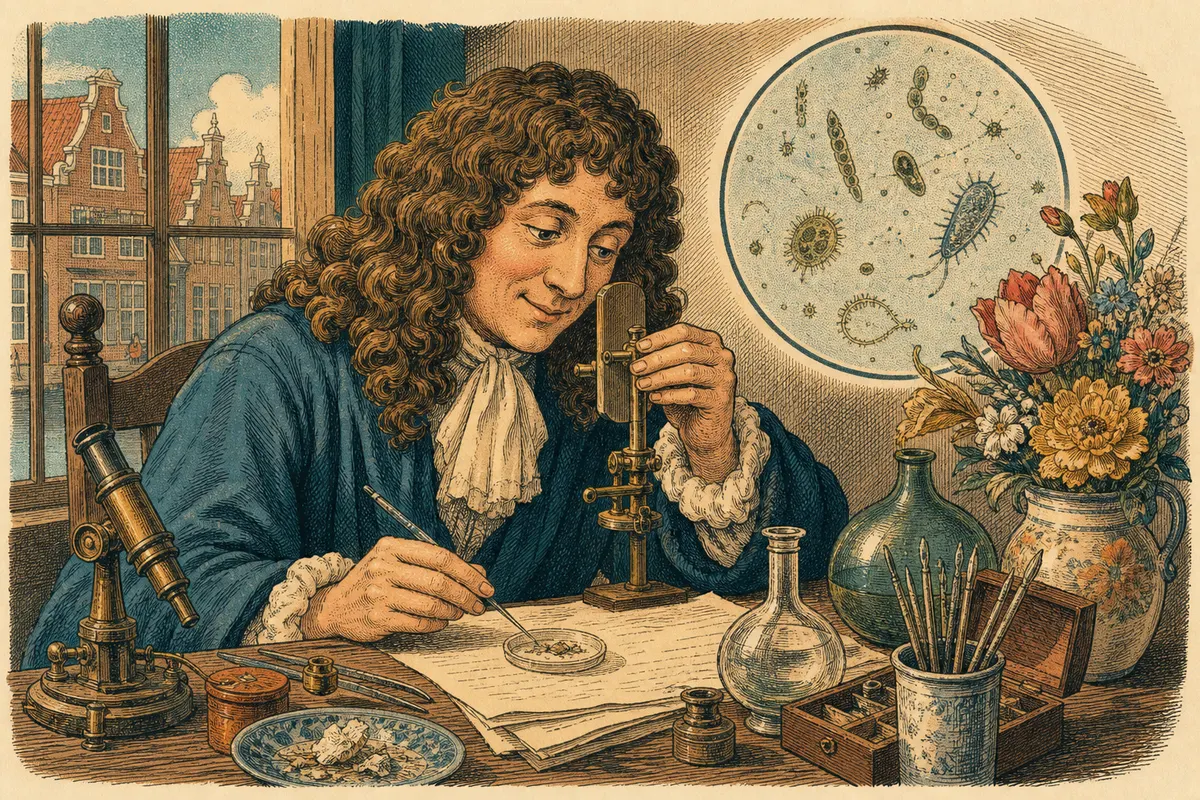
What if the greatest scientific discoveries come not from prestigious institutions but from someone tinkering away without a formal education? On 17 September 1683, Antonie van Leeuwenhoek penned a letter so consequential it reshaped our understanding of life on Earth. By reporting the existence of bacteria in mouth scrapings, he uncovered a world hidden in plain sight.

Van Leeuwenhoek, a Dutch draper by trade, was an unlikely candidate for scientific greatness. Yet, armed with lenses he crafted himself, he achieved magnifications of up to 270 times. This made him the first human to witness the microscopic realm of bacteria and protozoa. He shared his findings with the Royal Society, kickstarting a significant scientific conversation that led, ultimately, to the field of microbiology.

Leeuwenhoek’s observations required not just skill but a radical curiosity. His work reminds us that knowledge doesn’t always need a formal stamp of approval; sometimes, it only requires a question and the courage to seek answers.

Other Events on 17 September

While Leeuwenhoek was delving into invisible realms centuries ago, an altogether different saga unfolded in India on 17 September 2022. This was the day eight cheetahs arrived at Kuno National Park, reintroducing a species that had been absent from the subcontinent for 75 years. This marks a poignant chapter in conservation efforts.

Travel to Hungary in 2006 and you find a political drama worthy of any modern script. A leaked recording exposed Hungarian Prime Minister Ferenc Gyurcsány admitting his party’s deceit in the recent election campaign. The fallout was swift, triggering protests and eroding public trust.

Meanwhile, in Alaska, a silent giant awoke after a 10,000-year nap. Fourpeaked Mountain erupted, its unexpected activity prompting geologists to re-evaluate what had been classified as dormant. It was an abrupt reminder that nature, much like history, enjoys surprising the unsuspecting.

Leeuwenhoek’s story shows that the world is full of invisible wonders, waiting to be seen by an inquisitive eye. Take a closer look at today’s episode, and consider how the things we haven’t yet perceived could reshape our reality.

In this episode

  • Intro Clara introduces the episode’s central question: what if an entire invisible world had existed alongside humanity all along, completely unknown until someone bothered to look closely enough?
  • The Man Who Found the Invisible World On 17 September 1683, Antonie van Leeuwenhoek wrote to the Royal Society describing his observation of bacteria and protozoa in human mouth scrapings. The self-taught Dutch draper had built microscopes achieving magnifications of up to 270 times, revealing microorganisms no one had ever seen before. His careful observations laid the groundwork for modern microbiology, two centuries before germ theory would fully emerge.
  • Cheetahs Return to India On 17 September 2022, eight cheetahs from Namibia arrived at Kuno National Park in Madhya Pradesh, marking the first time the species had stood on Indian soil since 1947. The reintroduction programme aimed to restore an animal that had lived in India for thousands of years before being hunted to local extinction.
  • The Speech That Wasn’t Meant for Everyone On 17 September 2006, a leaked audio recording revealed Hungarian Prime Minister Ferenc Gyurcsány admitting to his own party that they had lied consistently about the economy during their election campaign. The confession sparked widespread protests and lasting damage to public trust.
  • The Volcano That Waited Ten Thousand Years Also on 17 September 2006, Fourpeaked Mountain in Alaska erupted for the first time in at least 10,000 years. The volcano had been classified as dormant, forcing geologists to reassess and reclassify it as active, a reminder that geological timescales operate independently of human categories.
  • Outro Clara reflects on Leeuwenhoek’s legacy: a man who made his own tools, asked his own questions, and fundamentally changed humanity’s understanding of life on Earth, driven purely by curiosity that would not let him stop looking.

Sources

More from the archive

5 min

The Unending Hunt for the Golden Owl

Explore the captivating tale of The Hunt for the Golden Owl, a treasure hunt that spanned over thirty years, initiated by French author Max Valentin and artist Michel Becker in 1993. Discover the extraordinary story of a bronze owl and a grand prize of a golden owl adorned with diamonds. Despite Valentin’s cryptic style and the frustrations faced by treasure hunters, the hunt concluded in 2024, yet its legacy lingers. Delve into the significance of Gaecheonjeol in South Korea, where the mythical descent of Hwanung is celebrated. Examine the impact of the O. J. Simpson acquittal on popular culture and the explosive revelations of the Pandora Papers in 2021, which unveiled the hidden wealth of the world’s elite, sparking debates on financial transparency. Join Clara Vale as she navigates these compelling narratives in The Daily Time Drop.

Read & listen →
4 min

The Nottingham Cheese Riot and Beyond

In this episode of The Daily Time Drop, Clara Vale delves into a peculiar chapter of history: the Nottingham Cheese Riot of 1766. What began as an ordinary day at Nottingham’s Goose Fair transformed into a chaotic scene due to soaring cheese prices. Locals, outraged by the cost hike, took matters—and cheese—into their own hands, resulting in a riot quelled only by militia intervention. Clara then shifts focus to a 2023 event involving the US Federal Communications Commission’s action against Dish Network for neglecting space debris, marking a significant step in tackling space pollution. Next, we look forward to a celestial spectacle: the solar eclipse in Patagonia in 2024. Finally, Clara reflects on the origins of parkrun in 2004, a small initiative that evolved into a global movement championing community fitness. Each story illustrates unique instances of human behaviour, from passionate protests to inspiring initiatives.

Read & listen →
4 min

Milestone Moments: Breaking Barriers and Reshaping History

On today’s episode of The Daily Time Drop, host Clara Vale delves into a day rich with historical significance and cultural milestones. We explore how Claudia Sheinbaum made history in 2024 as Mexico’s first female president and the country’s first president of Jewish heritage. This groundbreaking moment challenges conventions and inspires a new generation. We also highlight Karolina Styczyńska’s remarkable journey as she became Japan’s first non-Japanese professional shogi player in 2015, breaking long-standing cultural barriers. Additionally, we recount the United States’ return to UNESCO in 2023, a sign of shifting diplomatic ties. Lastly, we touch upon Koromogae, Japan’s charming tradition of changing wardrobes with the seasons. Each story offers a glimpse into how everyday events and extraordinary accomplishments shape our world.

Read & listen →