On this day · 16 September 2026

The Balloon Escape Over the Iron Curtain and a Pope Excommunicated After Death

· 11 min

The Balloon Escape Over the Iron Curtain and a Pope Excommunicated After Death

Listen to this episode

11 min

The 1979 balloon escape is a reminder that human ingenuity, given enough patience and stubbornness, can outmanoeuvre even the most repressive machinery. And the Honorius case illustrates how institutional questions, once opened, tend to stay open for an uncomfortably long time.

Imagine you want to leave your country. The border is mined, watched, and actively lethal. Your options are limited. Unless, of course, you happen to own a sewing machine.

The Balloon That Beat the Iron Curtain

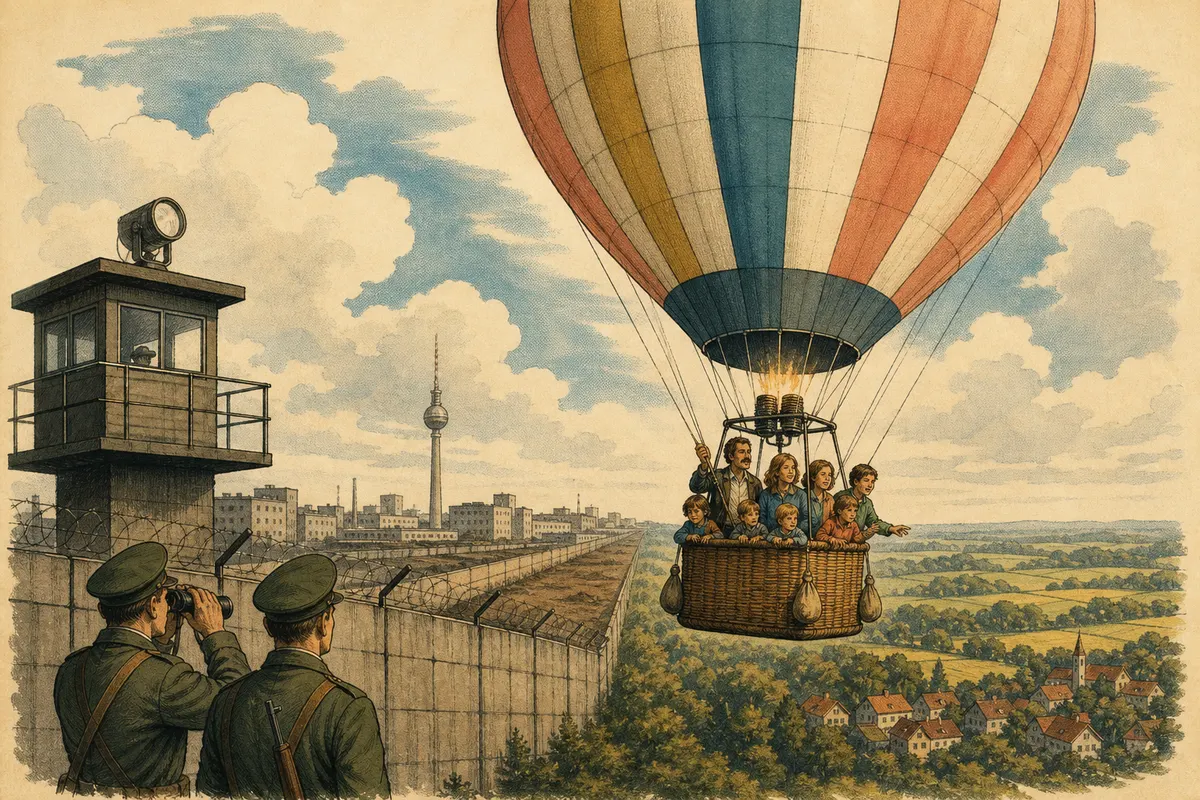
On 16 September 1979, two families from Pössneck in East Germany did something that would have seemed preposterous if it hadn’t actually worked. The Strelzyks and the Wetzels built a 28-metre hot air balloon from taffeta and cotton, sourced carefully so as not to arouse suspicion, sewed it at home, and then flew eight people, including four children, across one of the most heavily militarised borders in modern history.

The flight lasted 28 minutes. They landed in Bavaria. They were free.

This was not their first attempt. A failed try in 1978 had taught them enough to go back, improve the design, and try again, which is, depending on your disposition, either inspiring or quietly terrifying. The Stasi were reportedly furious. The escape was later made into a Disney film in 1982, which feels both fitting and faintly surreal.

The Pope Who Was Excommunicated After He Died

Also on this date in 681, the Sixth Ecumenical Council excommunicated Pope Honorius I. The detail worth sitting with is that Honorius had been dead for 42 years. His letters during the Monothelite controversy had been judged too sympathetic to heresy, and the council saw no reason to let death get in the way of a formal rebuke.

The posthumous condemnation became a central problem in debates about papal infallibility, one that was not fully resolved until the First Vatican Council in 1870. Some arguments, it turns out, are remarkably patient.

Campo Maior, 1732

On the same date in 1732, lightning struck the armoury in Campo Maior, Portugal. The stored gunpowder ignited. The explosion killed around 800 people, roughly two-thirds of the town’s entire population. The town was rebuilt, and today it hosts the Festa do Povo, a flower festival that fills its streets with colour. History is, among other things, very good at complicated endings.

Three stories, one date. Today’s episode covers all of them in ten minutes, and Clara ties them together around a single question: what do people do when they hit a wall, literal or otherwise? The answers range from quietly brilliant to thoroughly posthumous. It is worth a listen.

In this episode

  • Intro Clara introduces the seemingly impossible question: how do you escape one of the most militarised borders in modern history? Two East German families answered by building a hot air balloon in secret.
  • The Great Balloon Escape of 1979 On 16 September 1979, the Strelzyk and Wetzel families flew a homemade hot air balloon over the Iron Curtain. After a failed first attempt in 1978, they built a 28-metre envelope from fabric bought in secret, sewed it at home, and launched with eight people on board. After 28 minutes in the air, they landed in Bavaria, having crossed one of the world’s most lethal borders. The Stasi were reportedly furious. The escape became a Disney film in 1982.
  • The Pope Who Was Excommunicated After He Died On 16 September 681, the Sixth Ecumenical Council excommunicated Pope Honorius I, who had died 42 years earlier. His letters during the Monothelite controversy were deemed too sympathetic to heresy. The posthumous condemnation became a key historical problem in debates about papal infallibility, unresolved until the First Vatican Council in 1870.
  • The Campo Maior Catastrophe of 1732 On 16 September 1732, lightning struck the armoury in Campo Maior, Portugal, igniting stored gunpowder. The explosion killed around 800 people, roughly two-thirds of the town’s population. Campo Maior was rebuilt and today hosts the Festa do Povo, a flower festival that fills the streets with colour.
  • Outro Clara closes with reflections on walls, literal and otherwise, and what people do when faced with them. She signs off with her usual dry amusement about human overconfidence.

Sources

More from the archive

5 min

The Unending Hunt for the Golden Owl

Explore the captivating tale of The Hunt for the Golden Owl, a treasure hunt that spanned over thirty years, initiated by French author Max Valentin and artist Michel Becker in 1993. Discover the extraordinary story of a bronze owl and a grand prize of a golden owl adorned with diamonds. Despite Valentin’s cryptic style and the frustrations faced by treasure hunters, the hunt concluded in 2024, yet its legacy lingers. Delve into the significance of Gaecheonjeol in South Korea, where the mythical descent of Hwanung is celebrated. Examine the impact of the O. J. Simpson acquittal on popular culture and the explosive revelations of the Pandora Papers in 2021, which unveiled the hidden wealth of the world’s elite, sparking debates on financial transparency. Join Clara Vale as she navigates these compelling narratives in The Daily Time Drop.

Read & listen →
4 min

The Nottingham Cheese Riot and Beyond

In this episode of The Daily Time Drop, Clara Vale delves into a peculiar chapter of history: the Nottingham Cheese Riot of 1766. What began as an ordinary day at Nottingham’s Goose Fair transformed into a chaotic scene due to soaring cheese prices. Locals, outraged by the cost hike, took matters—and cheese—into their own hands, resulting in a riot quelled only by militia intervention. Clara then shifts focus to a 2023 event involving the US Federal Communications Commission’s action against Dish Network for neglecting space debris, marking a significant step in tackling space pollution. Next, we look forward to a celestial spectacle: the solar eclipse in Patagonia in 2024. Finally, Clara reflects on the origins of parkrun in 2004, a small initiative that evolved into a global movement championing community fitness. Each story illustrates unique instances of human behaviour, from passionate protests to inspiring initiatives.

Read & listen →
4 min

Milestone Moments: Breaking Barriers and Reshaping History

On today’s episode of The Daily Time Drop, host Clara Vale delves into a day rich with historical significance and cultural milestones. We explore how Claudia Sheinbaum made history in 2024 as Mexico’s first female president and the country’s first president of Jewish heritage. This groundbreaking moment challenges conventions and inspires a new generation. We also highlight Karolina Styczyńska’s remarkable journey as she became Japan’s first non-Japanese professional shogi player in 2015, breaking long-standing cultural barriers. Additionally, we recount the United States’ return to UNESCO in 2023, a sign of shifting diplomatic ties. Lastly, we touch upon Koromogae, Japan’s charming tradition of changing wardrobes with the seasons. Each story offers a glimpse into how everyday events and extraordinary accomplishments shape our world.

Read & listen →