On this day · 14 September 2026

Gravitational Waves, Black Holes, and the Day Britain Lost Eleven Days

· 10 min

Gravitational Waves, Black Holes, and the Day Britain Lost Eleven Days

Listen to this episode

10 min

Understanding gravitational waves offers a new cosmic perspective, while Britain's calendar change highlights history's ability to disrupt the mundane.

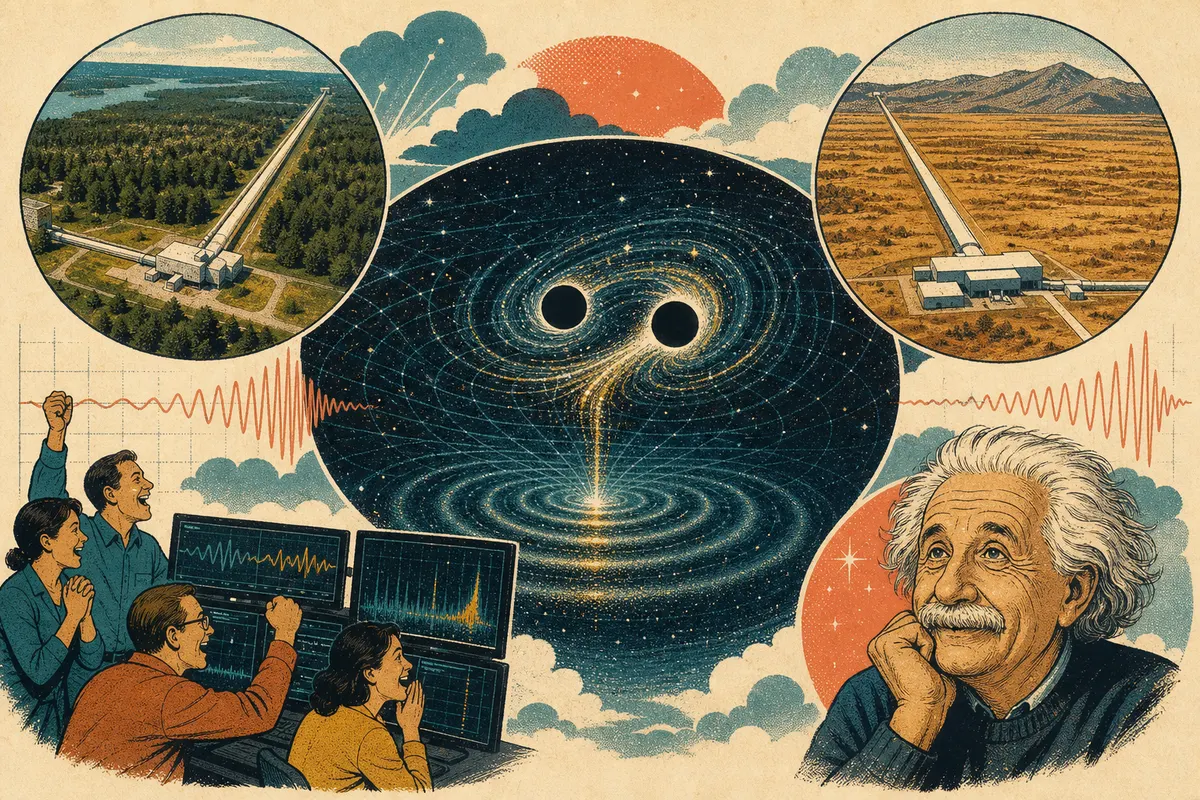
What does the universe sound like? You’d imagine the vastness of space would be a sanctuary of silence. Yet famously, on 14th September 2015, the LIGO detectors in the United States picked up a curious sound—a chirp that signalled a cosmic event from over a billion years ago.

The Chirp Heard Across a Billion Years

LIGO’s Louisiana and Washington State observatories captured gravitational waves for the first time, validating a hundred-year-old prediction by Einstein’s General Theory of Relativity. This was no ordinary echo. The source? Two black holes colliding 1.3 billion light-years away. Their dramatic merger transformed three solar masses into pure energy, rippling across space-time until it reached us. This discovery did more than just scoop a Nobel Prize in 2017; it introduced a new frontier in astronomy, allowing scientists to observe the universe through the lens of gravitational wave astronomy.

Britain Loses Eleven Days

While our friends at LIGO were busy making scientific history, let’s take a step back to a time when simply keeping track of days was a bit of a challenge. Flashback to 14th September 1752 when Britain, after 170 years of thumbingly holding onto the Julian calendar, finally realigned with the Gregorian calendar. This change required that the citizens of Britain jump straight from 2nd to 14th September, effectively losing eleven days.

The realignment was dizzying: contracts, rent due-dates, and everyday life schedules were thrown into a state of chaos overnight. And while stories of riots by citizens demanding “Give us our eleven days back!” colour the tales from this era, historians approach these stories with some scepticism. What isn’t disputed is the administrative headache that ensued.

A Tale of Timing

Two stories, both deeply centred on time and its consequential tinkering. One about a chirp that travelled 1.3 billion years to reach us, the other about an eleven-day vanishing act forced by a calendar correction. Listen to how these seemingly disparate events illuminate human endeavours and the cosmic dance of our universe.

Join me as we delve deeper into history’s curious cases of cosmic and human timing in today’s episode of The Daily Time Drop. It’s a tale of two timelines you won’t want to miss out on.

In this episode

  • Intro Clara opens by asking what the universe actually sounds like, introducing the 14 September 2015 detection of gravitational waves by LIGO, a signal that had travelled 1.3 billion years and sounded like a chirp.
  • The Chirp Heard Across a Billion Years On 14 September 2015, LIGO’s Louisiana and Washington State detectors captured a gravitational wave signal from two colliding black holes 1.3 billion light-years away. The detection, announced in February 2016, confirmed Einstein’s 1916 prediction, earned the 2017 Nobel Prize, and opened the field of gravitational wave astronomy.
  • Britain Loses Eleven Days On 14 September 1752, Britain adopted the Gregorian calendar, skipping eleven days to realign with Europe after 170 years of resistance. The Calendar Act caused administrative confusion, though popular stories of riots demanding the days back are historically disputed.
  • Outro Clara reflects on history’s sense of timing: a signal that travelled for over a billion years, and eleven days that simply disappeared from the calendar.

Sources

More from the archive

5 min

The Unending Hunt for the Golden Owl

Explore the captivating tale of The Hunt for the Golden Owl, a treasure hunt that spanned over thirty years, initiated by French author Max Valentin and artist Michel Becker in 1993. Discover the extraordinary story of a bronze owl and a grand prize of a golden owl adorned with diamonds. Despite Valentin’s cryptic style and the frustrations faced by treasure hunters, the hunt concluded in 2024, yet its legacy lingers. Delve into the significance of Gaecheonjeol in South Korea, where the mythical descent of Hwanung is celebrated. Examine the impact of the O. J. Simpson acquittal on popular culture and the explosive revelations of the Pandora Papers in 2021, which unveiled the hidden wealth of the world’s elite, sparking debates on financial transparency. Join Clara Vale as she navigates these compelling narratives in The Daily Time Drop.

Read & listen →
4 min

The Nottingham Cheese Riot and Beyond

In this episode of The Daily Time Drop, Clara Vale delves into a peculiar chapter of history: the Nottingham Cheese Riot of 1766. What began as an ordinary day at Nottingham’s Goose Fair transformed into a chaotic scene due to soaring cheese prices. Locals, outraged by the cost hike, took matters—and cheese—into their own hands, resulting in a riot quelled only by militia intervention. Clara then shifts focus to a 2023 event involving the US Federal Communications Commission’s action against Dish Network for neglecting space debris, marking a significant step in tackling space pollution. Next, we look forward to a celestial spectacle: the solar eclipse in Patagonia in 2024. Finally, Clara reflects on the origins of parkrun in 2004, a small initiative that evolved into a global movement championing community fitness. Each story illustrates unique instances of human behaviour, from passionate protests to inspiring initiatives.

Read & listen →
4 min

Milestone Moments: Breaking Barriers and Reshaping History

On today’s episode of The Daily Time Drop, host Clara Vale delves into a day rich with historical significance and cultural milestones. We explore how Claudia Sheinbaum made history in 2024 as Mexico’s first female president and the country’s first president of Jewish heritage. This groundbreaking moment challenges conventions and inspires a new generation. We also highlight Karolina Styczyńska’s remarkable journey as she became Japan’s first non-Japanese professional shogi player in 2015, breaking long-standing cultural barriers. Additionally, we recount the United States’ return to UNESCO in 2023, a sign of shifting diplomatic ties. Lastly, we touch upon Koromogae, Japan’s charming tradition of changing wardrobes with the seasons. Each story offers a glimpse into how everyday events and extraordinary accomplishments shape our world.

Read & listen →