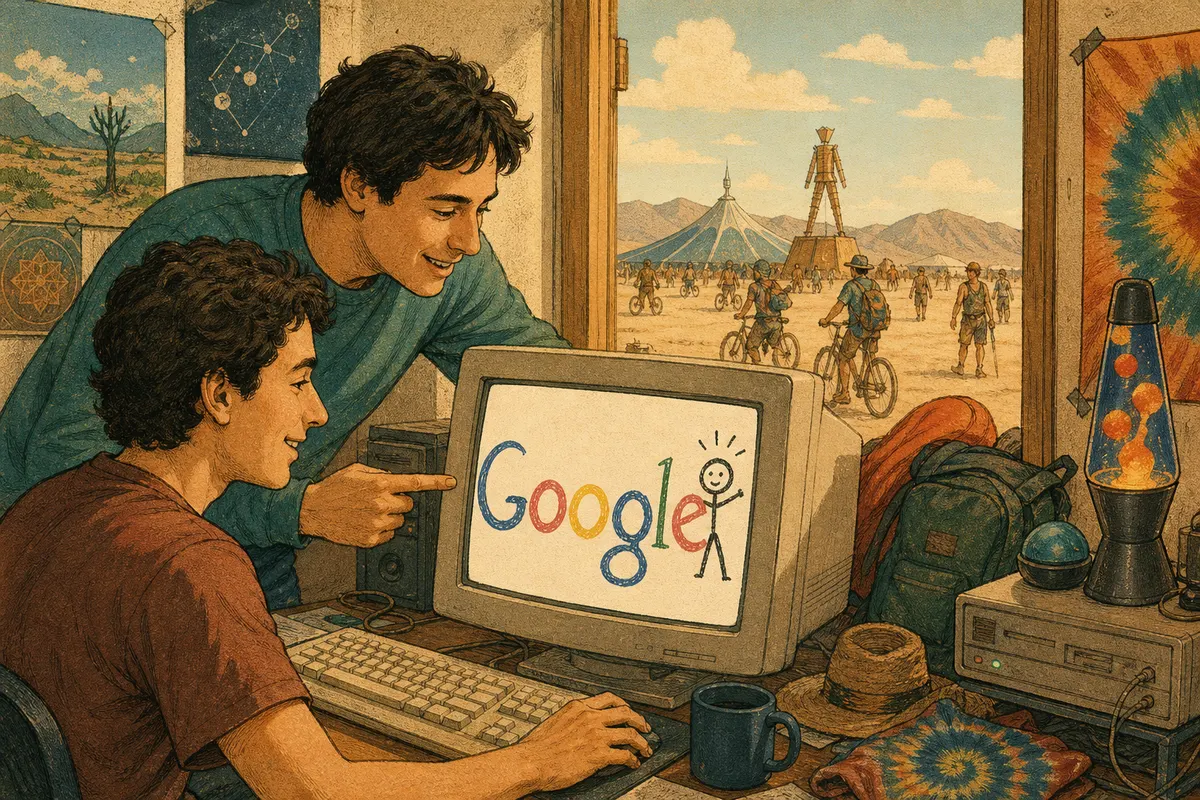
The Google Doodle is now seen by hundreds of millions of people every day, all because two people wanted to flag that they were at a festival and could not be held responsible for a server crash. It is a useful reminder that some of the most enduring design traditions start as someone's afterthought.
The Google Doodle began as an out-of-office message. That is the whole origin story. No design brief, no brand workshop, no committee sign-off. Just a stick figure and a desert festival.
The Accidental Tradition
On 30 August 1998, Larry Page and Sergey Brin were heading to Burning Man in Nevada. Before they left, they modified Google’s homepage logo with a crude stick figure placed behind the second ‘O’, a visual signal to anyone who visited that they were away and could not be blamed if the servers went down.
That improvised gesture became the first Google Doodle. The tradition now encompasses thousands of doodles seen by hundreds of millions of people daily. All of it traces back to two people who did not want anyone to panic if the internet broke while they were in the desert.
Also Happening on 30 August
The date has a habit of producing the quietly extraordinary. In 2013, scientists announced the discovery of an 800-kilometre canyon buried beneath Greenland’s ice sheet, larger than the Grand Canyon, carved by ancient rivers before the ice ever arrived. It was found using ice-penetrating radar and has been visited by no one. It had simply been sitting there, under two kilometres of ice, for millions of years.
In 2019, amateur astronomer Gennady Borisov spotted a comet passing through our solar system that had originated from another star entirely. Designated 2I/Borisov, it gave astronomers months to observe it before it continued on towards Cassiopeia. Its chemistry suggested that comets, and the materials they carry, may be common across the galaxy. A visitor from somewhere else, briefly studied, then gone.
And in 2002, the most gloriously niche piece of infrastructure in American history quietly closed. Leonard’s Subway in Birmingham, Alabama was a 300-metre privately operated line built in 1972 beneath the Pizitz department store, running shoppers between car park and shop floor. It operated for nearly three decades. The tunnel still exists today, now sitting beneath a food hall, largely unannounced.
One More Reason to Press Play
This episode is ten minutes on what happens when nobody is really trying: a logo tweak that became a global tradition, a canyon that spent millions of years unnoticed, a comet that stopped by from another solar system, and a department store that solved its parking problem by building a railway. History is not short of ideas. It is just short of people paying attention.