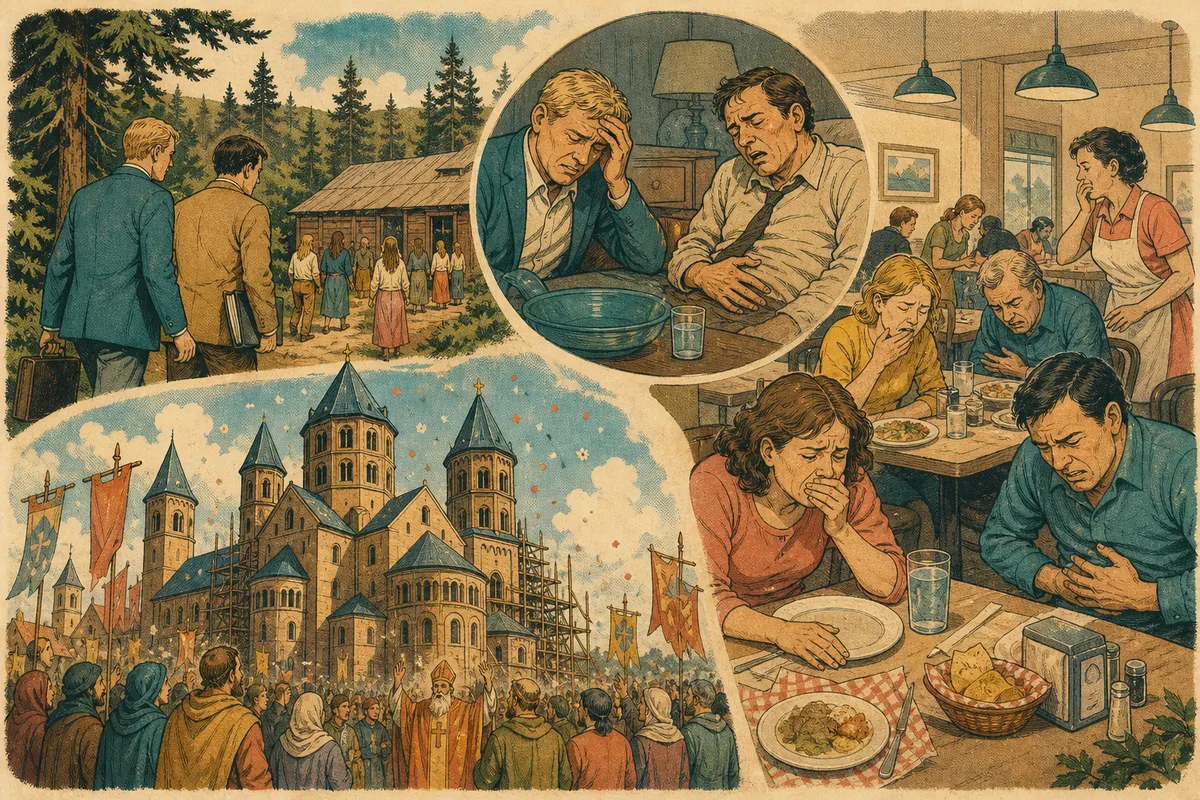
America's first large-scale bioterrorist attack was motivated not by ideology in any grand sense, but by a local council election. The Rajneeshee case is a reminder that the most dangerous plans often hide inside the most mundane ambitions.
In 1984, if you’d told someone that the biggest bioterrorism attack in American history was being planned around a salad bar, they probably would have found that funny. It isn’t funny, exactly, but it is very strange.
On 29 August 1984, two county commissioners in rural Oregon fell ill after visiting a local religious commune. What followed was the unravelling of an extraordinary scheme: members of the Rajneeshee commune, led by a guru’s secretary named Ma Anand Sheela, had deliberately contaminated salad bars at ten restaurants with salmonella bacteria. 751 people were sickened. The motive wasn’t nihilism or a grand manifesto. It was local politics: the commune wanted to influence county elections by making enough voters too ill to reach the polls. It is, genuinely, the first large-scale bioterrorist attack in American history, and it started with the salad bar.
The Other Stories from 29 August
The date has form for dramatic failures of planning.
In 1009, Mainz Cathedral in Germany was consecrated. This was a significant occasion: a grand Romanesque building finally complete and ready for its inaugural ceremony. During the ceremony, it caught fire. The cathedral that stands today is the product of centuries of subsequent rebuilding, which does at least mean the end result had plenty of time to be refined.
In 1588, Toyotomi Hideyoshi issued his Sword Hunt ordinance in Japan, requiring the peasantry to surrender all their weapons. The practical effect was to crystallise the divide between samurai and commoner into something close to permanent, shaping Japan’s rigid class structure for the next three centuries.
And on 29 August 1991, Sicilian businessman Libero Grassi was murdered on his own doorstep. He had publicly refused to pay Mafia protection money, written an open letter naming his extortionists, and was killed seven months later. His name is worth remembering.
Four Plans, One Calendar Date
What connects a salad bar poisoning, a burning cathedral, a feudal disarmament decree, and one man’s refusal to be intimidated? They are all, in their different ways, about trying to control what happens next: through scheming, through building, through law, through sheer stubbornness. History, as ever, keeps its options open.
This one is ten minutes. Give it a listen.