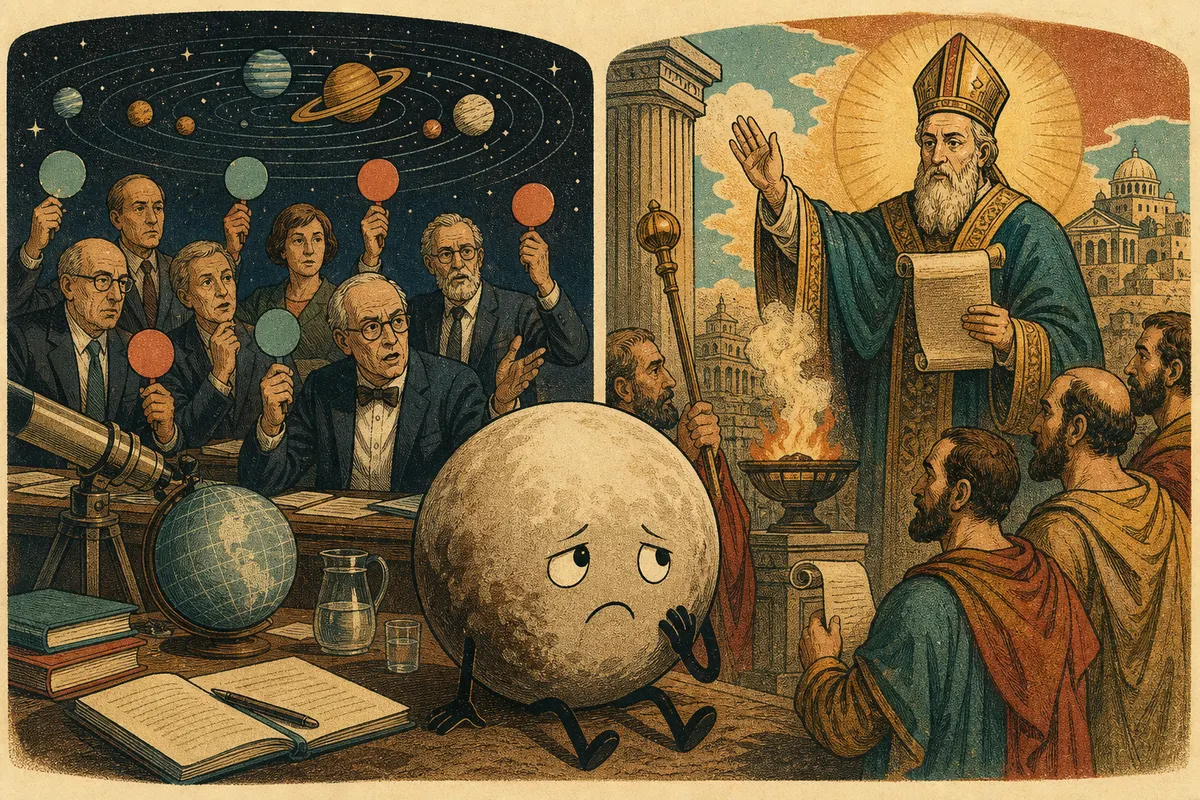
The Pluto vote is a reminder that even the most familiar scientific facts rest on definitions that can be revised the moment someone looks closely enough. When the category shifts, so does the certainty everything else was built on.
The 24th of August has a habit of pulling the rug out. Planets get demoted. Languages go silent. Noble gases make unlikely friends. And sitting presidents discover that their own voters have rather strong opinions about job security.
Pluto Gets the Sack
On 24 August 2006, the International Astronomical Union voted to reclassify Pluto as a dwarf planet, ending its 76-year run as the ninth planet in our solar system. The embarrassing part is not that Pluto was demoted. It is that the IAU had to formally define what a planet actually is in order to do it.
Clyde Tombaugh discovered Pluto in 1930, and it was named by an eleven-year-old girl from Oxford. For decades, that was that. But Kuiper Belt discoveries in the 1990s, and especially the identification of Eris in 2005, forced astronomers to confront a question they had apparently been comfortable ignoring.
Under the new definition, Pluto failed the third criterion: clearing its orbital neighbourhood. The IAU created the category of dwarf planet, and Pluto was duly reassigned. New Mexico passed a legislative resolution in protest. Science, it turns out, has feelings attached to it.
Three Thousand Years, Quietly Concluded
On the same date in 394 CE, a priest at the Temple of Isis at Philae carved the Graffito of Esmet-Akhom: the last known hieroglyphic inscription. Egyptian writing, a tradition that had lasted over three thousand years, ended not with proclamation or ceremony but with a single carving, as Christianity spread and temple traditions faded.
There is something quietly extraordinary about knowing which one was the last.
An Unlikely Bond, Near Absolute Zero
On 24 August 2000, Finnish chemist Markku Räsänen announced the creation of argon fluorohydride, the only known stable compound containing argon. Argon is a noble gas, famously and almost defiantly unreactive. The compound existed only at temperatures near absolute zero, but it existed. The periodic table’s most committed loner had, under considerable duress, made a friend.
The President Who Lost His Own Seat
On 24 August 2019, Nauru’s President Baron Waqa lost his parliamentary seat in a general election. Because the Nauruan constitution requires the president to be a sitting MP, losing his constituency immediately ended his presidency. There is a particular kind of political humiliation that needs no further comment.
Four stories from one date: a definition redrawn, a tradition concluded, an assumption overturned, and a career ended by the very people it was meant to serve. That is the episode in a sentence. The ten minutes are considerably more entertaining.