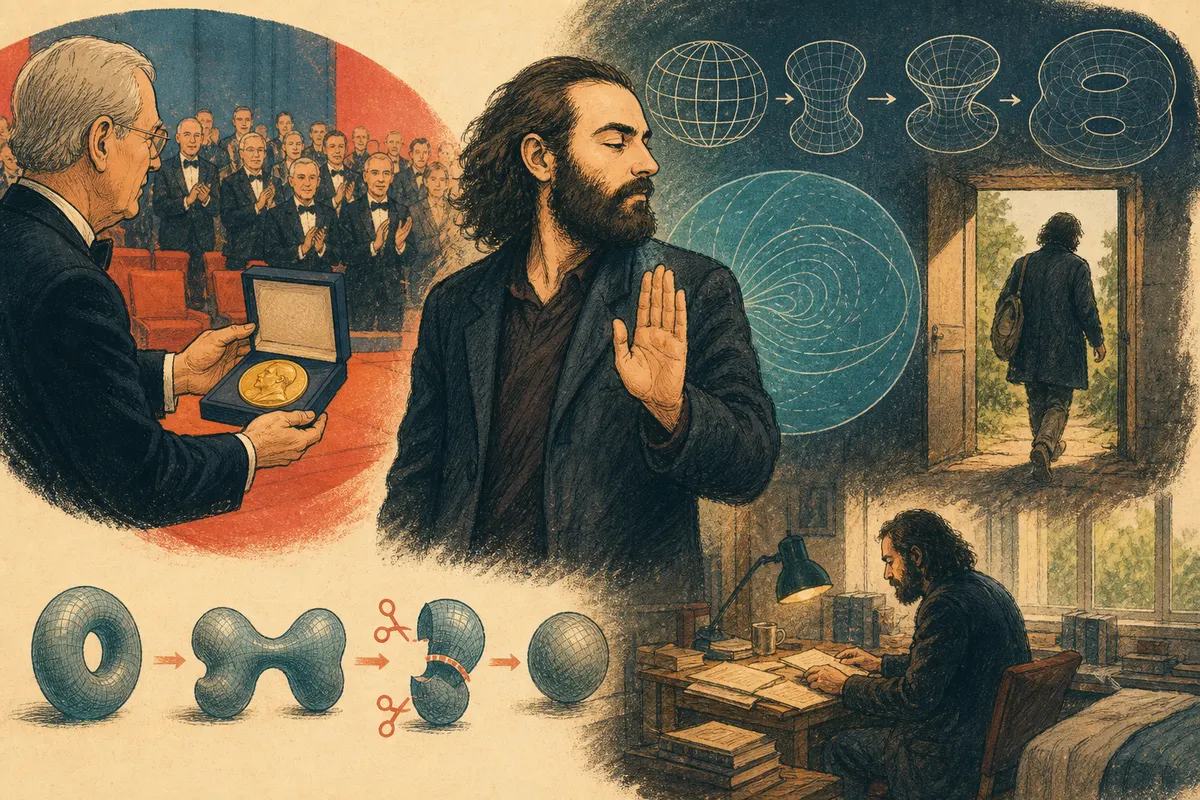
Perelman's refusal raises a question that hasn't dated: what do prizes actually reward, the work or the willingness to play the game? That tension between achievement and recognition still runs through academic institutions today.
Most people, upon winning the most prestigious prize in their field and being offered a million dollars, would at minimum show up to collect them. Grigori Perelman did not. He withdrew from public life entirely, and left the mathematical world to make of that what it would.
The Man Who Proved the Unprovable
Henri Poincaré posed his conjecture about three-dimensional topology in 1904. It sat there, unproven and quietly humiliating mathematicians, for nearly a century. Perelman published his proof between 2002 and 2003, using a technique called Ricci flow with surgery, and solved it.
On 22 August 2006, the International Mathematical Union awarded him the Fields Medal, mathematics’ highest honour. He declined to attend the ceremony. He subsequently turned down the million-dollar Clay Millennium Prize as well, citing his disillusionment with the ethical standards of the mathematical community and disputes over attribution. Then he withdrew from public life.
It is, depending on your disposition, either the most principled thing a person has ever done, or a very expensive way of making a point. Possibly both.
While All That Was Happening
Two years before Perelman’s award, on 22 August 2004, two masked gunmen walked into Oslo’s Munch Museum in broad daylight and removed Edvard Munch’s The Scream and Madonna in under two minutes. The theft coincided with an armed robbery in which a police officer was killed. Both paintings were recovered in August 2006, though not without damage.
And then there is 22 August 2007, when the Texas Rangers defeated the Baltimore Orioles 30-3. Thirty to three. The Rangers had 29 hits across nearly every inning in a game that simply refused to end. It remains the most runs ever scored by a single team in a modern Major League Baseball game.
What 22 August Keeps Telling Us
Three stories, one date: a man who refused every prize, a painting taken in plain sight, and a baseball team that treated a nine-inning game like a personal project. History is not short of days like this. It just takes someone to go looking.
This episode is ten minutes. It is worth your time, even if Perelman would probably disagree.