On this day · 20 August 2026

The Plane That Exploded After Landing (and Everyone Survived)

· 13 min

The Plane That Exploded After Landing (and Everyone Survived)

Listen to this episode

13 min

The Flight 120 disaster is a reminder that aviation safety is not just about preventing crashes; it is about buying people enough time to survive the ones that happen anyway. Engineering done quietly and well can be the difference between a catastrophe and a story everyone walks away from.

There is a sentence you never expect to read in an aviation incident report: the aircraft landed safely, taxied to the gate, and then exploded.

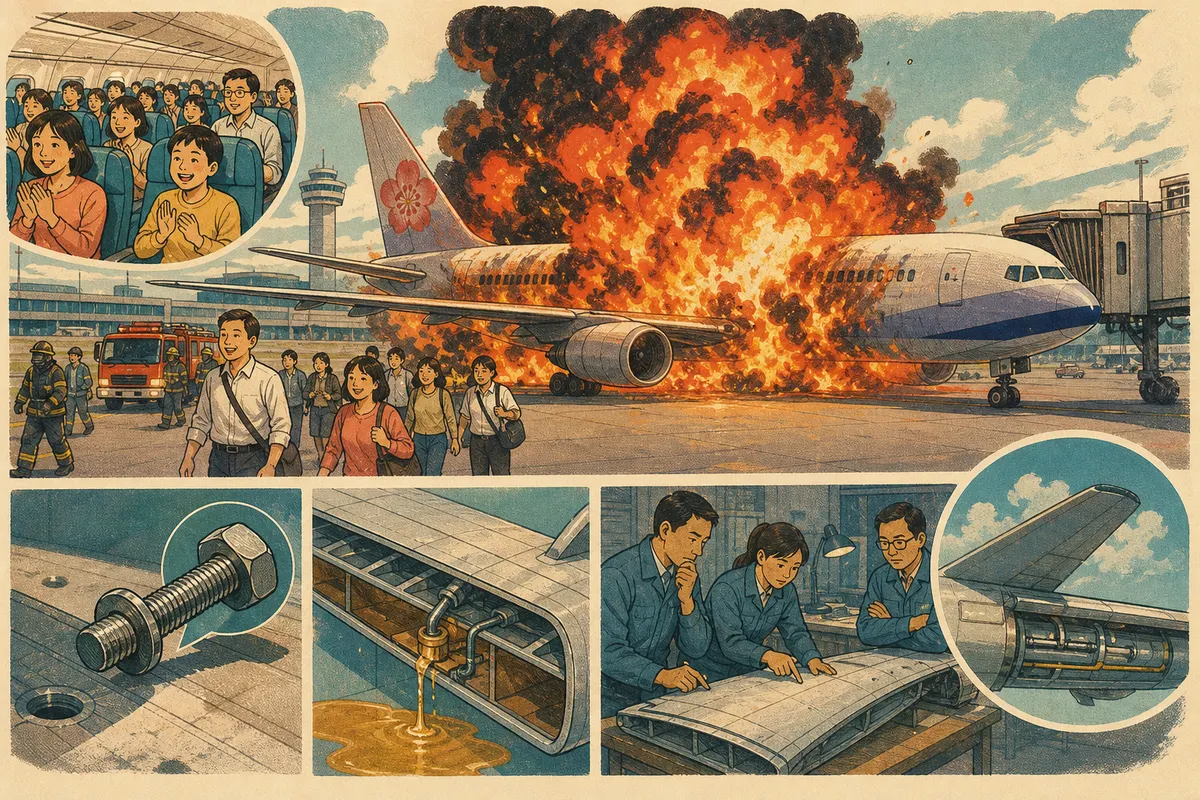
And yet, on 20 August 2007, that is almost exactly what happened to China Airlines Flight 120 at Naha Airport in Okinawa. All 165 people on board survived.

A Fireball at the Gate

The sequence of events is almost comically cruel in its timing. The plane had landed. The danger, by any reasonable measure, was over. And then a single loose bolt, implicated in a catastrophic fuel leak, turned an ordinary arrival into a total loss of the aircraft. The fireball consumed the entire jet.

What saved everyone was not luck, or not only luck. Decades of aviation safety engineering had quietly done its job, buying passengers just enough time to evacuate before the aircraft was gone. The disaster also revealed uncomfortable things about aviation safety culture, but it demonstrated, in the most visceral possible way, how much good engineering can stretch the margin between catastrophe and survival. One loose bolt, 165 survivors. Both of those things are true at once.

Also on This Day

This episode is full of people testing limits, and not always the limits you might expect.

On the same date in 1980, Reinhold Messner stood alone on the summit of Mount Everest, having climbed it without supplemental oxygen and without companions. The physiological edge he reached that day redefined what human endurance actually means.

In 2018, Venezuela introduced the bolívar soberano, a new currency that removed five zeros from the old one. The context for that rather drastic bit of tidying up: inflation exceeding one million percent. The zeros, it turned out, were the least of the problem.

And in 1519, the Chinese philosopher Wang Yangming put down a major rebellion against the Ming dynasty in just three days. He held the principle that knowledge and action are inseparable, which is a very elegant idea for a man who was also, evidently, quite good at winning.

Why Listen?

Four stories about survival, absurdity, and the uncomfortable gap between what should happen and what actually does. Sometimes the plane explodes and everyone walks away. Sometimes the philosopher wins the war in a long weekend. History has a strange sense of timing, and this episode leans right into it.

In this episode

  • Intro A passenger jet lands, taxis to the gate, and explodes into a fireball. Every single person walks away.
  • China Airlines Flight 120: The Plane That Exploded and Lost How 165 passengers and crew survived the catastrophic explosion of their aircraft at Naha Airport on 20 August 2007, triggered by a single loose bolt and contained by decades of safety engineering.
  • Reinhold Messner: The Mountain, Alone On 20 August 1980, Reinhold Messner stood alone on the summit of Mount Everest, having climbed it without oxygen or companions, redefining the limits of human endurance.
  • Venezuela’s Currency and the Art of Losing Five Zeros On 20 August 2018, Venezuela introduced the bolívar soberano, removing five zeros from its currency in response to inflation exceeding one million percent.
  • Wang Yangming: The Philosopher Who Won a War in Three Days On 20 August 1519, the Chinese philosopher Wang Yangming ended a major rebellion in three days, demonstrating his principle that knowledge and action are inseparable.
  • Outro Four moments when the impossible became survivable, the theoretical became practical, and human decisions were tested in real time.

Sources

More from the archive

5 min

The Unending Hunt for the Golden Owl

Explore the captivating tale of The Hunt for the Golden Owl, a treasure hunt that spanned over thirty years, initiated by French author Max Valentin and artist Michel Becker in 1993. Discover the extraordinary story of a bronze owl and a grand prize of a golden owl adorned with diamonds. Despite Valentin’s cryptic style and the frustrations faced by treasure hunters, the hunt concluded in 2024, yet its legacy lingers. Delve into the significance of Gaecheonjeol in South Korea, where the mythical descent of Hwanung is celebrated. Examine the impact of the O. J. Simpson acquittal on popular culture and the explosive revelations of the Pandora Papers in 2021, which unveiled the hidden wealth of the world’s elite, sparking debates on financial transparency. Join Clara Vale as she navigates these compelling narratives in The Daily Time Drop.

Read & listen →
4 min

The Nottingham Cheese Riot and Beyond

In this episode of The Daily Time Drop, Clara Vale delves into a peculiar chapter of history: the Nottingham Cheese Riot of 1766. What began as an ordinary day at Nottingham’s Goose Fair transformed into a chaotic scene due to soaring cheese prices. Locals, outraged by the cost hike, took matters—and cheese—into their own hands, resulting in a riot quelled only by militia intervention. Clara then shifts focus to a 2023 event involving the US Federal Communications Commission’s action against Dish Network for neglecting space debris, marking a significant step in tackling space pollution. Next, we look forward to a celestial spectacle: the solar eclipse in Patagonia in 2024. Finally, Clara reflects on the origins of parkrun in 2004, a small initiative that evolved into a global movement championing community fitness. Each story illustrates unique instances of human behaviour, from passionate protests to inspiring initiatives.

Read & listen →
4 min

Milestone Moments: Breaking Barriers and Reshaping History

On today’s episode of The Daily Time Drop, host Clara Vale delves into a day rich with historical significance and cultural milestones. We explore how Claudia Sheinbaum made history in 2024 as Mexico’s first female president and the country’s first president of Jewish heritage. This groundbreaking moment challenges conventions and inspires a new generation. We also highlight Karolina Styczyńska’s remarkable journey as she became Japan’s first non-Japanese professional shogi player in 2015, breaking long-standing cultural barriers. Additionally, we recount the United States’ return to UNESCO in 2023, a sign of shifting diplomatic ties. Lastly, we touch upon Koromogae, Japan’s charming tradition of changing wardrobes with the seasons. Each story offers a glimpse into how everyday events and extraordinary accomplishments shape our world.

Read & listen →