On this day · 19 August 2026

Two Dogs, a Bonfire, and a Senate That Changed Its Mind

· 12 min

Two Dogs, a Bonfire, and a Senate That Changed Its Mind

Listen to this episode

12 min

Belka and Strelka's survival proved living creatures could endure re-entry, which made human spaceflight possible, which is a rather large debt to owe two Soviet street dogs. The other events of 19 August are a useful reminder that history's hinge moments often look, from the inside, like barely controlled improvisation.

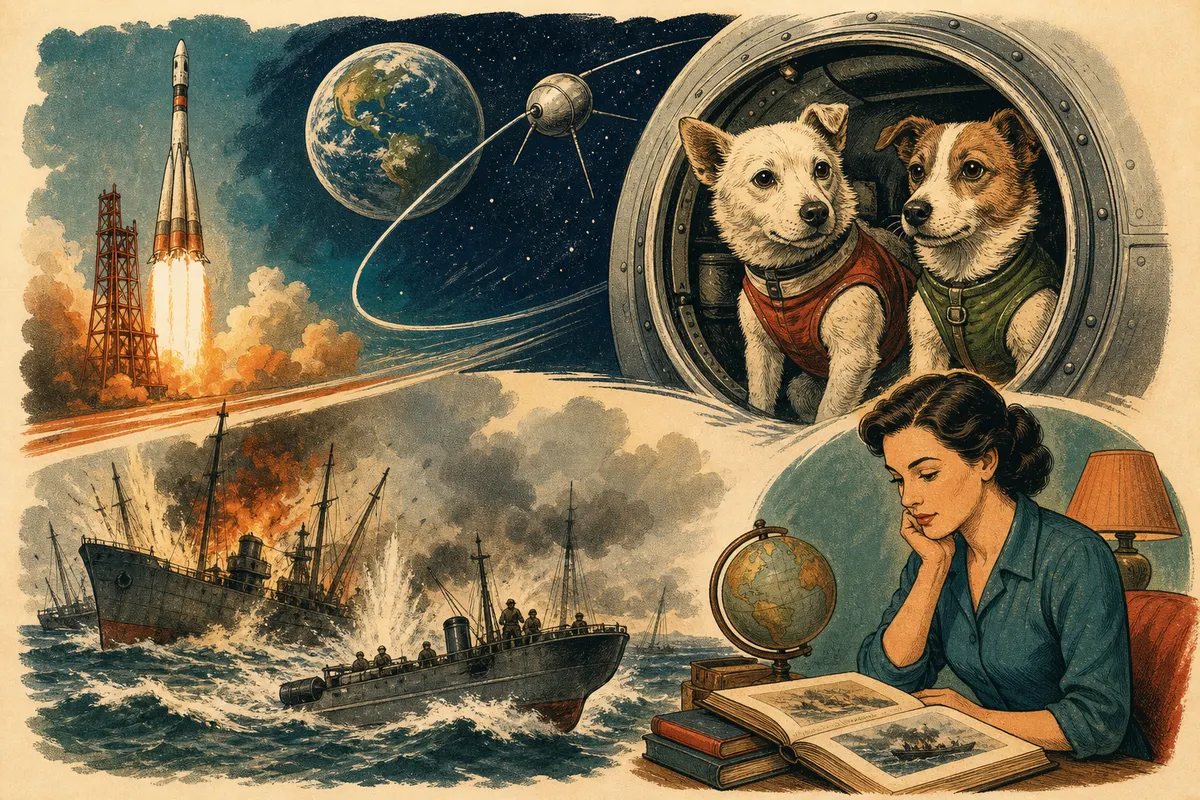
On 19 August 1960, two stray dogs named Belka and Strelka were launched into orbit aboard Sputnik 5, completed seventeen laps of the Earth, and then came home alive. That alone would be enough for one day in history. 19 August, it turns out, had other ideas.

The Dogs Who Paved the Way

Belka and Strelka were not just passengers; they were proof of concept. Their mission lasted 25 hours, during which the capsule completed seventeen orbits before returning safely to Earth. They were accompanied by mice, rats, insects, plants, and a rabbit, which is either the world’s strangest road trip or the world’s most high-stakes science experiment, depending on your perspective.

Their survival mattered enormously. Before Sputnik 5, nobody could be certain that a living creature could endure re-entry and return intact. Belka and Strelka answered that question definitively, and Yuri Gagarin’s flight, and everything that followed, was built on what they proved.

Strelka later had puppies. One of them was gifted to the Kennedy family.

The Rest of the Day

19 August has considerable form for dramatic events. In 1666, Rear Admiral Robert Holmes led a raid on the Dutch island of Terschelling during the Second Anglo-Dutch War, burning up to 150 merchant vessels and much of the town of West-Terschelling. The event became known as Holmes’s Bonfire, which is a remarkably tidy name for what amounted to large-scale economic destruction of the Dutch Republic.

Then there is 43 BC, when a nineteen-year-old named Octavian marched his legions to Rome and demanded to be elected Consul. He was far below the legal age. The Senate declined. He gestured at his army. They reconsidered. That teenager eventually became Augustus, and Rome was never quite the same.

And in 2017, a salmon pen owned by Cooke Aquaculture off Cypress Island in Washington State collapsed, releasing somewhere between 100,000 and 300,000 farmed Atlantic salmon into Pacific waters. The non-native fish posed real ecological risks to native Pacific salmon populations. Thousands were recovered; many were not, and the company’s leases were eventually revoked.

Why Listen?

This episode is ten minutes of history that actually happened: audacious, improbable, and in several cases, catastrophically underestimated by the people who thought they were in charge. Two Soviet street dogs proved that living creatures could survive re-entry. A teenager with an army rewrote Roman politics entirely. An admiral burned a fleet. Salmon ended up in entirely the wrong ocean.

The most unlikely things have a habit of actually happening. Clara Vale will walk you through all of them.

In this episode

  • Intro Clara sets the scene with an impossible thought experiment: what if you were a stray dog about to be launched into orbit at eight kilometres per second? She introduces the episode’s focus on 19 August 1960, when Sputnik 5 carried two dogs and dozens of other animals into space and brought them all home alive.
  • Belka and Strelka: The First Survivors The story of the Soviet Union’s Sputnik 5 mission, which launched on 19 August 1960 with two street dogs, Belka and Strelka, alongside mice, rats, insects, plants, and a rabbit. After seventeen orbits and 25 hours in space, the capsule returned safely, proving that living creatures could survive re-entry and making Yuri Gagarin’s flight possible. Strelka later had puppies, one of whom was gifted to the Kennedy family.
  • Holmes’s Bonfire On 19 August 1666, Rear Admiral Robert Holmes led a devastating raid on the Dutch island of Terschelling during the Second Anglo-Dutch War, burning up to 150 merchant vessels and much of the town of West-Terschelling. The event became known as Holmes’s Bonfire and dealt significant economic damage to the Dutch Republic.
  • Octavian Persuades the Senate On 19 August 43 BC, a nineteen-year-old Octavian marched his legions to Rome and demanded to be elected Consul, despite being far below the legal age. The Senate declined until he gestured at his army. They reconsidered. He became Consul and would later transform Rome into an empire as Augustus.
  • The Great Salmon Escape On 19 August 2017, a salmon pen owned by Cooke Aquaculture off Cypress Island, Washington, collapsed, releasing between 100,000 and 300,000 farmed Atlantic salmon into Pacific waters. The non-native fish posed ecological risks to native Pacific salmon populations. Thousands were recovered, but many escaped into rivers across the Pacific Northwest, prompting regulatory investigations and the eventual revocation of the company’s leases.
  • Outro Clara reflects on the improbable events of 19 August across history: two dogs who orbited Earth and came home, an admiral who set fire to a fleet, a teenager who redrew the map of the ancient world, and salmon in the wrong ocean. She reminds listeners that the most unlikely things have a habit of actually happening.

Sources

More from the archive

5 min

The Unending Hunt for the Golden Owl

Explore the captivating tale of The Hunt for the Golden Owl, a treasure hunt that spanned over thirty years, initiated by French author Max Valentin and artist Michel Becker in 1993. Discover the extraordinary story of a bronze owl and a grand prize of a golden owl adorned with diamonds. Despite Valentin’s cryptic style and the frustrations faced by treasure hunters, the hunt concluded in 2024, yet its legacy lingers. Delve into the significance of Gaecheonjeol in South Korea, where the mythical descent of Hwanung is celebrated. Examine the impact of the O. J. Simpson acquittal on popular culture and the explosive revelations of the Pandora Papers in 2021, which unveiled the hidden wealth of the world’s elite, sparking debates on financial transparency. Join Clara Vale as she navigates these compelling narratives in The Daily Time Drop.

Read & listen →
4 min

The Nottingham Cheese Riot and Beyond

In this episode of The Daily Time Drop, Clara Vale delves into a peculiar chapter of history: the Nottingham Cheese Riot of 1766. What began as an ordinary day at Nottingham’s Goose Fair transformed into a chaotic scene due to soaring cheese prices. Locals, outraged by the cost hike, took matters—and cheese—into their own hands, resulting in a riot quelled only by militia intervention. Clara then shifts focus to a 2023 event involving the US Federal Communications Commission’s action against Dish Network for neglecting space debris, marking a significant step in tackling space pollution. Next, we look forward to a celestial spectacle: the solar eclipse in Patagonia in 2024. Finally, Clara reflects on the origins of parkrun in 2004, a small initiative that evolved into a global movement championing community fitness. Each story illustrates unique instances of human behaviour, from passionate protests to inspiring initiatives.

Read & listen →
4 min

Milestone Moments: Breaking Barriers and Reshaping History

On today’s episode of The Daily Time Drop, host Clara Vale delves into a day rich with historical significance and cultural milestones. We explore how Claudia Sheinbaum made history in 2024 as Mexico’s first female president and the country’s first president of Jewish heritage. This groundbreaking moment challenges conventions and inspires a new generation. We also highlight Karolina Styczyńska’s remarkable journey as she became Japan’s first non-Japanese professional shogi player in 2015, breaking long-standing cultural barriers. Additionally, we recount the United States’ return to UNESCO in 2023, a sign of shifting diplomatic ties. Lastly, we touch upon Koromogae, Japan’s charming tradition of changing wardrobes with the seasons. Each story offers a glimpse into how everyday events and extraordinary accomplishments shape our world.

Read & listen →