On this day · 18 August 2026

Funeral for a Glacier, Helium's Accidental Discovery, and the Lost Colony

· 12 min

Funeral for a Glacier, Helium's Accidental Discovery, and the Lost Colony

Listen to this episode

12 min

The plaque left on that Icelandic mountainside asks future generations whether we acted on what we knew about climate change, and that question only gets louder. Meanwhile, after more than four centuries, nobody has satisfactorily explained what happened at Roanoke.

Some dates just show up to work harder than others. The eighteenth of August has hosted a solar eclipse discovery, a colonial disappearance, the birth of a language empire, and a funeral for a nine-hundred-year-old glacier. History, as ever, did not pace itself.

The Glacier That Got a Funeral

In 2014, Okjökull was officially stripped of its glacier status. Nine hundred years of ice, once covering fifteen and a half square kilometres of Icelandic mountainside, had thinned past the point of return. By that measure, the death had already happened. The funeral came five years later.

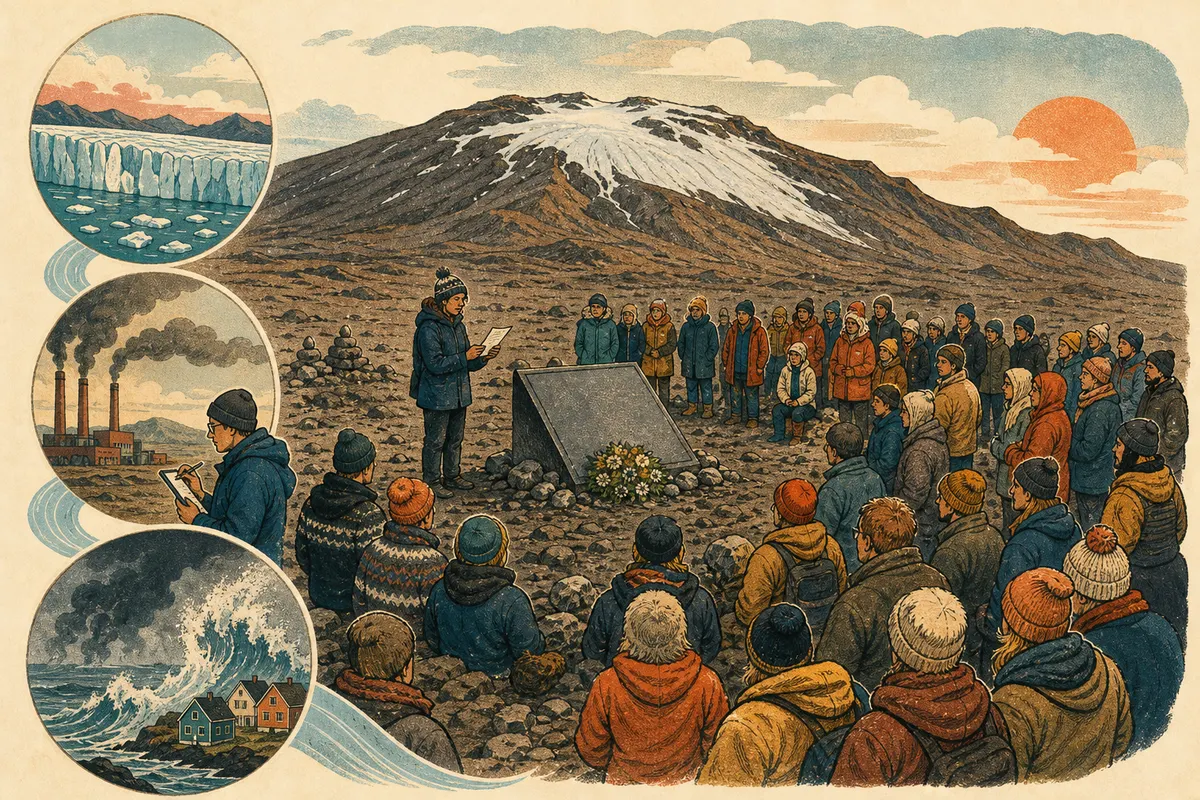
On 18 August 2019, around a hundred people climbed a bare Icelandic mountainside to attend a memorial ceremony for Okjökull, the first glacier in Iceland to lose its official classification. Scientists, activists, and Icelandic officials were among those present. They installed a plaque addressed not to the people standing there, but to future generations, asking whether humanity acted on what it knew about climate change. Iceland expects to lose all its remaining glaciers by 2200 if current trends continue.

A funeral for ice. A plaque for people who have not been born yet. It is, depending on your temperament, either extraordinarily moving or deeply alarming. Possibly both.

Three More Drops from the Same Date

The same date carries remarkable company across the centuries.

In 1868, French astronomer Pierre Janssen spotted an unknown yellow spectral line in the sun’s spectrum during a total solar eclipse in India. English astronomer Norman Lockyer would name the element helium after the Greek word for sun. It would not be found on Earth until 1895, when William Ramsay isolated it from a uranium mineral. Helium was identified in space before anyone found it on the planet we actually live on.

In 1590, Governor John White returned to Roanoke Colony after a three-year absence to find one hundred and fifteen colonists simply gone. Among them were his daughter and granddaughter, Virginia Dare. The only clue was the word “Croatoan” carved into a post, with no cross to signal distress and no further explanation. White never discovered what happened. Neither, frankly, have we.

And on 18 August 1492, scholar Antonio de Nebrija presented Queen Isabella of Castile with the first grammar of the Spanish language, arguing that standardised language would serve as an instrument of empire. Spanish is now spoken by around five hundred million people as a first language across twenty countries. He was, it turns out, not wrong.

Worth Your Ten Minutes

Four stories, one date, spanning more than five centuries: a funeral, an accidental discovery, an unsolved mystery, and a language built to govern an empire. If any of that sounds like your sort of thing, the audio is waiting for you.

In this episode

  • Intro Clara opens with the striking image of a funeral held for Okjökull, a glacier that once covered fifteen and a half square kilometres of Iceland and is now gone.
  • Funeral for a Glacier: Okjökull, 2019 On 18 August 2019, scientists, activists, and Icelandic officials held a memorial ceremony for Okjökull, which lost its glacier status in 2014 after nine hundred years. A plaque was installed addressing future generations, asking whether humanity acted on climate knowledge. Iceland expects to lose all its glaciers by 2200 if current trends continue.
  • Helium’s Accidental Birthday: Pierre Janssen, 1868 During a total solar eclipse in India on 18 August 1868, French astronomer Pierre Janssen identified an unknown yellow spectral line. English astronomer Norman Lockyer named the element helium after the Greek word for sun. It was not found on Earth until 1895, when William Ramsay isolated it from uranium mineral.
  • The Silence at Roanoke: John White, 1590 Governor John White returned to Roanoke Colony on 18 August 1590 after a three-year absence to find the settlement abandoned. The word ‘Croatoan’ was carved into a post, indicating a possible destination, but no cross suggesting distress. White never discovered what happened to the hundred and fifteen colonists, including his daughter and granddaughter Virginia Dare.
  • The First Grammar of Spanish: Antonio de Nebrija, 1492 On 18 August 1492, scholar Antonio de Nebrija presented Queen Isabella of Castile with the first grammar of the Spanish language. He proposed that standardised language would serve as an instrument of empire. Spanish is now spoken by around five hundred million people as a first language across twenty countries.
  • Outro Clara reflects on how history places the enormous and intimate side by side, asking us to hold world-changing events and heartbreaking mysteries in the same moment.

Sources

More from the archive

5 min

The Unending Hunt for the Golden Owl

Explore the captivating tale of The Hunt for the Golden Owl, a treasure hunt that spanned over thirty years, initiated by French author Max Valentin and artist Michel Becker in 1993. Discover the extraordinary story of a bronze owl and a grand prize of a golden owl adorned with diamonds. Despite Valentin’s cryptic style and the frustrations faced by treasure hunters, the hunt concluded in 2024, yet its legacy lingers. Delve into the significance of Gaecheonjeol in South Korea, where the mythical descent of Hwanung is celebrated. Examine the impact of the O. J. Simpson acquittal on popular culture and the explosive revelations of the Pandora Papers in 2021, which unveiled the hidden wealth of the world’s elite, sparking debates on financial transparency. Join Clara Vale as she navigates these compelling narratives in The Daily Time Drop.

Read & listen →
4 min

The Nottingham Cheese Riot and Beyond

In this episode of The Daily Time Drop, Clara Vale delves into a peculiar chapter of history: the Nottingham Cheese Riot of 1766. What began as an ordinary day at Nottingham’s Goose Fair transformed into a chaotic scene due to soaring cheese prices. Locals, outraged by the cost hike, took matters—and cheese—into their own hands, resulting in a riot quelled only by militia intervention. Clara then shifts focus to a 2023 event involving the US Federal Communications Commission’s action against Dish Network for neglecting space debris, marking a significant step in tackling space pollution. Next, we look forward to a celestial spectacle: the solar eclipse in Patagonia in 2024. Finally, Clara reflects on the origins of parkrun in 2004, a small initiative that evolved into a global movement championing community fitness. Each story illustrates unique instances of human behaviour, from passionate protests to inspiring initiatives.

Read & listen →
4 min

Milestone Moments: Breaking Barriers and Reshaping History

On today’s episode of The Daily Time Drop, host Clara Vale delves into a day rich with historical significance and cultural milestones. We explore how Claudia Sheinbaum made history in 2024 as Mexico’s first female president and the country’s first president of Jewish heritage. This groundbreaking moment challenges conventions and inspires a new generation. We also highlight Karolina Styczyńska’s remarkable journey as she became Japan’s first non-Japanese professional shogi player in 2015, breaking long-standing cultural barriers. Additionally, we recount the United States’ return to UNESCO in 2023, a sign of shifting diplomatic ties. Lastly, we touch upon Koromogae, Japan’s charming tradition of changing wardrobes with the seasons. Each story offers a glimpse into how everyday events and extraordinary accomplishments shape our world.

Read & listen →