On this day · 16 August 2026

When Morocco's Air Force Attacked Their King and He Talked Them Down

· 10 min

When Morocco's Air Force Attacked Their King and He Talked Them Down

Listen to this episode

10 min

The 1972 attack is a reminder that the most dangerous threats can come from within an institution. And the 1989 Toronto solar event remains an underappreciated warning about how exposed modern digital infrastructure is to cosmic weather.

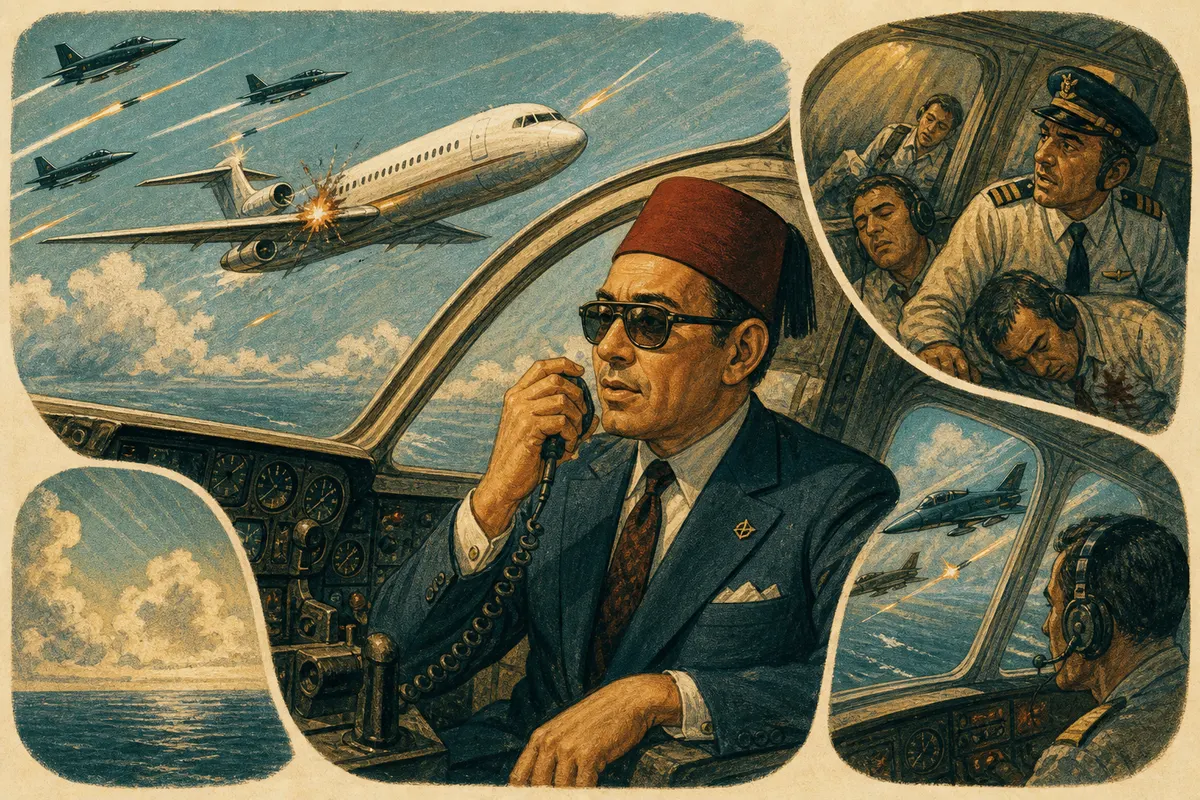
There are bad flights, and then there is 16 August 1972, when King Hassan II of Morocco boarded his Boeing 727 and found himself intercepted by six of his own air force’s F-5 fighters over the Atlantic.

The pilots opened fire. Crew members were killed. The aircraft was hit. By any reasonable measure, this should have been the end of Hassan II.

It was not.

The King Gets on the Radio

What allegedly happened next is the sort of thing that would earn a sceptical look from a fiction editor. Hassan, according to the story, got on the radio himself and talked the attacking pilots into standing down. How exactly he managed it, history does not fully illuminate. That is, characteristically, the most interesting part.

He landed. He survived. He then moved with considerable speed: arrests and executions followed, and General Oufkir, a senior figure connected to the plot, died in circumstances described as suicide and believed by almost nobody to be exactly that. Hassan went on to rule Morocco for another 27 years.

It is an extraordinary account of a man who, when everything went catastrophically wrong at altitude, concluded that his best survival tool was his own voice.

Two More from the Sixteenth of August

This episode does not stop there. We also visit 1550, when Rabbi Moses Isserles ruled on a dispute between Venetian printers competing over editions of the Talmud. The decision is considered one of the earliest recorded copyright rulings, which means arguments about intellectual ownership have a considerably longer history than anyone arguing about streaming rights might suppose.

Then there is 1989, when a solar particle event interfered with computer systems at the Toronto Stock Exchange and forced trading to halt. No villain, no drama: just the sun going about its business. Part of a broader year of heightened solar activity, the incident highlighted how fragile digital infrastructure remains in the face of cosmic weather. The lesson has not exactly been acted on.

Why Listen?

Three stories, one calendar date: a king who survived by talking, a rabbi who drew one of the earliest legal lines around intellectual property, and a star that quietly knocked out a stock exchange. This episode is about nerve, improvisation, and the persistent human talent for getting through days that had no business ending well.

Ten minutes. Worth your time.

In this episode

  • Intro Opening hook: a king flying home when his own air force opens fire. Clara introduces the episode and the day’s theme of improbable survival.
  • The Day Morocco’s Air Force Shot at Their Own King On 16 August 1972, six Moroccan F-5 fighters attacked King Hassan II’s Boeing 727. Hassan survived by allegedly getting on the radio and talking the pilots down. The aftermath was swift: arrests, executions, and the suspicious death of General Oufkir. Hassan ruled for another 27 years.
  • A Sixteenth-Century Copyright Dispute On 16 August 1550, Rabbi Moses Isserles ruled on a dispute between Venetian printers over competing Talmud editions. The case is considered one of the earliest recorded copyright decisions, planting an early flag in the legal territory that now shapes modern intellectual property law.
  • The Sun Takes Down the Stock Exchange On 16 August 1989, a solar particle event interfered with computer systems at the Toronto Stock Exchange, forcing a halt to trading. The incident was part of a broader year of heightened solar activity and highlighted the fragility of digital infrastructure to cosmic weather.
  • Outro Clara reflects on the three stories: a king who survived by talking, a rabbi who drew an early line around intellectual ownership, and a star that quietly broke a stock exchange. History, she notes, is rarely short of nerve.

More from the archive

5 min

The Unending Hunt for the Golden Owl

Explore the captivating tale of The Hunt for the Golden Owl, a treasure hunt that spanned over thirty years, initiated by French author Max Valentin and artist Michel Becker in 1993. Discover the extraordinary story of a bronze owl and a grand prize of a golden owl adorned with diamonds. Despite Valentin’s cryptic style and the frustrations faced by treasure hunters, the hunt concluded in 2024, yet its legacy lingers. Delve into the significance of Gaecheonjeol in South Korea, where the mythical descent of Hwanung is celebrated. Examine the impact of the O. J. Simpson acquittal on popular culture and the explosive revelations of the Pandora Papers in 2021, which unveiled the hidden wealth of the world’s elite, sparking debates on financial transparency. Join Clara Vale as she navigates these compelling narratives in The Daily Time Drop.

Read & listen →
4 min

The Nottingham Cheese Riot and Beyond

In this episode of The Daily Time Drop, Clara Vale delves into a peculiar chapter of history: the Nottingham Cheese Riot of 1766. What began as an ordinary day at Nottingham’s Goose Fair transformed into a chaotic scene due to soaring cheese prices. Locals, outraged by the cost hike, took matters—and cheese—into their own hands, resulting in a riot quelled only by militia intervention. Clara then shifts focus to a 2023 event involving the US Federal Communications Commission’s action against Dish Network for neglecting space debris, marking a significant step in tackling space pollution. Next, we look forward to a celestial spectacle: the solar eclipse in Patagonia in 2024. Finally, Clara reflects on the origins of parkrun in 2004, a small initiative that evolved into a global movement championing community fitness. Each story illustrates unique instances of human behaviour, from passionate protests to inspiring initiatives.

Read & listen →
4 min

Milestone Moments: Breaking Barriers and Reshaping History

On today’s episode of The Daily Time Drop, host Clara Vale delves into a day rich with historical significance and cultural milestones. We explore how Claudia Sheinbaum made history in 2024 as Mexico’s first female president and the country’s first president of Jewish heritage. This groundbreaking moment challenges conventions and inspires a new generation. We also highlight Karolina Styczyńska’s remarkable journey as she became Japan’s first non-Japanese professional shogi player in 2015, breaking long-standing cultural barriers. Additionally, we recount the United States’ return to UNESCO in 2023, a sign of shifting diplomatic ties. Lastly, we touch upon Koromogae, Japan’s charming tradition of changing wardrobes with the seasons. Each story offers a glimpse into how everyday events and extraordinary accomplishments shape our world.

Read & listen →