On this day · 20 July 2026

Napoleon's engine, the javelin that was too good, and the retired terrorists

· 11 min

Napoleon's engine, the javelin that was too good, and the retired terrorists

Listen to this episode

11 min

These stories highlight the creativity, ambition, and unpredictability of human actions that have long-lasting effects on technology and society.

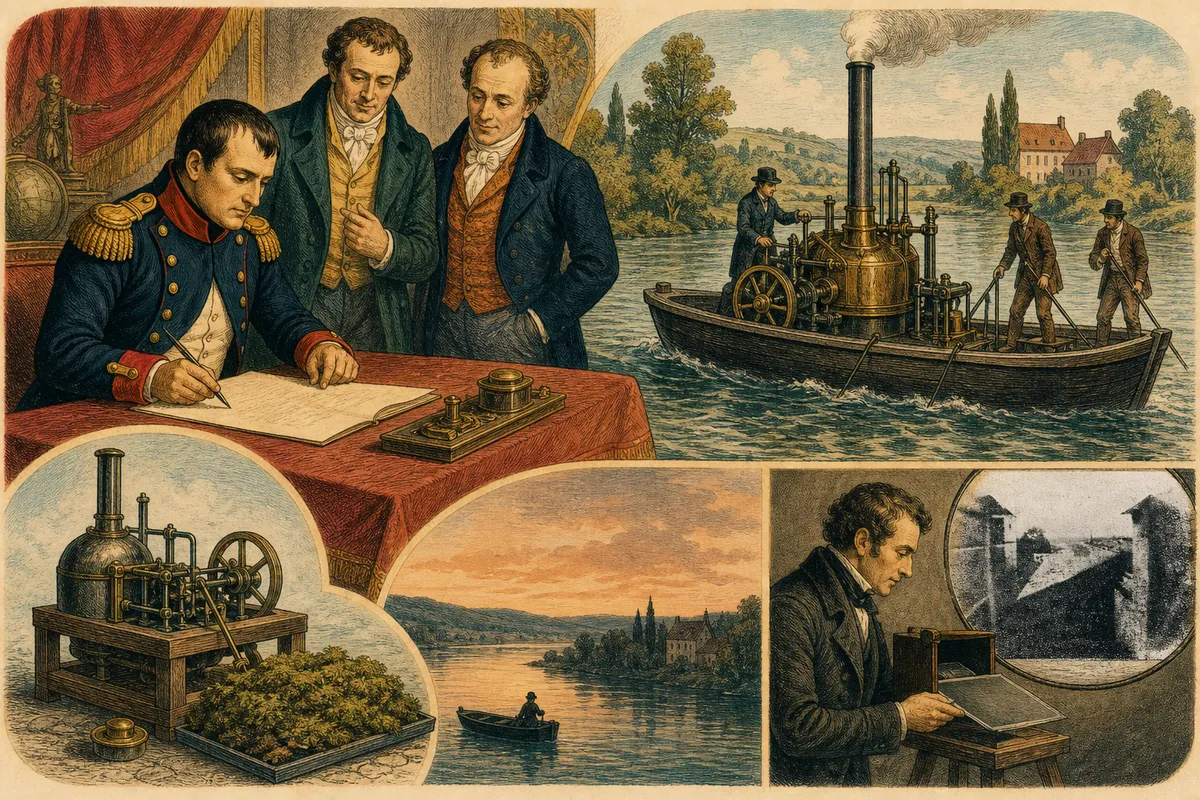
If you thought Napoleon Bonaparte was simply all about military conquests, allow me to introduce you to one of his lesser-known patents. On 20 July 1807, our favourite French emperor signed off on the Pyréolophore, an internal combustion engine powered by the damp undergrowth of Burgundy. Imagine Napoleon, pen in hand, nodding as Nicéphore Niépce and his brother Claude pitched what was essentially a boat’s motor fuelled by moss and Lycopodium powder.

The Pyréolophore: Invention Ahead of Its Time

Nicéphore Niépce may have been a man ahead of his era. Before dabbling in the world of photography—where he’s credited for creating the oldest surviving photo in the 1820s—he and his brother experimented with combustion above the gentle currents of the River Saône. The Pyréolophore may not have reached commercial viability, but it certainly left its mark on the timeline of engineering feats, prompting even the likes of Napoleon to glance away from his battle maps.

The Javelin That Changed the Game

Fast forward to 1984, and we see another paradigm-shifting feat on 20 July. East German athlete Uwe Hohn launched not just a javelin, but a conversation across athletic communities, when his throw soared to 104.8 metres. This was no minor hiccup. The throw defied standard tracks entirely, leading to a redesign of the javelin by 1986 which ensured Hohn’s record would remain unchallenged under new regulations.

A Farewell That Wasn’t

Finally, we take a detour down the perplexing lanes of radical retirements. The Red Army Faction, an infamous German militant group, announced their curtain call only to be less ‘retired’ than advertised. In 1999, fourteen months post-dissolution, two members engaged in what one might call an ‘ambitious pension plan’—an armoured vehicle attack in Duisburg using a rocket launcher. One participant, Daniela Klette, blended right back into civilian life until 2024, when 21st-century tech got the last laugh with facial recognition unraveling her decades of anonymity.

Each of these stories tickles the brain with the unexpected outcomes of human endeavour. Whether it’s a pet project of an emperor, a sports record that reset the playing field, or a revolutionary return gone awry, they remind us: intention and reality often live in separate camps. To dive deeper into these peculiar chapters of history, tune into today’s episode of The Daily Time Drop.

In this episode

  • Intro Napoleon Bonaparte signs a patent in 1807, not for a weapon but for a small engine powered by moss and Lycopodium powder. The inventor, Nicéphore Niépce, would later also invent photography.
  • The Pyréolophore: Napoleon’s Most Unexpected Patent Nicéphore Niépce and his brother Claude build the Pyréolophore, the world’s first internal combustion engine, and successfully test it on the River Saône in 1807. Napoleon grants them a patent on 20 July. The engine never becomes commercial, but Niépce goes on to create the first photograph in the 1820s.
  • The Javelin That Broke the Olympics On 20 July 1984, Uwe Hohn throws a javelin 104.8 metres, beyond the length of a standard athletics track. The IAAF responds by redesigning the javelin in 1986, making Hohn’s record unbreakable under current rules.
  • The Bank Robbery That Wasn’t Supposed to Happen Fourteen months after the Red Army Faction announces its dissolution, two members attack an armoured vehicle in Duisburg with a rocket launcher on 20 July 1999. Daniela Klette evades capture until 2024, identified through online capoeira videos.
  • Outro A recap of the day’s events: an inventor who changed two industries, a javelin throw that rewrote the rules, and retired revolutionaries who weren’t quite retired.

Sources

More from the archive

7 min

Collision of the Unexpected: Trump, Vigdís, and Kelston's Ingenuity

In this episode of The Daily Time Drop, host Clare Vale unravels a tapestry of global historical moments that reveal the unpredictable dance between human endeavour and fate. We begin with former US President Donald Trump’s third indictment in 2023, a significant event intertwining political accountability and democratic principles. The discussion then shifts to 1980, where Vigdís Finnbogadóttir’s election as Iceland’s President marked a breakthrough for gender equality, inspiring communities worldwide. The launch of Microsoft Office in 1989 is highlighted as a pivotal moment that revolutionised productivity and digital working environments. Closing with a story from 2014, Clare explores the Kelston toll road, a symbol of community action and creative solutions. Each story underscores the power of human agency and the enduring impact of leadership, innovation, and collective action.

Read & listen →
4 min

Moon Crashes and Floral Penalties

In this episode of The Daily Time Drop, host Clara Vale explores two intriguing stories of human ambition and unexpected results. First, we delve into NASA’s audacious 1999 mission to crash the Lunar Prospector into the Moon—a planned cosmic collision intended to reveal hidden mysteries. Despite the dramatic impact, the hoped-for evidence of water ice remained elusive. Then, travel back to 1703 to witness how Daniel Defoe, the famous author of ‘Robinson Crusoe’, faced public punishment for his biting satire. Intended to be a spectacle of shame, Defoe’s pillory became an inspired moment when the crowd showered him with flowers instead of insults. Join us as we examine these tales of scientific daring and literary defiance, underscoring the unpredictable nature of human endeavours.

Read & listen →
5 min

Echoes of Extinction: The Pyrenean Ibex's Brief Return

Join Clara Vale on The Daily Time Drop as she unravels a tapestry of intriguing historical moments. Discover the extraordinary tale of the Pyrenean ibex, a species that defied extinction only to face it again. Step into the vibrant energy of Tomorrowland, where Charlotte de Witte’s groundbreaking performance changed the face of techno music. Bid adieu to the classic Volkswagen Beetle, an automotive icon whose journey ended in 2003. Finally, witness Lisa Leslie’s historic slam dunk in the Women’s National Basketball Association, a defining moment that challenged perceptions of women in sport. Through these stories, Clara invites us to reflect on human ingenuity, nature’s unpredictability, and the ever-present dance with overconfidence.

Read & listen →