On this day · 17 July 2026

Royal Barges, Papal Footnotes, and the Vice-President Who Voted No

· 11 min

Royal Barges, Papal Footnotes, and the Vice-President Who Voted No

Listen to this episode

11 min

History is full of people who got a footnote when they deserved a chapter, and people who accidentally made the chapter by turning up on the right day. Both things happened on 17 July.

Most people have a quiet 17 July. King George I did not.

Handel on the Thames

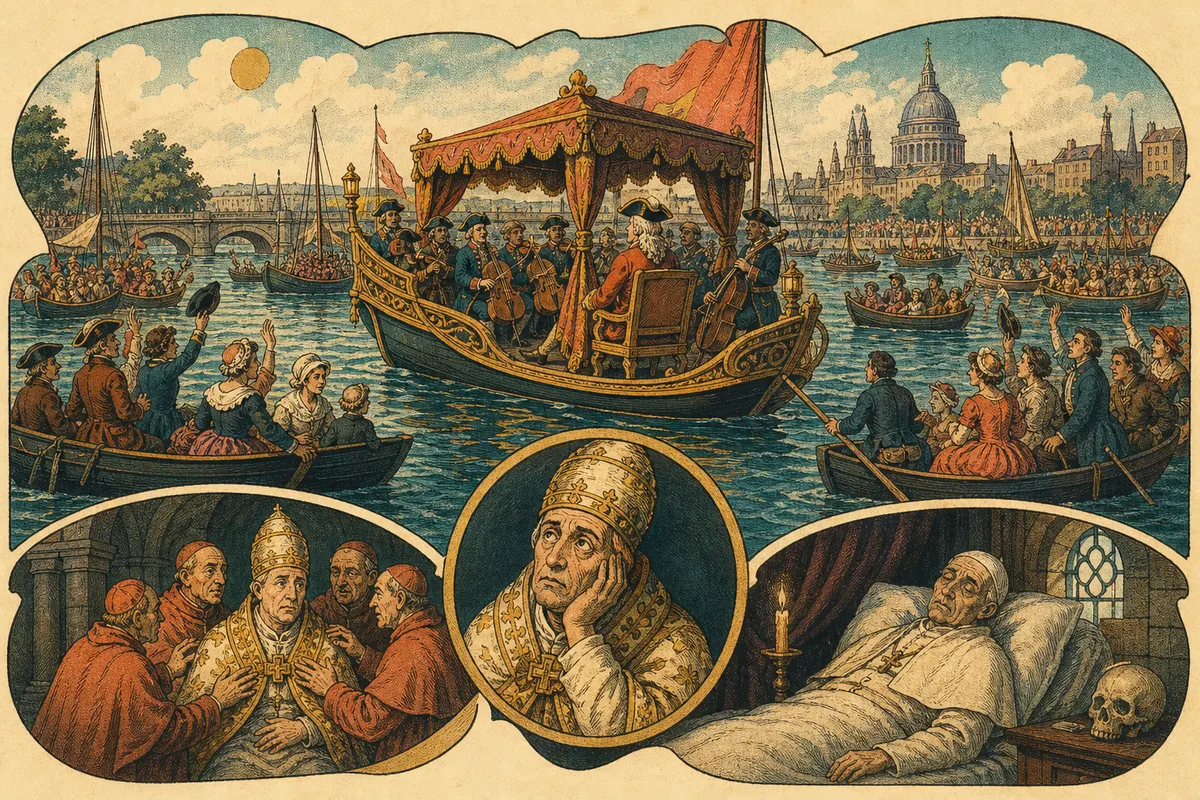
On 17 July 1717, George I took an evening on the river and turned it into something rather more memorable. Handel had been commissioned to write the music, fifty musicians were loaded onto a floating barge, and the public arrived in hundreds of boats to listen, entirely uninvited. The king was delighted. The music has been performed ever since.

It is a very good argument for commissioning art.

The Twenty-Three Day Pope

On the same date in 1048, Poppo of Brixen was elected Pope Damasus II. He died twenty-three days later, barely enough time to learn where anything was. His successor went on to reform the papacy significantly. Damasus got a footnote.

There is something quietly comic about a reign so brief it can be measured in the time it takes to get over a bad cold, but there is also something worth sitting with: the job still mattered, the moment still happened, and someone still had to do it.

The Star That Posed for a Portrait

In 1850, astronomer John Adams Whipple captured the first photograph of a star other than the Sun. The star was Vega, and its light had been travelling for twenty-five years to reach a glass plate in Massachusetts. The image was faint and blurry. Astronomy was never quite the same after it.

The universe, it turns out, does not object to being photographed.

The Vice-President Who Voted Against His Own Government

In 2008, the Argentine Senate was deadlocked on a controversial agricultural export tax. The deciding vote fell to Vice-President Julio Cobos, who cast it against his own government, telling the Senate his conscience compelled him to do so. The chamber went berserk. His approval ratings soared. He served out his term.

Four stories, one date, a thousand years of people showing up and doing something that still gets talked about. The episode is ten minutes. The Argentine Senate scene alone is worth it.

In this episode

  • Intro A warm July evening in 1717. The Thames glittering. Fireworks. Hundreds of boats. A royal barge. And fifty musicians about to play something nobody’s heard before.
  • Handel’s Water Music: A Royal Concert on the Thames On 17 July 1717, King George I took a river party up the Thames whilst Handel’s newly commissioned Water Music played from a floating barge of fifty musicians. The king was delighted. The public turned out in droves. The music is still being performed three centuries later.
  • Damasus II: The Twenty-Three Day Pope On 17 July 1048, Poppo of Brixen was elected Pope Damasus II during a turbulent period for the Catholic Church. He died twenty-three days later, barely enough time to begin. His successor went on to reform the papacy. Damasus got a footnote.
  • Vega: The First Star to Be Photographed On 17 July 1850, astronomer John Adams Whipple captured the first photograph of a star other than the Sun. The star was Vega. The image was faint and blurry, but astronomy was never quite the same. The universe became a place you could document.
  • The Vice-President Who Voted No On 17 July 2008, a tied vote in the Argentine Senate on controversial agricultural export taxes went to Vice-President Julio Cobos, who cast the deciding vote against his own government. The chamber went berserk. His approval ratings soared. He served out his term.
  • Outro History rewards the ones who show up, whether you’re a composer with a royal commission, a pope who barely unpacked, an astronomer with a camera, or a vice-president with a vote that’s going to cause trouble.

Sources

More from the archive

7 min

Collision of the Unexpected: Trump, Vigdís, and Kelston's Ingenuity

In this episode of The Daily Time Drop, host Clare Vale unravels a tapestry of global historical moments that reveal the unpredictable dance between human endeavour and fate. We begin with former US President Donald Trump’s third indictment in 2023, a significant event intertwining political accountability and democratic principles. The discussion then shifts to 1980, where Vigdís Finnbogadóttir’s election as Iceland’s President marked a breakthrough for gender equality, inspiring communities worldwide. The launch of Microsoft Office in 1989 is highlighted as a pivotal moment that revolutionised productivity and digital working environments. Closing with a story from 2014, Clare explores the Kelston toll road, a symbol of community action and creative solutions. Each story underscores the power of human agency and the enduring impact of leadership, innovation, and collective action.

Read & listen →
4 min

Moon Crashes and Floral Penalties

In this episode of The Daily Time Drop, host Clara Vale explores two intriguing stories of human ambition and unexpected results. First, we delve into NASA’s audacious 1999 mission to crash the Lunar Prospector into the Moon—a planned cosmic collision intended to reveal hidden mysteries. Despite the dramatic impact, the hoped-for evidence of water ice remained elusive. Then, travel back to 1703 to witness how Daniel Defoe, the famous author of ‘Robinson Crusoe’, faced public punishment for his biting satire. Intended to be a spectacle of shame, Defoe’s pillory became an inspired moment when the crowd showered him with flowers instead of insults. Join us as we examine these tales of scientific daring and literary defiance, underscoring the unpredictable nature of human endeavours.

Read & listen →
5 min

Echoes of Extinction: The Pyrenean Ibex's Brief Return

Join Clara Vale on The Daily Time Drop as she unravels a tapestry of intriguing historical moments. Discover the extraordinary tale of the Pyrenean ibex, a species that defied extinction only to face it again. Step into the vibrant energy of Tomorrowland, where Charlotte de Witte’s groundbreaking performance changed the face of techno music. Bid adieu to the classic Volkswagen Beetle, an automotive icon whose journey ended in 2003. Finally, witness Lisa Leslie’s historic slam dunk in the Women’s National Basketball Association, a defining moment that challenged perceptions of women in sport. Through these stories, Clara invites us to reflect on human ingenuity, nature’s unpredictability, and the ever-present dance with overconfidence.

Read & listen →