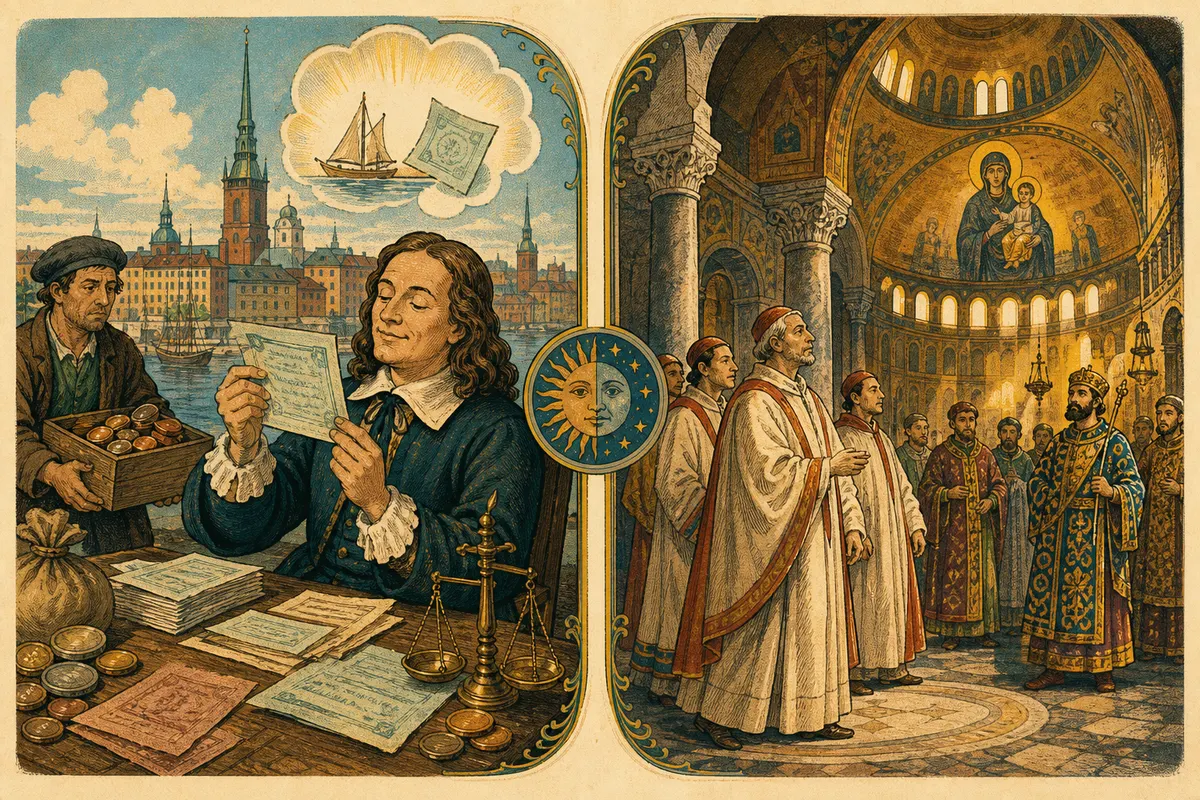
These stories remind us that the frameworks we rely on—currency, faith, and even the ground beneath us—are shaped by human decisions and natural forces.
If you’ve ever wondered how a simple sheet of paper could reshape economies, you’ve touched upon one of history’s pivotal moments. On 16 July 1661, Johan Palmstruch, a visionary yet overly ambitious Stockholm banker, transformed your heavy purse of copper coins into convenient paper promises. These were Europe’s first banknotes, issued during Sweden’s copper crisis. What seemed a genius idea turned spectacularly sour when Palmstruch printed more notes than his bank had copper reserves to honour. It all crumbled by 1664, dragging Palmstruch to court, convicted of fraud. Despite the chaos, the concept survived, redefining modern finance and making wallets significantly lighter.
Schisms and Splits
Travel back to 1054, and you find another, arguably more seismic shift. Imagine the scene: Roman legates striding into the fabled Hagia Sophia, casually placing a papal bull of excommunication on the altar. This act formalised the East-West Schism, splitting Christianity into the Roman Catholic and Eastern Orthodox Churches. Theological rifts over issues like papal authority and the filioque (