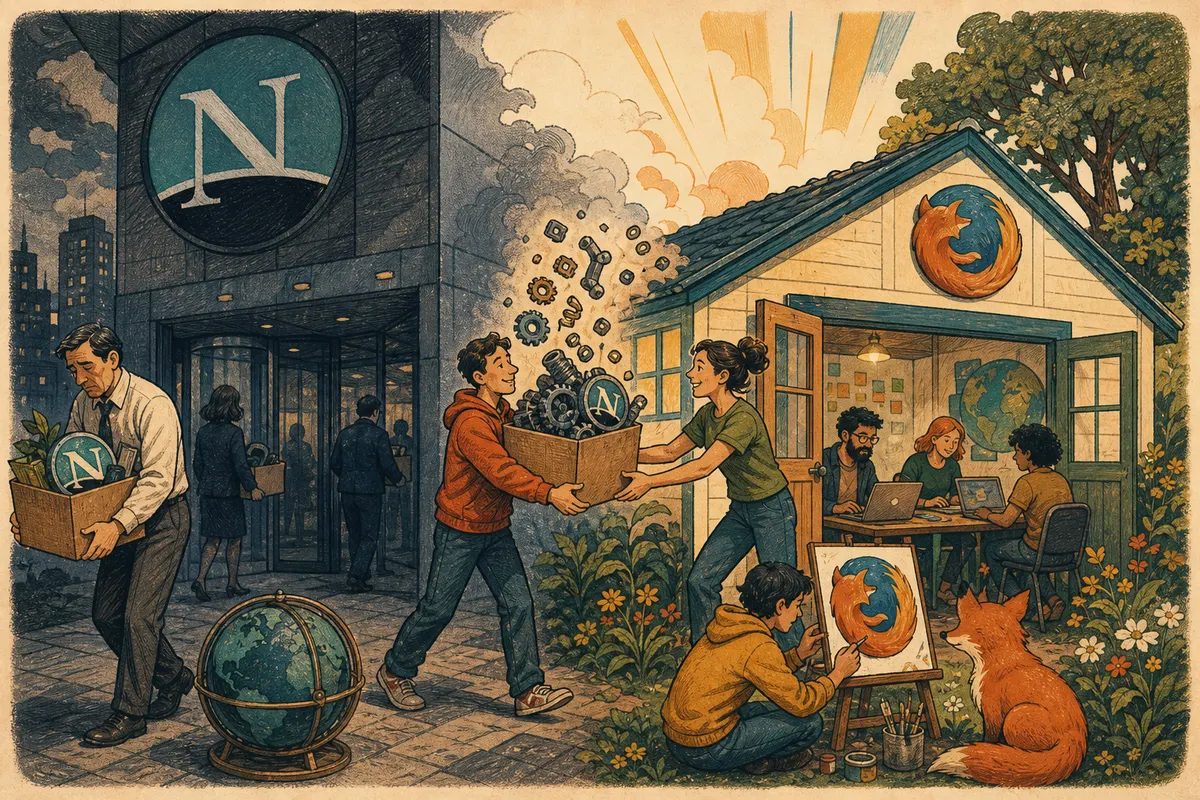
Netscape's decision to open-source its code in 1998 looked like an act of desperation; it turned out to be the move that kept the open web competitive. The browser wars shaped the internet infrastructure that billions of people use every day, and this is where the decisive moment happened.
On 15 July 2003, AOL Time Warner turned off the lights on Netscape Navigator. A browser that had once commanded 90% of the internet market, purchased four years earlier for $4.2 billion, was quietly retired. And on exactly the same day, the Mozilla Foundation opened its doors.
The irony is almost too neat.
The Death That Started Something
Netscape had owned the browser market in the mid-1990s, with around 90% market share. Then came the browser wars, and its share collapsed. In 1998, facing a losing battle against Internet Explorer, Netscape made a striking decision: it open-sourced its code. AOL acquired Netscape in 1999 for $4.2 billion, kept the brand alive for a few more years, and on 15 July 2003 shut it down entirely.
What AOL does not appear to have anticipated is that the open-source code had taken on a life of its own. The Mozilla Foundation was established on that same day as an independent non-profit, receiving $2 million and the Netscape IP rights. In 2004, it released Firefox 1.0, went on to challenge Internet Explorer, and helped shape the modern web as we know it.
AOL spent $4.2 billion and accidentally helped fund the thing that would outlast it.
Meanwhile, Twenty Years Earlier
On 15 July 1983, Nintendo launched the Family Computer, the Famicom, in Japan. A small red and white console that, despite early hardware problems serious enough to require a full recall, sold 40,000 units in its first month. It would eventually reach North America as the NES, establish the template for platform console gaming, and create the third-party licensing model that the games industry still runs on today.
The video game crash of 1983 had done its best to bury home gaming as a commercial proposition. Nintendo had other plans.
A Harder Note
The same date carries a much heavier memory. On 15 July 1996, a Belgian Air Force C-130 Hercules crashed on approach to Eindhoven Airport in the Netherlands. Thirty-four people were killed, among them members of the Royal Netherlands Army marching band. The investigation found crew errors during the instrument approach were the cause. It is the kind of accident that a community does not easily move past.
Three moments, one date: a browser that died and left something better behind, a console that rewrote the rules of play, and 34 lives that ended too soon. Today’s episode covers all three in about ten minutes, and it is worth your time.