The question of what gets written down and what gets destroyed is never just a historical curiosity. Every generation makes its own records and lights its own fires, and the gap between the two is where most of culture either survives or vanishes.
Imagine being shipwrecked on a foreign coast while already on your way home for your father’s funeral. Now imagine the local authorities suspect you might be a pirate. That is the situation Choe Bu found himself in on this date in 1488, and his response was to write one of the most remarkable travel diaries in history.
The Official Who Accidentally Toured Ming China
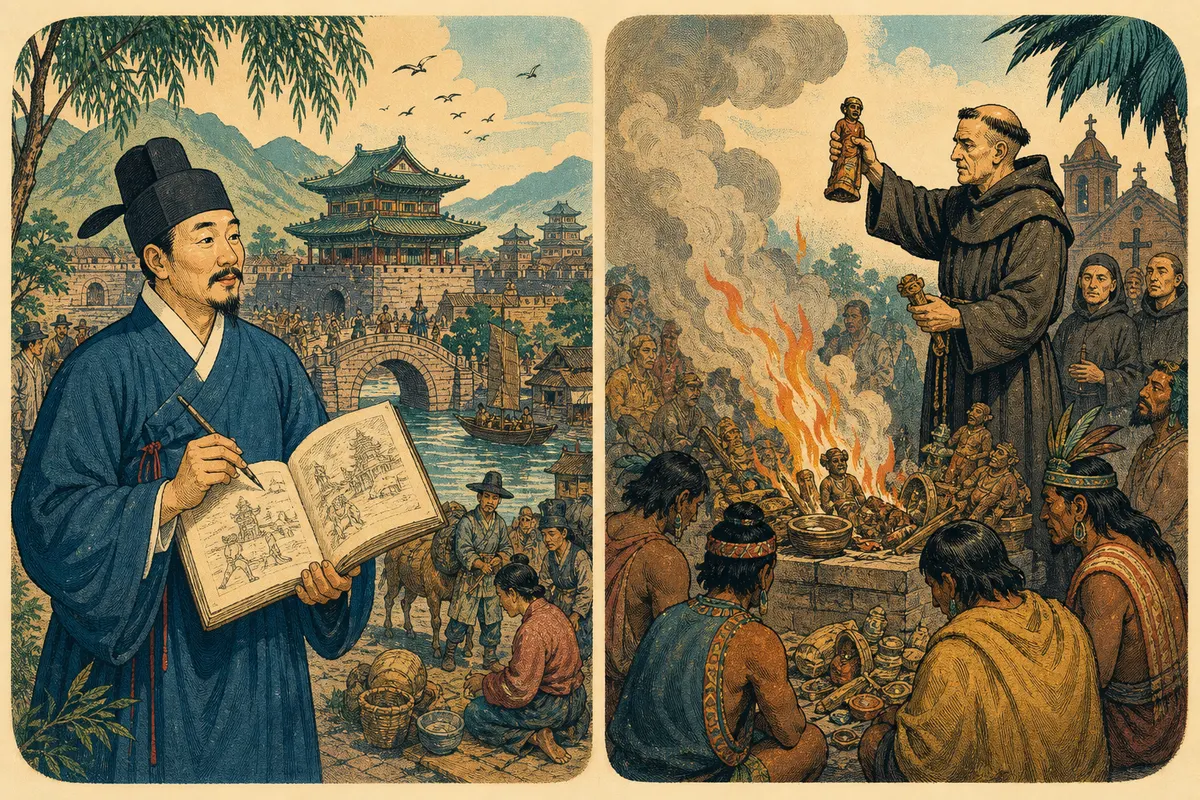
Choe Bu was a Joseon Dynasty official who, after being shipwrecked off the Chinese coast, was detained by Ming authorities with reasonable concerns about who exactly he was. He demonstrated his identity the only way available to him: through his literacy in classical Chinese. It worked. Rather than an indefinite and unpleasant detention, he was escorted across the breadth of China via the Grand Canal, and he documented everything he saw. Infrastructure, daily life, the texture of a civilisation in the fifteenth century. His resulting fifty-thousand-character diary is now considered one of the most valuable accounts of Ming society ever written.
It is the kind of record that only exists because someone was paying close attention during what should have been a catastrophe.
The Friar Who Burned the Books (Then Wrote About Them)
Four centuries later, on the same date in 1562, Franciscan friar Diego de Landa did something rather different with recorded knowledge. He ordered the burning of Maya codices in Maní, Yucatán. Between 27 and 40 manuscripts containing astronomical knowledge, religious ritual, and calendrical systems were destroyed. Only four Maya codices are known to have survived the Spanish colonial period.
The bitter irony is that de Landa later wrote one of the most important accounts of Maya culture himself, helping to preserve elements of their writing system for future scholars. History has a very particular sense of humour about these things.
Two Shorter Drops from the Same Date
In 1995, Chinese seismologists successfully predicted a major earthquake on the Myanmar-China border, allowing evacuations that limited casualties to eleven people. Successful earthquake prediction remains exceptionally rare in modern seismology, which makes this one of the clearest documented cases of it actually working.
And in 1997, Berlin’s ninth Love Parade was met with a counter-protest called the Hateparade, organised by those who felt the techno festival had been commercialised beyond recognition. That protest later evolved into the annual Fuckparade, which continues as a demonstration against corporate takeover of countercultural spaces. The underground, it turns out, does not go quietly.
This episode is about what gets recorded, what gets destroyed, and what survives long enough to matter. It is ten minutes well spent, and the de Landa irony alone is worth the price of admission.