On this day · 10 July 2026

The 1,720-Foot Wave That Rewrote the Science Books

· 11 min

The 1,720-Foot Wave That Rewrote the Science Books

Listen to this episode

11 min

The 1958 Lituya Bay megatsunami remains the largest wave in recorded history and still drives coastal hazard science today. The other events of 10 July are a reminder that catastrophe, covert operations, and extraordinary human coordination can, improbably, share a single date on the calendar.

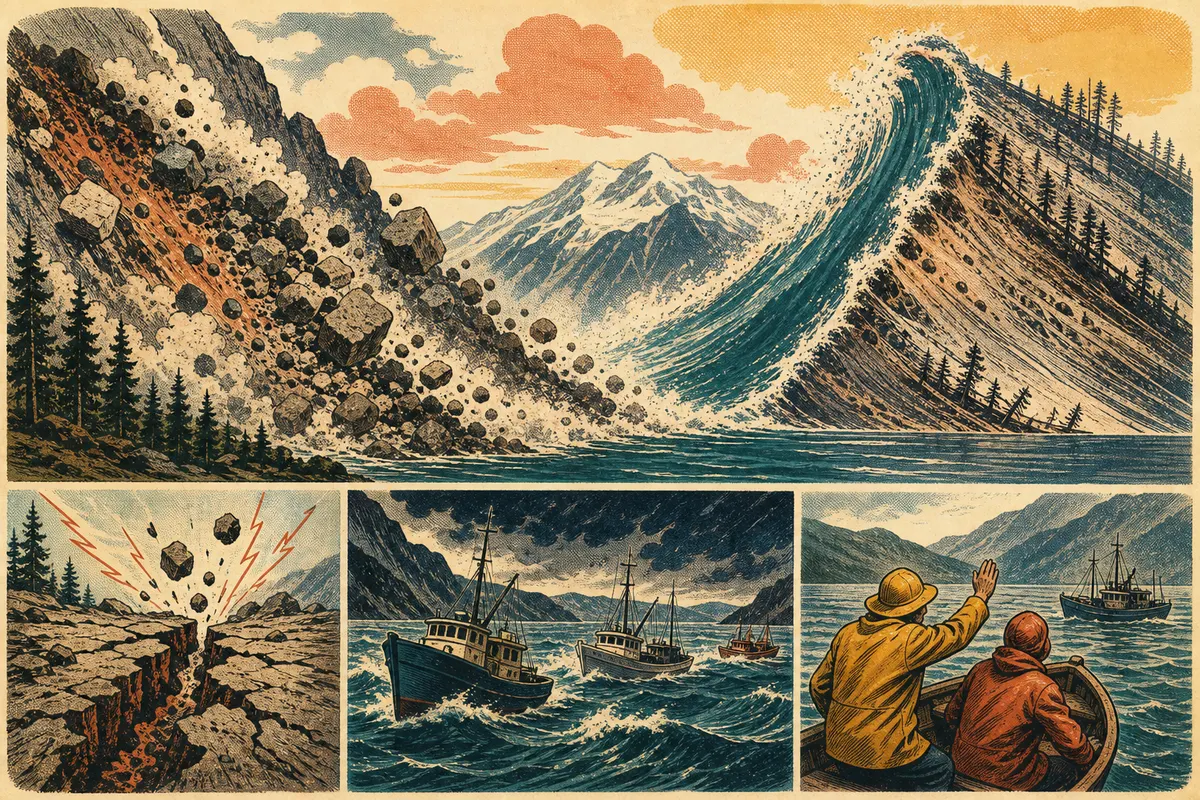
On the evening of 10 July 1958, three fishing boats were anchored in Lituya Bay, a remote inlet on the Alaskan coast. It was, by all accounts, a quiet summer night. Then a magnitude 7.9 earthquake struck, ninety million tons of rock collapsed into the bay, and the water did something science had not yet properly imagined.

The wave that followed surged 1,720 feet up the mountainside on the opposite shore, stripping trees and soil in one catastrophic pass. That is not a misprint: 1,720 feet. Two of the three fishing crews in the bay that night survived. The crew of the Sunmore, Orville and Mickey Wagner, did not.

What happened in Lituya Bay permanently redefined what geologists and coastal scientists believed water was physically capable of doing. The event remains the defining case study in megatsunami research and continues to shape how coastal hazards are modelled today. It is the sort of thing that makes you reconsider the phrase “safe harbour” entirely.

Also on this date

Ten July is, it turns out, a date with a habit of making history in the most inconvenient ways possible.

In 1985, French intelligence agents bombed the Greenpeace vessel Rainbow Warrior while it was moored in Auckland Harbour, New Zealand. Photographer Fernando Pereira was killed in the attack. Two agents were arrested and convicted. France initially denied any involvement, then admitted it. The word “scandal” barely covers it; the phrase “state-sponsored terrorism” was used, and not without cause.

Then, in 2018, the final four members of a Thai youth football team emerged from the Tham Luang cave system after 18 days trapped underground. Twelve boys and their assistant coach had been caught by flooding on 23 June. An international rescue operation involving specialist cave divers, sedation, and round-the-clock engineering brought all 13 out alive. Thai Navy SEAL Saman Kunan died during the effort. It remains one of the most remarkable rescue operations of the century.

Three stories, three completely different ways history can arrive: as a wall of water, as a state secret that refused to stay secret, and as something that, against all reasonable odds, ends well. Today’s episode unpacks all three, and it is ten minutes you will not regret.

In this episode

  • Introduction Clara sets the scene in Lituya Bay, Alaska, where a calm summer evening in 1958 turned into the most extreme recorded wave event in human history.
  • The 1958 Lituya Bay Megatsunami A magnitude 7.9 earthquake triggered a rockslide that sent 90 million tons of material into Lituya Bay, creating a wave that surged 1,720 feet up the opposite mountainside. Three fishing boats were in the bay that night. Two crews survived. The Sunmore and its crew, Orville and Mickey Wagner, were lost. The event redefined megatsunami science and changed how geologists assess coastal hazards.
  • The Sinking of the Rainbow Warrior On 10 July 1985, French intelligence agents bombed the Greenpeace vessel Rainbow Warrior in Auckland Harbour, killing photographer Fernando Pereira. Two agents were arrested and convicted. France initially denied involvement, then admitted it. The incident was condemned internationally as state-sponsored terrorism.
  • The Tham Luang Cave Rescue On 10 July 2018, the final four boys and their coach emerged from the Tham Luang cave system in northern Thailand after 18 days trapped underground. Twelve boys and their assistant coach had been caught by flooding on 23 June. An international rescue effort involving specialist cave divers, sedation, and round-the-clock engineering brought all 13 out alive. Thai Navy SEAL Saman Kunan died during the operation.
  • Closing Thoughts Clara reflects on a day that brought a wave that rewrote science, a covert operation that failed to stay secret, and a rescue that defied the odds. History arrives in many forms, reminding us the world is larger, stranger, and more fragile than we anticipate.

Sources

More from the archive

7 min

Collision of the Unexpected: Trump, Vigdís, and Kelston's Ingenuity

In this episode of The Daily Time Drop, host Clare Vale unravels a tapestry of global historical moments that reveal the unpredictable dance between human endeavour and fate. We begin with former US President Donald Trump’s third indictment in 2023, a significant event intertwining political accountability and democratic principles. The discussion then shifts to 1980, where Vigdís Finnbogadóttir’s election as Iceland’s President marked a breakthrough for gender equality, inspiring communities worldwide. The launch of Microsoft Office in 1989 is highlighted as a pivotal moment that revolutionised productivity and digital working environments. Closing with a story from 2014, Clare explores the Kelston toll road, a symbol of community action and creative solutions. Each story underscores the power of human agency and the enduring impact of leadership, innovation, and collective action.

Read & listen →
4 min

Moon Crashes and Floral Penalties

In this episode of The Daily Time Drop, host Clara Vale explores two intriguing stories of human ambition and unexpected results. First, we delve into NASA’s audacious 1999 mission to crash the Lunar Prospector into the Moon—a planned cosmic collision intended to reveal hidden mysteries. Despite the dramatic impact, the hoped-for evidence of water ice remained elusive. Then, travel back to 1703 to witness how Daniel Defoe, the famous author of ‘Robinson Crusoe’, faced public punishment for his biting satire. Intended to be a spectacle of shame, Defoe’s pillory became an inspired moment when the crowd showered him with flowers instead of insults. Join us as we examine these tales of scientific daring and literary defiance, underscoring the unpredictable nature of human endeavours.

Read & listen →
5 min

Echoes of Extinction: The Pyrenean Ibex's Brief Return

Join Clara Vale on The Daily Time Drop as she unravels a tapestry of intriguing historical moments. Discover the extraordinary tale of the Pyrenean ibex, a species that defied extinction only to face it again. Step into the vibrant energy of Tomorrowland, where Charlotte de Witte’s groundbreaking performance changed the face of techno music. Bid adieu to the classic Volkswagen Beetle, an automotive icon whose journey ended in 2003. Finally, witness Lisa Leslie’s historic slam dunk in the Women’s National Basketball Association, a defining moment that challenged perceptions of women in sport. Through these stories, Clara invites us to reflect on human ingenuity, nature’s unpredictability, and the ever-present dance with overconfidence.

Read & listen →