On this day · 6 July 2026

The Monument That Vanished and a Message Still Travelling to the Stars

· 12 min

The Monument That Vanished and a Message Still Travelling to the Stars

Listen to this episode

12 min

These stories span centuries and remind us how messages, whether carved in stone or sent into space, can reverberate through time, sparking debate and reflection.

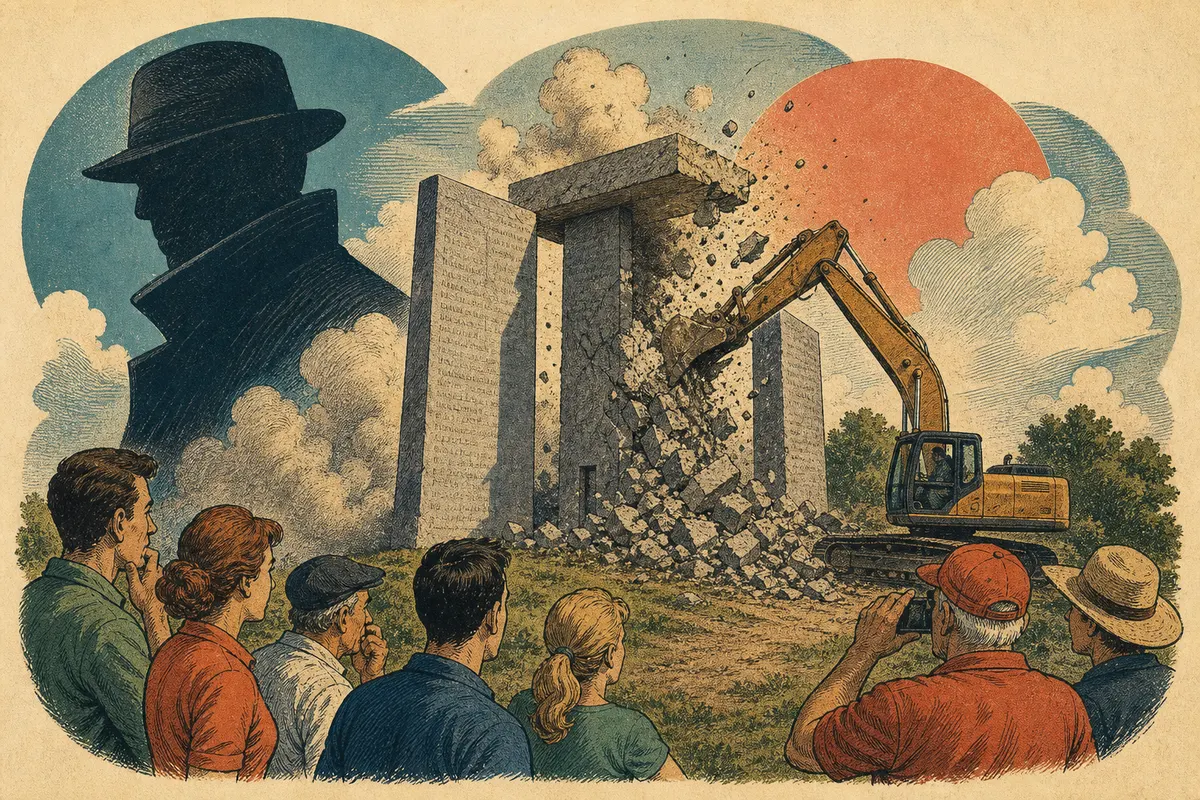
It’s not every day a granite monument gets blown up and subsequently erased from the landscape. On 6 July 2022, the Georgia Guidestones—an enigmatic structure bearing mysterious inscriptions—met its abrupt end. Built in 1980 by an anonymous individual known only as R.C. Christian, it presided over four decades of speculation and conspiracy theories. Were its guidelines for rebuilding civilisation post-apocalypse a generous gift or a chilling warning? The debate was as enduring as the granite itself. With its sudden destruction, the mysteries echo on, leaving no physical trace but plenty of intrigue.

Meanwhile, a message of a different kind floats in the vast expanse of space. On 6 July 2003, Ukraine’s Yevpatoria Planetary Radar sent Cosmic Call 2 toward five stars, a communication that won’t arrive until at least 2036. Part of the METI initiative, this venture had scientists divided: an inspired attempt to connect with extraterrestrial life or a reckless shot in the dark. Regardless, the message continues its lonely voyage, a testament to human curiosity and our desire to reach beyond our terrestrial confines.

Acts of Courage Amidst Catastrophe

If we’re seeking messages with impact closer to home, here’s one delivered during the Black Death: on 6 July 1348, Pope Clement VI issued a papal bull from Avignon. This daring declaration sought to protect Jewish communities from misplaced blame for the plague’s devastation. A rare moment of moral clarity in a shadowy time, it was a reminder that not everything lost its sanity in the throes of a pandemic.

Finally, we sail back to 1411, when Admiral Zheng He returned to Nanjing from a treasury-laden voyage to the west. A fleet that dwarfed those of Columbus, it heralded China’s maritime prowess, though records and ambitions were curtailed soon after. With tales of capturing a reluctant Sri Lankan king, it highlights the era’s bold exploration before China’s introspective turn.

These stories from 6 July showcase humanity’s timeless inclination to communicate, explore, and assert justice. By exploring them, we uncover the whispered messages and bold statements threaded through history, still reverberating in our modern world. Each tale leaves us with questions, a hallmark of history’s enduring narrative. Listen to this episode to discover which mysteries captivate you most.

In this episode

  • Intro A monument in rural Georgia sparked decades of debate before being bombed and demolished on 6 July 2022. Clara introduces today’s stories: an anonymous granite mystery, a message to the stars, a courageous pope, and an admiral’s triumphant return.
  • The Georgia Guidestones: America’s Most Controversial Granite In 1980, a man calling himself R.C. Christian commissioned a massive granite monument in Elbert County, Georgia, inscribed with ten guidelines for rebuilding civilisation. For 42 years it stood, attracting tourists and conspiracy theorists alike. On 6 July 2022, an explosion destroyed part of it, and authorities demolished the rest within hours. The bomber was never formally charged, and the monument’s true creators remain unknown.
  • Cosmic Call 2: A Message in a Bottle, But the Bottle is a Radio Wave On 6 July 2003, Ukraine’s Yevpatoria Planetary Radar transmitted Cosmic Call 2 towards five stars. The messages, travelling at light speed, are due to arrive between 2036 and 2049. The transmission was part of METI (Messaging Extraterrestrial Intelligence), an approach some scientists support and others consider reckless. The messages are still in transit.
  • Pope Clement VI and the Courage of a Papal Bull On 6 July 1348, during the Black Death, Pope Clement VI issued a papal bull from Avignon defending Jewish communities against accusations of causing the plague. He stated clearly that Jews were also dying and ordered Christians to stop the persecution. Though violence continued in some regions, his moral stance during a continental catastrophe stands as a significant historical act.
  • Zheng He’s Return: The Admiral Who Came Home with a King On 6 July 1411, Admiral Zheng He returned to Nanjing from his third treasure voyage, bringing the captured king of Kotte (Sri Lanka) after a military confrontation. The Ming dynasty’s treasure voyages were among the largest maritime expeditions in history, reaching East Africa and the Persian Gulf. The fleets were later discontinued, and many records were destroyed, marking a turning point in global exploration history.
  • Outro Clara reflects on a day of unanswered questions: a secret monument now gone, a message still travelling through space, a pope who took a stand, and an admiral’s extraordinary homecoming. History often leaves mysteries in its wake.

Sources

More from the archive

7 min

Collision of the Unexpected: Trump, Vigdís, and Kelston's Ingenuity

In this episode of The Daily Time Drop, host Clare Vale unravels a tapestry of global historical moments that reveal the unpredictable dance between human endeavour and fate. We begin with former US President Donald Trump’s third indictment in 2023, a significant event intertwining political accountability and democratic principles. The discussion then shifts to 1980, where Vigdís Finnbogadóttir’s election as Iceland’s President marked a breakthrough for gender equality, inspiring communities worldwide. The launch of Microsoft Office in 1989 is highlighted as a pivotal moment that revolutionised productivity and digital working environments. Closing with a story from 2014, Clare explores the Kelston toll road, a symbol of community action and creative solutions. Each story underscores the power of human agency and the enduring impact of leadership, innovation, and collective action.

Read & listen →
4 min

Moon Crashes and Floral Penalties

In this episode of The Daily Time Drop, host Clara Vale explores two intriguing stories of human ambition and unexpected results. First, we delve into NASA’s audacious 1999 mission to crash the Lunar Prospector into the Moon—a planned cosmic collision intended to reveal hidden mysteries. Despite the dramatic impact, the hoped-for evidence of water ice remained elusive. Then, travel back to 1703 to witness how Daniel Defoe, the famous author of ‘Robinson Crusoe’, faced public punishment for his biting satire. Intended to be a spectacle of shame, Defoe’s pillory became an inspired moment when the crowd showered him with flowers instead of insults. Join us as we examine these tales of scientific daring and literary defiance, underscoring the unpredictable nature of human endeavours.

Read & listen →
5 min

Echoes of Extinction: The Pyrenean Ibex's Brief Return

Join Clara Vale on The Daily Time Drop as she unravels a tapestry of intriguing historical moments. Discover the extraordinary tale of the Pyrenean ibex, a species that defied extinction only to face it again. Step into the vibrant energy of Tomorrowland, where Charlotte de Witte’s groundbreaking performance changed the face of techno music. Bid adieu to the classic Volkswagen Beetle, an automotive icon whose journey ended in 2003. Finally, witness Lisa Leslie’s historic slam dunk in the Women’s National Basketball Association, a defining moment that challenged perceptions of women in sport. Through these stories, Clara invites us to reflect on human ingenuity, nature’s unpredictability, and the ever-present dance with overconfidence.

Read & listen →