On this day · 5 July 2026

The Staffordshire Hoard and the Stolen Codex Calixtinus

· 10 min

The Staffordshire Hoard and the Stolen Codex Calixtinus

Listen to this episode

10 min

The Staffordshire Hoard alone transformed what historians thought they knew about early medieval England's warrior culture, and the Codex Calixtinus case is a reminder that irreplaceable things can disappear from right under our noses. Both stories turn on the same question: what does it mean when something precious vanishes, and what do we recover when it comes back.

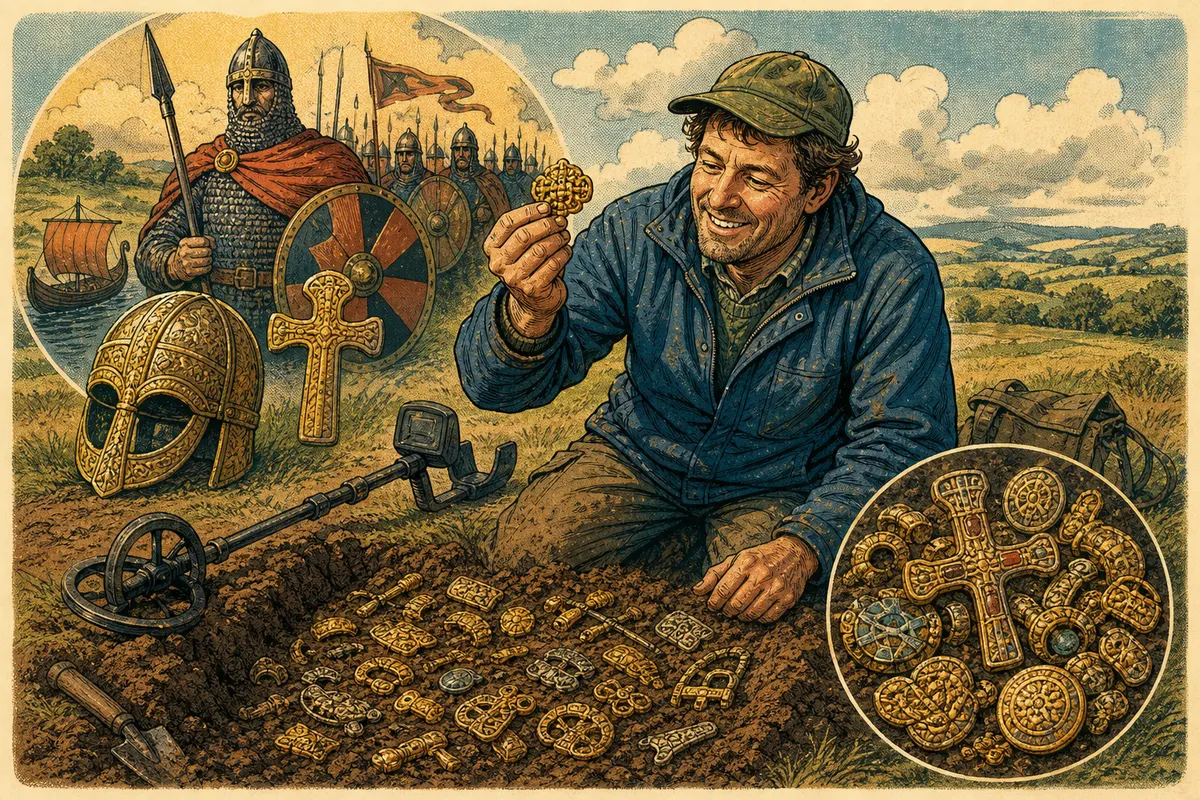
Terry Herbert’s metal detector cost him £2.50. It was second-hand. On 5 July 2009, it made him a millionaire.

Over five days of searching a Staffordshire field near Lichfield, Herbert unearthed more than 1,500 pieces of Anglo-Saxon gold and silver: the largest hoard of its kind ever found in Britain. The field sat in the heart of ancient Mercia, the early medieval warrior kingdom that dominated central England. What came out of the ground was not jewellery or coins but objects of war, sword fittings, helmet fragments, military equipment of humbling craftsmanship, most likely war loot taken from defeated enemies.

What Was It Worth?

The hoard was valued at £3.285 million and split between Herbert and Fred Johnson, the farmer who owned the land. Beyond the money, the find fundamentally shifted historical understanding of Anglo-Saxon England, revealing a sophisticated warrior culture that scholarship had not fully appreciated.

It is the sort of discovery that makes you wonder what else is sitting quietly in a field somewhere, waiting for the right person and a bargain detector.

Meanwhile, in Santiago

Exactly two years to the day, on 5 July 2011, staff at Santiago de Compostela Cathedral in Spain noticed something was missing. The Codex Calixtinus, a twelfth-century illuminated manuscript compiled around 1160, had vanished. This was not a minor inconvenience: the Codex is considered the world’s first guidebook to the Camino pilgrimage route, and it is entirely irreplaceable.

The investigation that followed led to the arrest of a cathedral electrician, Manuel Fernández Castiñeiras, who had stolen the manuscript along with other treasures. The Codex was recovered in 2012. In 2015, Castiñeiras received a ten-year prison sentence, and the manuscript was returned to Santiago under considerably tighter security.

Two Kinds of Lost

The pleasure of this episode is in the contrast. One treasure was buried for over a millennium before a man with a second-hand machine pulled it back into the light. The other was gone for less than a year before a very different kind of investigation brought it home. Both are stories about what happens to precious things when they disappear, and what their return reveals, about history, about human ingenuity, and about the occasionally very poor judgement of the people put in charge of looking after things.

If the fifth of July has ever seemed like an unremarkable date, this episode will change that. Ten minutes, two stories, and considerably more than £2.50 worth of history.

In this episode

  • Intro Clara introduces the extraordinary discovery made on 5 July 2009, when Terry Herbert unearthed the greatest Anglo-Saxon treasure ever found in a Staffordshire field.
  • The Staffordshire Hoard Terry Herbert’s five days of discovery unfold in detail: using a £2.50 detector near Lichfield in the heart of ancient Mercia, he found over 1,500 pieces of Anglo-Saxon gold and silver military equipment. The hoard, likely war loot from defeated enemies, contained sword fittings and helmet fragments of humbling craftsmanship. Valued at £3.285 million and split between Herbert and farmer Fred Johnson, the discovery fundamentally shifted historical understanding of Anglo-Saxon England’s sophisticated warrior culture.
  • The Theft of the Codex Calixtinus On 5 July 2011, the twelfth-century Codex Calixtinus vanished from Santiago de Compostela Cathedral. The illuminated manuscript, the world’s first Camino pilgrimage guidebook compiled around 1160, was recovered in 2012 after cathedral electrician Manuel Fernández Castiñeiras was arrested. He received a ten-year sentence in 2015, and the irreplaceable manuscript was returned to the cathedral under tighter security.
  • Outro Clara reflects on the contrasting stories of burial and discovery: treasure hidden for over a millennium versus treasure stolen and recovered within a year, both revealing different aspects of human memory and secrecy.

Sources

More from the archive

7 min

Collision of the Unexpected: Trump, Vigdís, and Kelston's Ingenuity

In this episode of The Daily Time Drop, host Clare Vale unravels a tapestry of global historical moments that reveal the unpredictable dance between human endeavour and fate. We begin with former US President Donald Trump’s third indictment in 2023, a significant event intertwining political accountability and democratic principles. The discussion then shifts to 1980, where Vigdís Finnbogadóttir’s election as Iceland’s President marked a breakthrough for gender equality, inspiring communities worldwide. The launch of Microsoft Office in 1989 is highlighted as a pivotal moment that revolutionised productivity and digital working environments. Closing with a story from 2014, Clare explores the Kelston toll road, a symbol of community action and creative solutions. Each story underscores the power of human agency and the enduring impact of leadership, innovation, and collective action.

Read & listen →
4 min

Moon Crashes and Floral Penalties

In this episode of The Daily Time Drop, host Clara Vale explores two intriguing stories of human ambition and unexpected results. First, we delve into NASA’s audacious 1999 mission to crash the Lunar Prospector into the Moon—a planned cosmic collision intended to reveal hidden mysteries. Despite the dramatic impact, the hoped-for evidence of water ice remained elusive. Then, travel back to 1703 to witness how Daniel Defoe, the famous author of ‘Robinson Crusoe’, faced public punishment for his biting satire. Intended to be a spectacle of shame, Defoe’s pillory became an inspired moment when the crowd showered him with flowers instead of insults. Join us as we examine these tales of scientific daring and literary defiance, underscoring the unpredictable nature of human endeavours.

Read & listen →
5 min

Echoes of Extinction: The Pyrenean Ibex's Brief Return

Join Clara Vale on The Daily Time Drop as she unravels a tapestry of intriguing historical moments. Discover the extraordinary tale of the Pyrenean ibex, a species that defied extinction only to face it again. Step into the vibrant energy of Tomorrowland, where Charlotte de Witte’s groundbreaking performance changed the face of techno music. Bid adieu to the classic Volkswagen Beetle, an automotive icon whose journey ended in 2003. Finally, witness Lisa Leslie’s historic slam dunk in the Women’s National Basketball Association, a defining moment that challenged perceptions of women in sport. Through these stories, Clara invites us to reflect on human ingenuity, nature’s unpredictability, and the ever-present dance with overconfidence.

Read & listen →