These tales remind us that concepts like time and reality are malleable, shaped by human needs and creativity.
What do a nation hopping across time and a whimsical boat trip have in common? A startling reminder that the foundations of our world are more pliable than we often dare to admit.
Samoa’s Time-Bending Monday
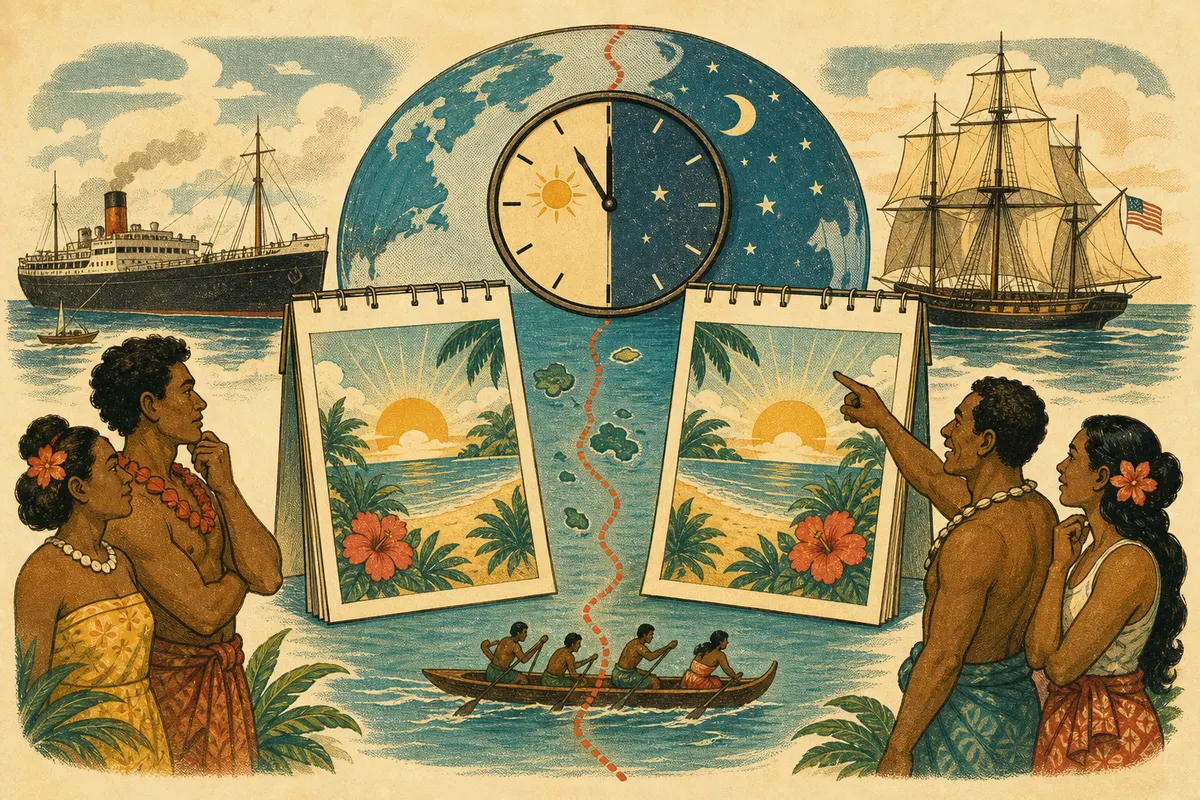
On 4 July 1892, Samoa performed a splendid temporal pirouette by repeating an entire day. This was no clerical error, but a deliberate manoeuvre designed to match time zones with American trade partners, yielding a calendar year boasting 367 days. The International Date Line wasn’t always the fixed barrier we think of today: Samoa’s dance with time would later reverse in 2011, when it skipped a day to cosy up to Australia and New Zealand. A reminder that our calendars are tools, not bosses.
Carroll’s Golden Afternoon
Meanwhile, half a globe and three decades back, Charles Dodgson took young Alice Liddell and her sisters on an imaginative Thames journey. This 1862 outing birthed the fantastical world of Wonderland, scribbled as a gift and later published under the now-legendary pseudonym Lewis Carroll. Dodgson’s friendship with the Liddells added colour to one of literature’s most enduring artworks, a manuscript that now rests in the British Library after its own curious journey.
The Flexibility of Certainties
Two years, two July afternoons, one enchanting theme: the elasticity of what we deem unchangeable. Both a Pacific island altering its alignment and a Victorian storyteller weaving a timeless tale demonstrate human creativity’s capacity to remodel reality and redefine logic. Time, much like Alice’s rabbit hole, can twist and turn, defying expectations as we chart our path.
Join me on today’s episode of The Daily Time Drop as we traverse Samoa’s doubled Monday and Carroll’s Wonderland creation. Explore how these fascinating historical detours show that sometimes, just sometimes, reality is ours to shape. Perfect with a cup of tea or, perhaps, a mad hatter’s brew.