History rarely sticks to one register. The fact that Larry Walters and the Asian financial crisis share a calendar date is a small reminder that the record contains every possible scale of human experience at once, and that is worth sitting with.
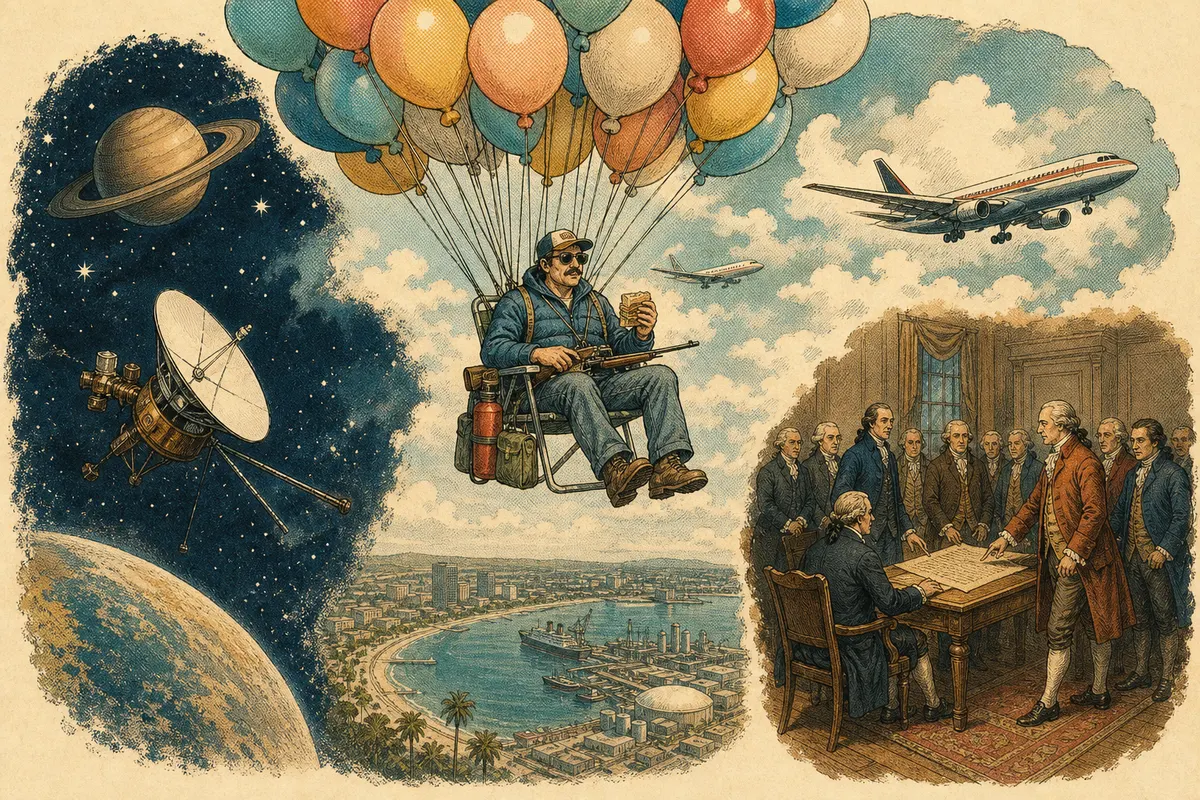
On the second of July 1982, a Los Angeles truck driver named Larry Walters attached forty-two helium weather balloons to a lawn chair, climbed in with a pellet gun and some sandwiches, and accidentally became an aviation incident.
That sentence is entirely true. Not a word of it is embellished.
The Man, the Chair, the Fifteen Thousand Feet
Larry had a dream to fly. He also had a plan, which is not quite the same thing as a good plan. Instead of drifting gently at low altitude as presumably intended, he shot up to fifteen thousand feet and found himself floating through commercial airline airspace over Long Beach. Airline pilots spotted him. He was, one imagines, not easy to miss.
He eventually descended, came down into power lines, and was arrested. The FAA fined him as well, which feels like adding a very particular kind of insult to injury. It is difficult to read this story without grinning, and harder still not to admire the sheer commitment involved in getting that far.
Meanwhile, in Rogers, Arkansas
Exactly twenty years earlier, on 2 July 1962, Sam Walton opened the first Walmart in Rogers, Arkansas. His reasoning was straightforward: smaller towns were underserved by discount retail. He was right, in a way that quietly restructured the entire shape of global commerce. That one shop grew into the largest company in the world by revenue. History has a habit of making modest beginnings look hilarious in retrospect.
And Then There Was the Baht
On the same date in 1997, Thailand made a very different kind of decision. The government abandoned the baht’s peg to the US dollar, and the resulting currency collapse spread rapidly across Southeast Asia. Millions lost jobs and savings. IMF bailouts followed. The consequences reshaped economies across the region and left a long political shadow. It is the sort of event that looks, in hindsight, like a single thread being pulled from an extremely large jumper.
Three stories, one date: one absurd and human and ultimately survivable, one quietly enormous, one genuinely catastrophic. The second of July is a good argument for never assuming history has a consistent mood.
The full episode runs ten minutes and tells all three stories with the details that make them stranger and more real. It is worth your commute.