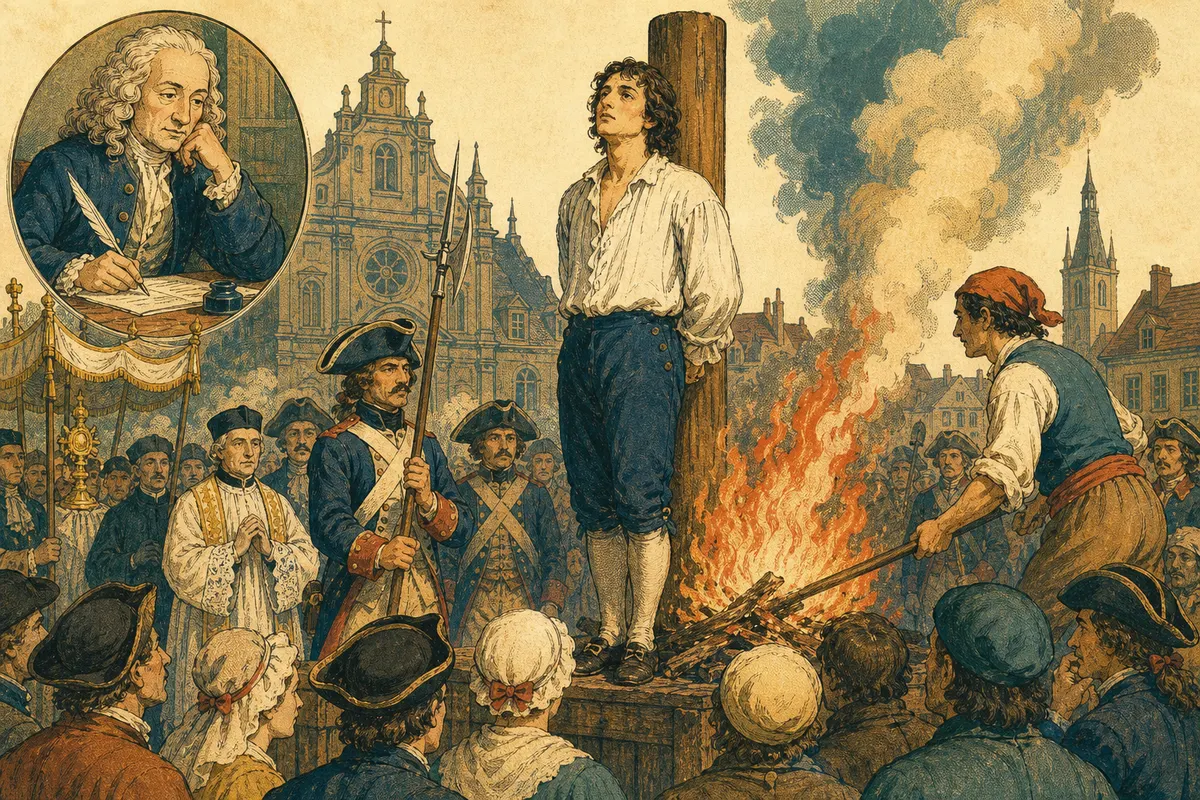
François-Jean de la Barre's story is a chilling example of the dangers of religious intolerance and a powerful testament to the enduring quest for freedom of thought.
There’s something fiendishly curious about a hat that could upset an entire institutional system, isn’t there? On 1 July 1766, a young French nobleman, François-Jean de la Barre, inadvertently found himself at the centre of a storm over religious conformity. And all because he wouldn’t remove his hat during a religious procession. His unfortunate decision led to his grizzly execution in the town square of Abbeville, forever marking him in history as a cautionary tale of intolerance.
De la Barre’s story didn’t only provoke public horror: it sparked Voltaire’s outrage and highlighted the stranglehold of religious orthodoxy over the French Enlightenment’s budding ideals. Owned possession of Voltaire’s controversial text, the Dictionnaire philosophique, added fuel to the fire; the book was posthumously nailed to his body as a high-profile gesture of condemnation. What transpired was not just the execution of a young man for a perceived slight but a dramatic demonstration of the period’s brutal enforcement of religious adherence.
Yet history is rarely flat. In our episode, we also visit other significant snapshots from history on this date. In 1770, Lexell’s Comet brushed closer to Earth than any other comet recorded before or since. Its unexpected close approach followed by a disappearance hints at the ephemeral nature of cosmic visitors.
Fast forward to 1109: Queen Urraca of León, a remarkably resilient figure who, despite facing fierce opposition, became Europe’s first woman to rule a kingdom independently. Her legacy showcased the complexities of power dynamics and gender politics in medieval Europe.
Lastly, an astronomical curiosity surfaced again on 1 July 2025 with the discovery of 3I/ATLAS, the third known interstellar object. As we unravel mysteries of the cosmos, each such event challenges us to exist beyond the confines of our world and perceptions.
So why does François-Jean de la Barre still matter? His tragically short life and the barbarity of his fate serve as stark reminders of the treacherous edge that lies between orthodoxy and free thought. His legacy underscores the Enlightenment’s ongoing arguments for reform and the ever-important pursuit of intellectual freedom. Tune in for a story woven with moments that push the boundaries of human understanding, from oppressive devotions to celestial dances far beyond our reach. Come for the history, stay for the ripples it continues to make today.