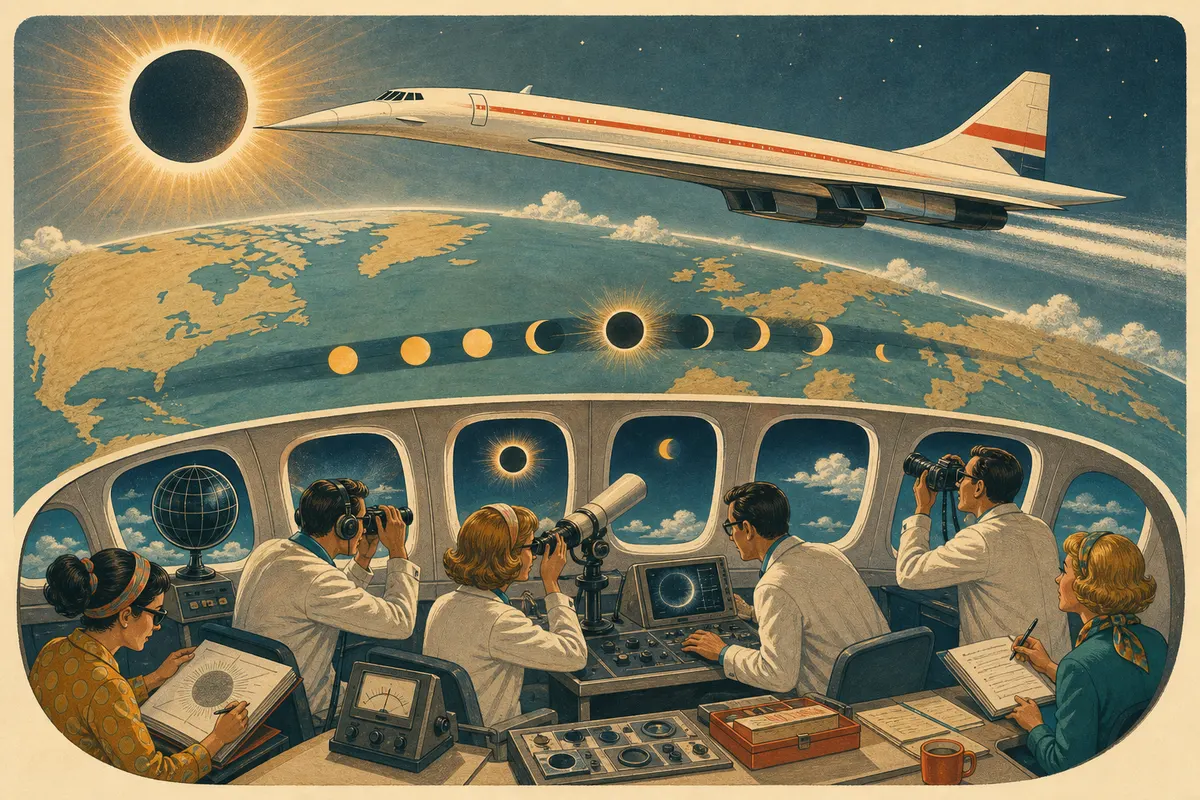
The 1973 Concorde eclipse chase is a reminder that scientific ambition and the right aircraft, arriving at exactly the same moment, can turn a seven-minute window into 74. It sits alongside stories of recklessness, royal folly, and the ongoing cost of visibility, making 30 June a quietly remarkable date.
If a total solar eclipse only lasts seven minutes, you have two choices: accept that, or charter a supersonic jet and follow it.
On 30 June 1973, a team of astronomers aboard Concorde 001 chose the second option. Flying at Mach 2 over the Atlantic, they stayed inside the moon’s shadow for 74 minutes, gathering data on the solar corona that simply could not have been collected any other way. At the time, it was the longest continuous eclipse observation ever recorded.
Chasing the Shadow
The aircraft was the French Concorde prototype, Concorde 001. The logic was elegant: the moon’s shadow moves fast, but Concorde moved faster. By matching the shadow’s speed at twice the speed of sound, the scientists on board effectively held the eclipse open for over an hour, rather than watching it close after seven minutes.
The data gathered on the solar corona, the sun’s outer atmosphere, was unprecedented. You do not get 74 minutes of that on a blanket in a field.
Everything Else That Happened on 30 June
This date has form. In 1859, French acrobat Charles Blondin crossed Niagara Gorge on a 335-metre tightrope, which is exactly as alarming as it sounds, and was apparently just the beginning of a career of increasingly audacious stunts above the falls.
In 1559, King Henry II of France was fatally wounded during a celebratory joust in Paris. His death reshaped the French succession and brought royal jousting to an end. Possibly a reasonable response.
And in 2005, a knife attack at the Jerusalem Pride march injured three people. The same attacker struck again in 2015, killing 16-year-old Shira Banki. This episode pauses on that, and on what it costs to simply show up when visibility carries a price.
Worth Ten Minutes of Your Time
The episode weaves all of this together: brilliance, recklessness, bravery, and the very human impulse to chase shadows at twice the speed of sound. The full episode is ten minutes. The eclipse lasted 74. The maths are very much in your favour.