On this day · 29 June 2026

The Tornado That Erased Mansions and the Wax Cylinder That Caught History

· 10 min

The Tornado That Erased Mansions and the Wax Cylinder That Caught History

Listen to this episode

10 min

Both stories are quiet reminders that significance is usually assigned in retrospect: a catastrophe can vanish from memory, and a novelty can turn out to be irreplaceable. History does not always come with a label.

The 29th of June has a lot to answer for.

In 1764, it sent one of the most violent tornadoes in recorded history barrelling through a small German town called Woldegk, with wind speeds estimated at over 300 miles per hour. In 1888, it handed a man named George Gouraud a wax cylinder and a machine that could catch sound, right at the moment a London choir was singing Handel. Neither event knew it was being historical. That is, frankly, their best quality.

The Tornado Nobody Quite Had Words For

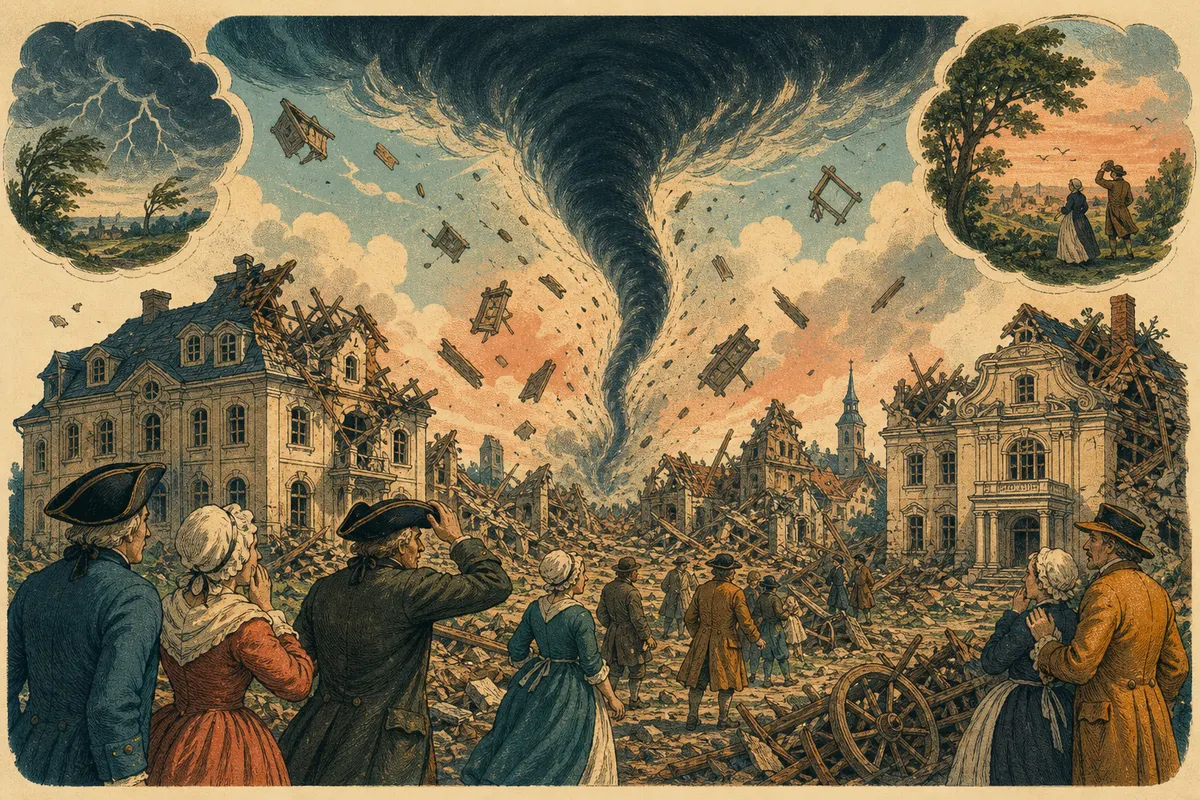
On 29 June 1764, a tornado struck Woldegk in northeastern Germany with enough force to level grand mansions across the flat, open countryside. Wind speeds have been estimated at over 300 miles per hour, placing it among the most violent tornadoes ever documented. Remarkably, only one person was killed.

The event was largely forgotten. Tornadoes are associated with the American Midwest in popular imagination, but they occur across Europe too, and catastrophic moments do not always leave the kind of paperwork that survives. The people of Woldegk in 1764 also had something of a vocabulary problem: nobody quite had the words for what had just happened to them.

The Evening Someone Accidentally Preserved History

On the same date in 1888, George Gouraud attended a performance of Handel’s Israel in Egypt at London’s Crystal Palace. He brought along Edison’s newly invented phonograph, and he recorded part of what he heard.

The resulting wax cylinder became one of the earliest known recordings of a live musical performance. Gouraud was not trying to create a historical document: he was demonstrating a piece of new technology, the Victorian equivalent of filming something on your phone because it seemed interesting. The recording survived wars and decades of archive management to become a fragile, crackling link to a June evening over 130 years ago.

What History Looks Like Before It Knows It Is History

Both events happened on the same date, 124 years apart. One was a catastrophe that reshaped a landscape and then slipped from collective memory. The other was a novelty that turned into something irreplaceable.

Neither announced itself as significant at the time. That is, in a strange way, reassuring. History is not always the thing with the trumpets.

This episode is ten minutes. It is well worth your morning coffee.

In this episode

  • Introduction A small German town, a violent event moving at over 300 miles per hour, and the problem of describing something in 1764 when nobody had the words for it yet.
  • The Woldegk Tornado of 1764 On 29 June 1764, one of the strongest tornadoes in recorded history struck Woldegk in northeastern Germany, with wind speeds exceeding 300 miles per hour. It levelled grand mansions across flat, open country but killed only one person. The event was largely forgotten, a reminder that tornadoes occur across Europe and that catastrophic moments do not always announce their own significance.
  • Listener Call to Action An invitation to follow the show and share it with curious friends who enjoy odd history with their morning coffee.
  • George Gouraud and the Oldest Recording of Music On 29 June 1888, George Gouraud attended a performance of Handel’s Israel in Egypt at London’s Crystal Palace and recorded it using Edison’s phonograph. That wax cylinder became one of the earliest known recordings of a live musical performance. Gouraud was demonstrating new technology, not creating a historical document, but the recording survived wars and decades to become a fragile link to a June evening over 130 years ago.
  • Closing Thoughts Two moments from 29 June, separated by 124 years. One a catastrophe, the other a novelty. Both took time to be recognised for what they were: history that did not announce itself.

Sources

More from the archive

7 min

Collision of the Unexpected: Trump, Vigdís, and Kelston's Ingenuity

In this episode of The Daily Time Drop, host Clare Vale unravels a tapestry of global historical moments that reveal the unpredictable dance between human endeavour and fate. We begin with former US President Donald Trump’s third indictment in 2023, a significant event intertwining political accountability and democratic principles. The discussion then shifts to 1980, where Vigdís Finnbogadóttir’s election as Iceland’s President marked a breakthrough for gender equality, inspiring communities worldwide. The launch of Microsoft Office in 1989 is highlighted as a pivotal moment that revolutionised productivity and digital working environments. Closing with a story from 2014, Clare explores the Kelston toll road, a symbol of community action and creative solutions. Each story underscores the power of human agency and the enduring impact of leadership, innovation, and collective action.

Read & listen →
4 min

Moon Crashes and Floral Penalties

In this episode of The Daily Time Drop, host Clara Vale explores two intriguing stories of human ambition and unexpected results. First, we delve into NASA’s audacious 1999 mission to crash the Lunar Prospector into the Moon—a planned cosmic collision intended to reveal hidden mysteries. Despite the dramatic impact, the hoped-for evidence of water ice remained elusive. Then, travel back to 1703 to witness how Daniel Defoe, the famous author of ‘Robinson Crusoe’, faced public punishment for his biting satire. Intended to be a spectacle of shame, Defoe’s pillory became an inspired moment when the crowd showered him with flowers instead of insults. Join us as we examine these tales of scientific daring and literary defiance, underscoring the unpredictable nature of human endeavours.

Read & listen →
5 min

Echoes of Extinction: The Pyrenean Ibex's Brief Return

Join Clara Vale on The Daily Time Drop as she unravels a tapestry of intriguing historical moments. Discover the extraordinary tale of the Pyrenean ibex, a species that defied extinction only to face it again. Step into the vibrant energy of Tomorrowland, where Charlotte de Witte’s groundbreaking performance changed the face of techno music. Bid adieu to the classic Volkswagen Beetle, an automotive icon whose journey ended in 2003. Finally, witness Lisa Leslie’s historic slam dunk in the Women’s National Basketball Association, a defining moment that challenged perceptions of women in sport. Through these stories, Clara invites us to reflect on human ingenuity, nature’s unpredictability, and the ever-present dance with overconfidence.

Read & listen →