On this day · 25 June 2026

The Woman Who Made History in a Cathedral Full of Witnesses

· 11 min

The Woman Who Made History in a Cathedral Full of Witnesses

Listen to this episode

11 min

Elena Cornaro Piscopia's story is a reminder that the gatekeepers do not always win, even when they manage to redirect you. The fact that it took three decades for another woman to follow her tells the other half of that story.

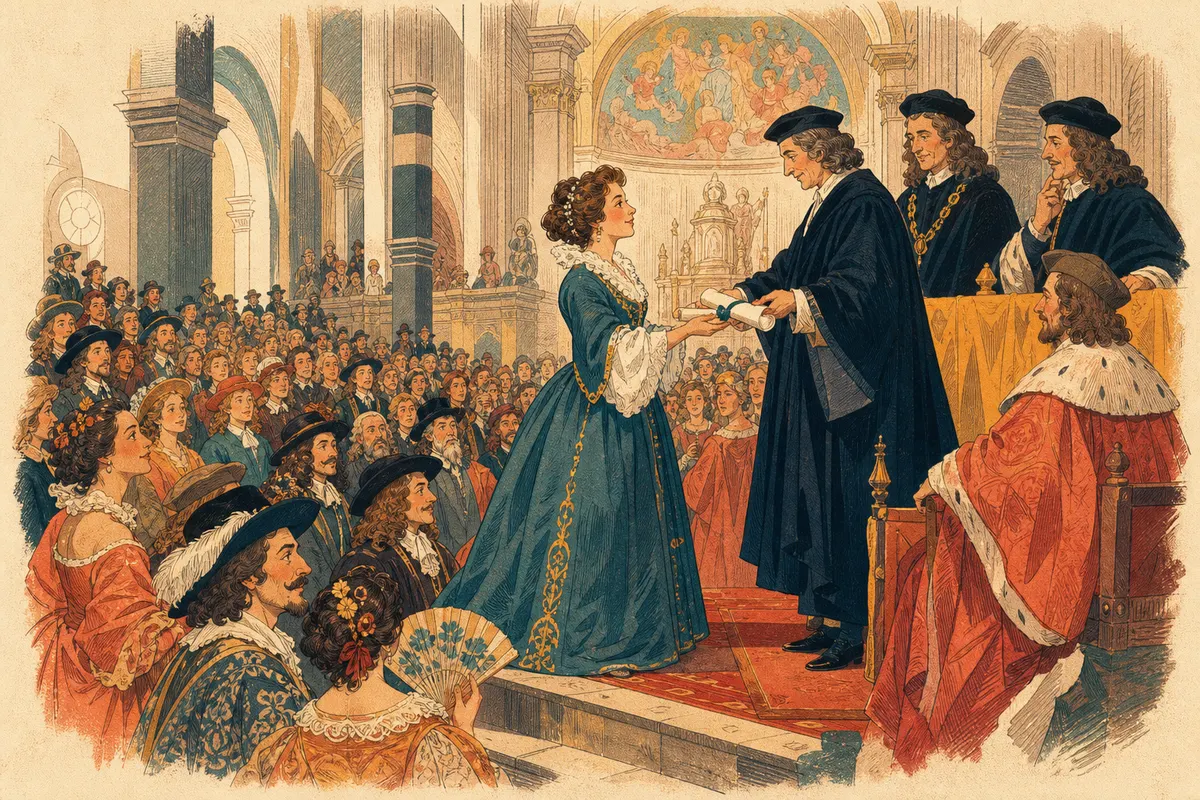
When your graduation is so well-attended that the university has to move it to a cathedral, you have done something genuinely unprecedented. On 25 June 1678, Elena Cornaro Piscopia became the first woman in recorded history to be awarded a doctorate of philosophy, and the people of Padua apparently decided this was worth showing up for in enormous numbers.

The Woman the Bishop Could Not Stop

Elena was born into a Venetian noble family in 1646. By the time anyone thought to examine her formally, she was fluent in seven languages, a published theologian, an accomplished musician, and a Benedictine oblate.

Her father proposed her for a doctorate in theology; the Bishop of Padua objected. So the University of Padua examined her in philosophy instead, which seems to have suited everyone except the Bishop.

The ceremony took place in the Cathedral of the Blessed Virgin because the university’s halls simply could not contain the crowd. She answered her examiners in Latin and was awarded her degree with distinction.

She died four years later, at thirty-eight. The University of Padua did not award another doctorate to a woman for three decades.

Also on 25 June

This date has form. In 1848, during the violent June Days Uprising in Paris, a photograph was taken of the barricades. Photography had only existed as a practical technology for about a decade at the time, which makes this image what many consider the first known example of photojournalism: history captured as it actually happened.

In 1900, a Taoist monk named Wang Yuanlu discovered a hidden chamber in the Mogao Caves near Dunhuang in China. Inside were tens of thousands of manuscripts, some dating as far back as the fourth century, sealed in the cave for approximately nine hundred years. It remains one of the most significant archaeological finds of the twentieth century.

And in 1982, West Germany and Austria played a World Cup match in Gijón that the crowd booed from beginning to end. West Germany scored in the tenth minute; both teams then appeared perfectly content with a result that would see them both advance at Algeria’s expense. FIFA subsequently changed its rules so that final group matches must now be played simultaneously. The match is still known, rather bluntly, as the Disgrace of Gijón.

Worth Ten Minutes of Your Day

Today’s episode covers a woman who earned her place in history despite being redirected at every turn, a football match that rewrote the rulebook, and a cave full of lost centuries. It is ten minutes well spent. Find it wherever you listen to podcasts.

In this episode

  • Intro Clara poses a question about expectations when you are the most educated woman in Europe and introduces the story of Elena Cornaro Piscopia, who on 25 June 1678 became the first woman awarded a doctorate of philosophy.
  • Elena Cornaro Piscopia and the First Doctorate Born in Venice in 1646, Elena was fluent in seven languages, an accomplished musician, and a Benedictine oblate. When proposed for a doctorate in theology, the Bishop of Padua objected. She was examined in philosophy instead at the University of Padua. So many people came to witness the ceremony it had to be moved to a cathedral. She was awarded her doctorate with distinction, in Latin, and died four years later at age thirty-eight.
  • CTA Clara asks listeners to follow the show and share it with others who enjoy odd history.
  • The Disgrace of Gijón On 25 June 1982, West Germany and Austria played a World Cup match in which, after West Germany scored in the tenth minute, both teams appeared content with a one-nil result that would see both advance at Algeria’s expense. The crowd booed and whistled. The match became known as the Disgrace of Gijón and led FIFA to change its rules so final group matches must be played simultaneously.
  • The First Photograph of History in the Making On 25 June 1848, during the violent June Days Uprising in Paris, a photograph was taken of the barricades. It is believed to be the first known example of photojournalism, capturing a news event as it unfolded. Photography had only existed as a practical technology for about a decade.
  • The Dunhuang Manuscripts On 25 June 1900, a Taoist monk named Wang Yuanlu discovered a hidden chamber in the Mogao Caves near Dunhuang, China, containing tens of thousands of manuscripts dating back as far as the fourth century. The texts had been sealed in the cave for approximately nine hundred years. The discovery remains one of the most significant archaeological finds of the twentieth century.
  • Outro Clara reflects on the day’s three stories: a woman proving what was possible, a football match that changed the rules, and a monk who found a lost library. She closes with a reminder that history keeps its surprises well hidden.

Sources

More from the archive

7 min

Collision of the Unexpected: Trump, Vigdís, and Kelston's Ingenuity

In this episode of The Daily Time Drop, host Clare Vale unravels a tapestry of global historical moments that reveal the unpredictable dance between human endeavour and fate. We begin with former US President Donald Trump’s third indictment in 2023, a significant event intertwining political accountability and democratic principles. The discussion then shifts to 1980, where Vigdís Finnbogadóttir’s election as Iceland’s President marked a breakthrough for gender equality, inspiring communities worldwide. The launch of Microsoft Office in 1989 is highlighted as a pivotal moment that revolutionised productivity and digital working environments. Closing with a story from 2014, Clare explores the Kelston toll road, a symbol of community action and creative solutions. Each story underscores the power of human agency and the enduring impact of leadership, innovation, and collective action.

Read & listen →
4 min

Moon Crashes and Floral Penalties

In this episode of The Daily Time Drop, host Clara Vale explores two intriguing stories of human ambition and unexpected results. First, we delve into NASA’s audacious 1999 mission to crash the Lunar Prospector into the Moon—a planned cosmic collision intended to reveal hidden mysteries. Despite the dramatic impact, the hoped-for evidence of water ice remained elusive. Then, travel back to 1703 to witness how Daniel Defoe, the famous author of ‘Robinson Crusoe’, faced public punishment for his biting satire. Intended to be a spectacle of shame, Defoe’s pillory became an inspired moment when the crowd showered him with flowers instead of insults. Join us as we examine these tales of scientific daring and literary defiance, underscoring the unpredictable nature of human endeavours.

Read & listen →
5 min

Echoes of Extinction: The Pyrenean Ibex's Brief Return

Join Clara Vale on The Daily Time Drop as she unravels a tapestry of intriguing historical moments. Discover the extraordinary tale of the Pyrenean ibex, a species that defied extinction only to face it again. Step into the vibrant energy of Tomorrowland, where Charlotte de Witte’s groundbreaking performance changed the face of techno music. Bid adieu to the classic Volkswagen Beetle, an automotive icon whose journey ended in 2003. Finally, witness Lisa Leslie’s historic slam dunk in the Women’s National Basketball Association, a defining moment that challenged perceptions of women in sport. Through these stories, Clara invites us to reflect on human ingenuity, nature’s unpredictability, and the ever-present dance with overconfidence.

Read & listen →