These events span nearly four centuries and all of them resist easy conclusions: heroism constructed from stolen uniforms, space exploration entangled with Nazi science, and a raid that erased an entire community before sunrise. The date is a reminder that history is rarely clean, and rarely dull.
Some dates keep their heads down and let history wash over them. The twentieth of June is not one of those dates.
Stealing the Commandant’s Car (and Getting Away With It)
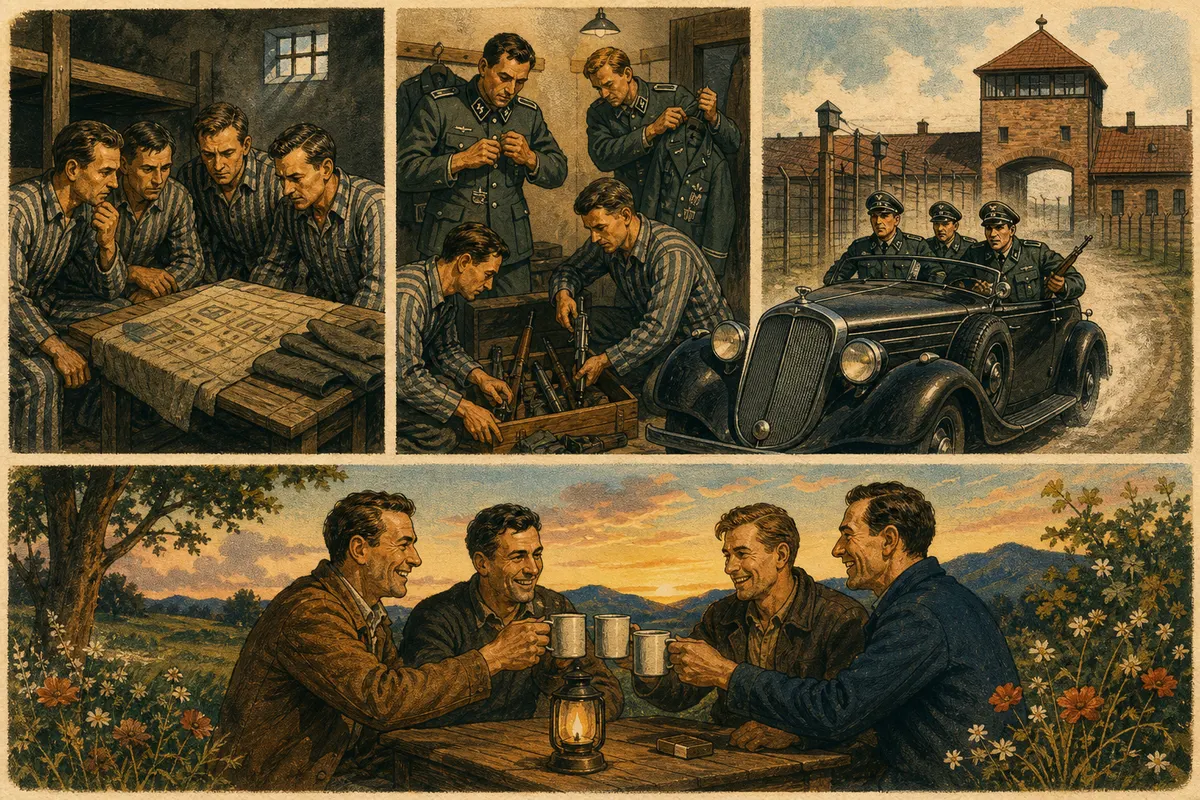
On 20 June 1942, Kazimierz Piechowski and three fellow prisoners put on stolen SS uniforms, picked up stolen weapons, climbed into the commandant’s own staff car, and drove out through the front gate of Auschwitz concentration camp. All four survived the war. This is the kind of story that sounds implausible because the audacity required is almost unreasonable, and yet it is entirely true.
It was one of the most brazen escapes of the Second World War, and it deserves to be far better known than it is.
The First Thing Humanity Ever Sent to Space
Two years later, on 20 June 1944, a German V-2 rocket designated MW 18014 crossed the Kármán line, reaching 176 kilometres altitude during a test launch. It became the first human-made object to enter outer space. The war was still ongoing. Nobody was marking the occasion with speeches.
The following year, on 20 June 1945, the US Secretary of State approved the transfer of Wernher von Braun and his team of Nazi rocket scientists to America under what became Operation Paperclip. Von Braun later became the chief architect of NASA’s Saturn V rocket programme, despite his wartime record. The history of space exploration is genuinely extraordinary, and also genuinely complicated.
Pirates in Ireland, 1631
Go back further, to the early hours of 20 June 1631, and you find Barbary corsairs led by Murat Reis the Younger arriving at the Irish fishing village of Baltimore. They took over a hundred men, women, and children captive to be sold into slavery in North Africa. Most never returned. It is one of the most dramatic and least-discussed episodes in Irish history: an entire community, gone before dawn.
Three Centuries, One Date
These are not thematically tidy stories. An escape, a technological milestone wrapped in moral compromise, a catastrophe that took a whole village. What they share is the sheer human extremity of each moment: people pushed to the very edge of what seemed possible, on the same calendar date across three different centuries.
The episode is ten minutes long. It is a very reasonable investment.