On this day · 15 June 2026

The Pig War and the Eclipse That Fixed History

· 9 min

The Pig War and the Eclipse That Fixed History

Listen to this episode

9 min

The Pig War is a testament to how minor incidents can escalate into international conflicts. Similarly, the recorded eclipse highlights the power of small observations in transforming historical understanding.

A pig and an eclipse: not the first things you imagine when thinking about international diplomacy or ancient history. Yet, on 15 June, centuries apart, these seemingly minor events played unexpected roles in their respective eras.

The Pig War: A Comedy of Errors?

Imagine living on a small island largely ignored in international treaties. That was San Juan Island in 1859, situated between American and British territories in the Pacific Northwest. The 1846 Oregon Treaty had left these waters’ sovereignty delightfully ambiguous.

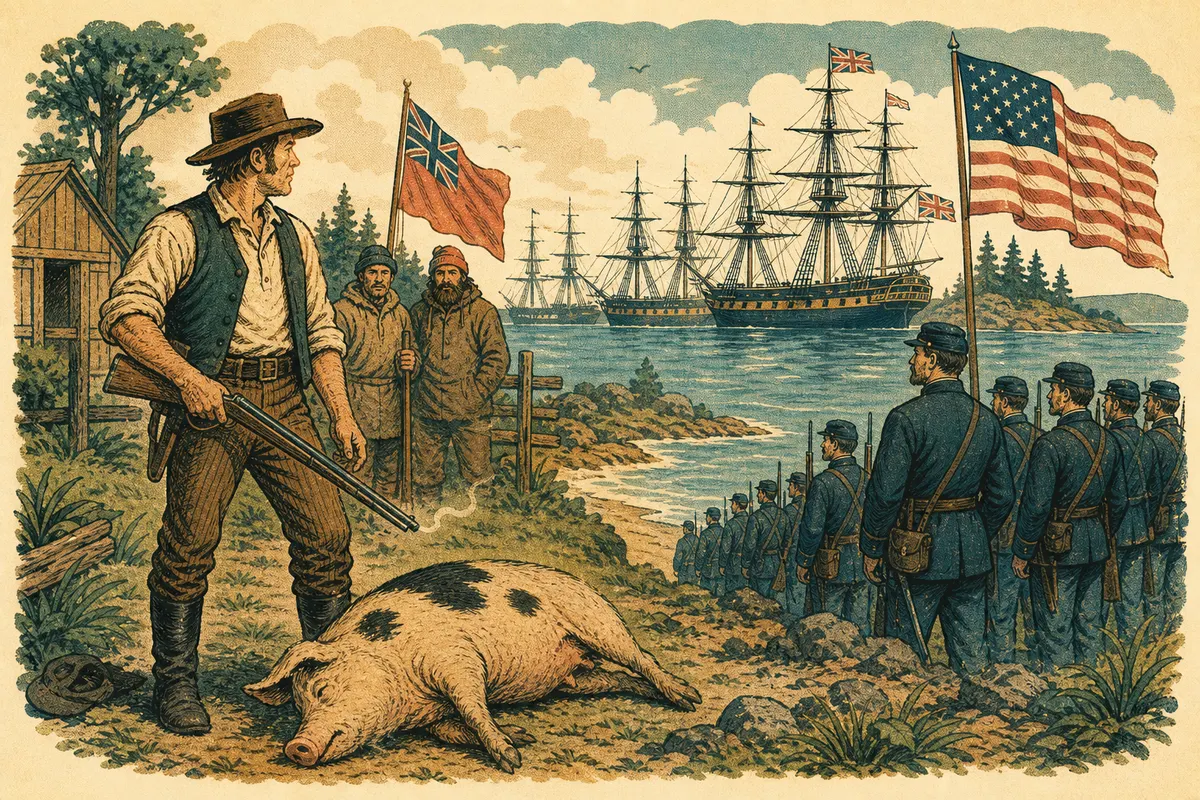
Enter Lyman Cutlar, an American farmer, and one slightly misguided pig owned by the Hudson’s Bay Company. When Cutlar discovered the pig feasting on his potatoes, he promptly shot it. Rather than this being a laughable dispute, the incident fanned the flames of international tension, culminating in what we cheekily recall as the Pig War.

Outraged, the British sent warships, and by August, 500 American soldiers faced off against a formidable British naval presence. Fortunately, Admiral Robert Baynes of the British fleet recognised the absurdity of instigating war over a pig, refusing to engage. The standoff turned into a peaceful twelve-year joint occupation, resolved only when Kaiser Wilhelm I generously arbitrated in 1872, siding with the United States. No blood was shed, proving that sometimes walking away from a fight is the best victory of all.

The Eclipse That Anchored Time

Leap back to the 8th century BC, and you’ll find a different small event with a much larger scholarly impact. In 763 BC, Assyrian scholars inscribed a solar eclipse into clay tablets. A seemingly routine bit of record keeping turned out to be a critical timestamp for historians.

Solar eclipses are cosmic clockmakers; their predictability allows astronomers to fix exact dates in history. That single record, captured in cuneiform, became the keystone for dating events in ancient Near Eastern history. It established a chronological anchor, giving clarity to a previously nebulous timeline.

These narratives remind us that the significance of events isn’t always evident at the time. Little things, whether a pig or an eclipse, can have surprisingly monumental impacts. Curious how these tales unfold? Listen to uncover the details that make history truly human.

In this episode

  • Intro A man shot a pig on a tiny island in the Pacific Northwest on 15 June 1859, and within weeks there were warships in the water and soldiers facing each other across a field. The Pig War.
  • The Pig War The 1846 Oregon Treaty left San Juan Island’s sovereignty ambiguous. When American farmer Lyman Cutlar shot a Hudson’s Bay Company pig in 1859, the dispute escalated rapidly. American troops occupied the island. British warships arrived. By August, five hundred American soldiers faced five British warships. Admiral Robert Baynes refused to engage, calling the situation absurd. Joint occupation lasted twelve years until Kaiser Wilhelm I ruled for the United States in 1872. No shots were fired.
  • CTA Follow the show and share with a curious friend.
  • The Eclipse That Fixed History On 15 June 763 BC, Assyrian scholars recorded a solar eclipse in cuneiform. Because eclipses are predictable, astronomers could calculate the exact date, creating an absolute chronological anchor. This fixed point allowed historians to assign precise calendar years to events across ancient Near Eastern history, transforming the chronological framework of Mesopotamian civilisation.
  • Outro Two stories from 15 June, separated by 2,788 years. A pig and an eclipse. Small things that carried unexpected weight.

Sources

More from the archive

7 min

Collision of the Unexpected: Trump, Vigdís, and Kelston's Ingenuity

In this episode of The Daily Time Drop, host Clare Vale unravels a tapestry of global historical moments that reveal the unpredictable dance between human endeavour and fate. We begin with former US President Donald Trump’s third indictment in 2023, a significant event intertwining political accountability and democratic principles. The discussion then shifts to 1980, where Vigdís Finnbogadóttir’s election as Iceland’s President marked a breakthrough for gender equality, inspiring communities worldwide. The launch of Microsoft Office in 1989 is highlighted as a pivotal moment that revolutionised productivity and digital working environments. Closing with a story from 2014, Clare explores the Kelston toll road, a symbol of community action and creative solutions. Each story underscores the power of human agency and the enduring impact of leadership, innovation, and collective action.

Read & listen →
4 min

Moon Crashes and Floral Penalties

In this episode of The Daily Time Drop, host Clara Vale explores two intriguing stories of human ambition and unexpected results. First, we delve into NASA’s audacious 1999 mission to crash the Lunar Prospector into the Moon—a planned cosmic collision intended to reveal hidden mysteries. Despite the dramatic impact, the hoped-for evidence of water ice remained elusive. Then, travel back to 1703 to witness how Daniel Defoe, the famous author of ‘Robinson Crusoe’, faced public punishment for his biting satire. Intended to be a spectacle of shame, Defoe’s pillory became an inspired moment when the crowd showered him with flowers instead of insults. Join us as we examine these tales of scientific daring and literary defiance, underscoring the unpredictable nature of human endeavours.

Read & listen →
5 min

Echoes of Extinction: The Pyrenean Ibex's Brief Return

Join Clara Vale on The Daily Time Drop as she unravels a tapestry of intriguing historical moments. Discover the extraordinary tale of the Pyrenean ibex, a species that defied extinction only to face it again. Step into the vibrant energy of Tomorrowland, where Charlotte de Witte’s groundbreaking performance changed the face of techno music. Bid adieu to the classic Volkswagen Beetle, an automotive icon whose journey ended in 2003. Finally, witness Lisa Leslie’s historic slam dunk in the Women’s National Basketball Association, a defining moment that challenged perceptions of women in sport. Through these stories, Clara invites us to reflect on human ingenuity, nature’s unpredictability, and the ever-present dance with overconfidence.

Read & listen →