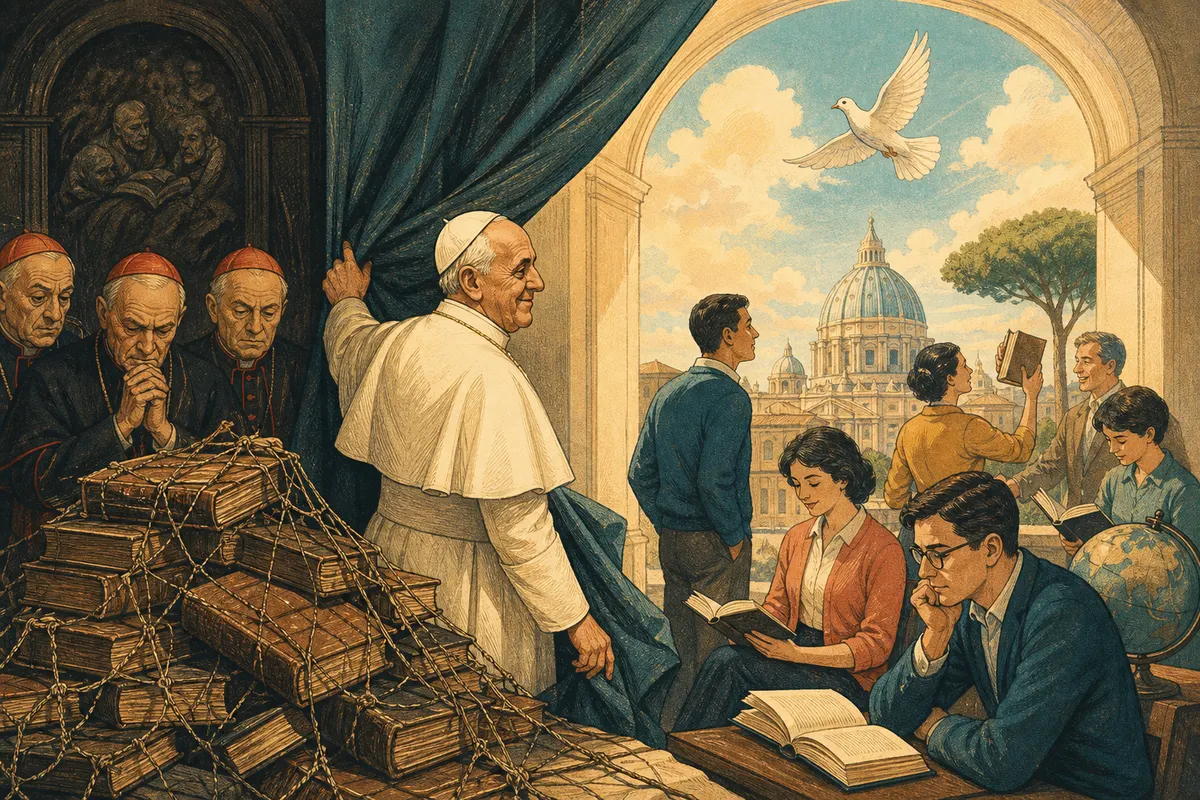
The Index Librorum Prohibitorum lasted 409 years, which is a long time to be officially wrong about what people should be allowed to read. The question of who controls access to ideas, and whether that control can ever really hold, has not aged a day.
For 409 years, the Catholic Church kept a list. Thousands of titles, meticulously catalogued, officially forbidden to the faithful. Galileo was on it. So were Descartes, Locke, Voltaire, and Simone de Beauvoir. The Index Librorum Prohibitorum was, in a sense, the most ambitious reading list in history, provided you read it as a guide to what not to miss.
The Day Rome Unlocked the Library
On 14 June 1966, the Vatican abolished the Index Librorum Prohibitorum, ending 409 years of official literary censorship. First published in 1557, the list had grown to encompass thousands of titles covering some of the most consequential thinkers in Western history. The Second Vatican Council recognised that the Index had become both unenforceable and incompatible with the Church’s desire to engage with the modern world. It ended not with a grand reckoning but with a quiet administrative decision, which feels about right.
But 14 June Was Busy in Other Ways Too
The date has form. In 1789, Captain William Bligh and 18 crew members arrived in Timor, completing a 7,400-kilometre open-boat navigation after the Bounty mutiny. They had been at sea for 47 days. Bligh had lost one man at Tofua, but all 18 who made the sea crossing arrived alive. It remains one of the most extraordinary feats of navigation ever accomplished, in a small open boat, against very long odds.
In 1822, Charles Babbage presented his Difference Engine to the Royal Astronomical Society: a mechanical calculating machine whose design contained the conceptual architecture of the modern computer. The machine was never completed in his lifetime. The idea was simply about a century ahead of the engineering required to realise it.
And in 1949, a rhesus macaque named Albert II was launched from White Sands aboard a V-2 rocket. He reached 134 kilometres altitude, becoming the first mammal in space. He survived the ascent. The parachute system failed on landing.
A Day Worth Ten Minutes of Your Time
It is a strange cluster of anniversaries: a library unlocked after four centuries, an impossible boat journey completed, a computer imagined before computers existed, and the first mammal to reach space. All of them involve pressing against a boundary that had seemed fixed.
Today’s episode covers all four in roughly ten minutes. If any of this sounds like your kind of thing, you know where to find it.