These stories highlight human ingenuity in overcoming challenges with sheer grit and creativity. They remind us that even improbable inventions can have lasting impacts.
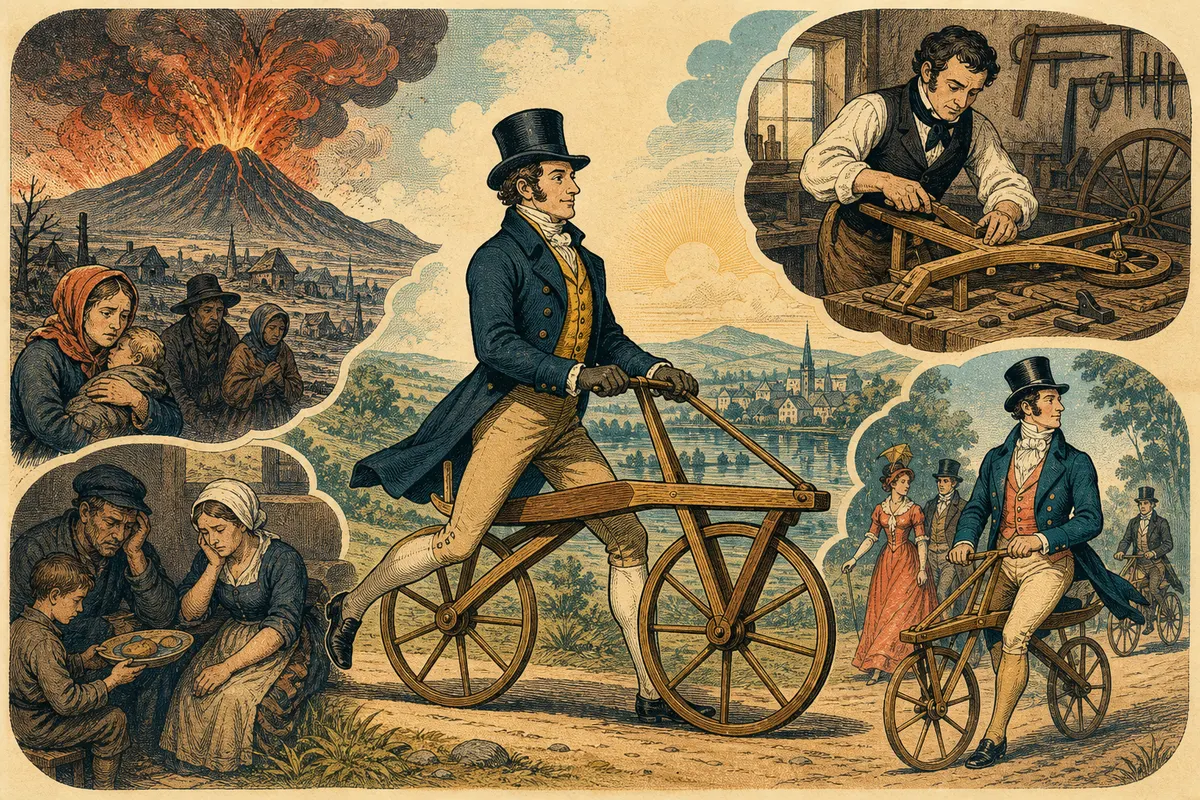
Inventive minds, much like human-powered machines, never really stop if they can help it. On 12 June 1817, Karl von Drais introduced the world to his Laufmaschine, gliding for 14 kilometres across the landscape with no more power than his own two legs. This peculiar contraption—essentially a wooden frame with two wheels—came to be affectionately known as the ‘dandy horse.’ Though it lacked pedals, chains, or gears, it elegantly skated through a crisis, tickling the imagination of early 19th-century observers.
The reason for this sudden bit of two-wheeled audacity was the aftermath of Mount Tambora’s 1815 eruption. The resulting ‘Year Without a Summer’ paralysed agriculture and shifted the way people thought about transport. Von Drais’ innovation didn’t simply solve a shortage problem with charm. It sparked the long journey towards the symbol of freedom and mobility we have today: the bicycle.
Human-Powered Dreams
Fast forward 162 years to another bewildering human-powered endeavour. On the exact anniversary, in 1979, cyclist Bryan Allen took human ingenuity to new heights—literally. Piloting the Gossamer Albatross, Allen achieved what many thought impossible: crossing the English Channel under thigh-burning power alone. In a flimsy aircraft resembling a reject from an alchemist’s vision, made of aluminium tubes and Mylar film, Allen pedalled his way to a Kremer Prize victory.
Weighing only 32 kilograms, the Gossamer Albatross was as much about engineering as it was about unparalleled stamina and resolve. This two-hour and 49-minute flight was living proof that human-powered flight over open water wasn’t something to scoff at, but something to celebrate in the annals of inventive history.
Both stories, separated by over a century but linked by shared ambition, illustrate our natural desire to push boundaries. They remind us as much of our physical limitations as our limitless potential to innovate. When transport solutions involved both tactical cunning and a lot of perspiration, these endeavours taught the world that sometimes, thinking outside the aircraft or pedal requires one to embrace the uncharted road just a bit.
Tune into ‘The Daily Time Drop’ podcast episode to hear about these remarkable testaments to human-centred innovation and be inspired by what people can achieve with little more than ordinary elbow grease and daring ideas.