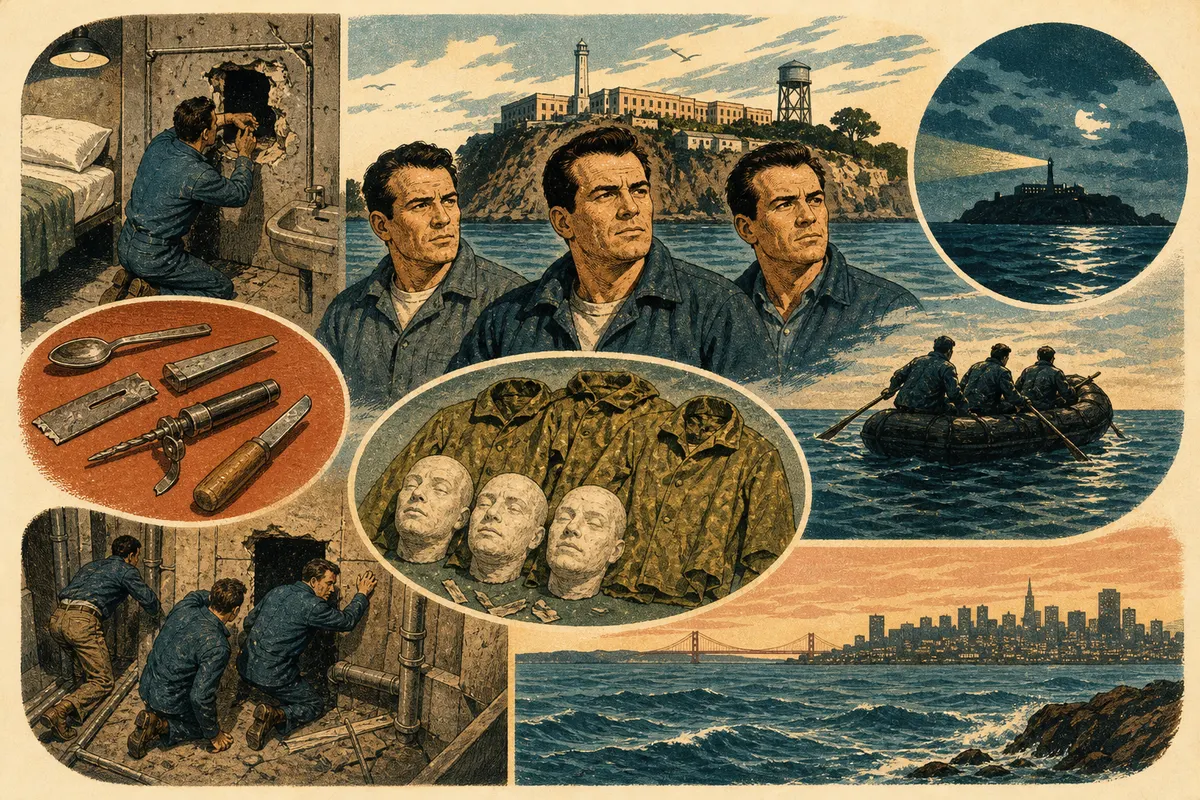
The Alcatraz escape of 1962 remains officially unsolved, which is rarer than you might think for a case this famous and this well-documented. It sits in an unusual space: thoroughly investigated, widely known, and genuinely unfinished.
Some dates just have form. 11 June has given us an unsolved prison escape, the origin of a phrase still used in every election cycle, a belated correction to over a century of telephone mythology, and a very famous ship being stopped hard by a reef. Not bad for a Tuesday.
The Escape That Nobody Solved
On 11 June 1962, Frank Morris and brothers John and Clarence Anglin vanished from Alcatraz Federal Penitentiary. What they left behind tells you everything about the preparation involved: homemade tools, a raft constructed from stolen raincoats, and dummy heads made from soap propped in their beds to fool the guards during checks.
The FBI investigated. No bodies were ever recovered. Whether they drowned in San Francisco Bay or reached the mainland has never been established, and the case remains, officially and genuinely, unresolved. Most historical mysteries have answers that historians eventually agree on. This one does not.
The Room Where the Phrase Was Born
On the same date in 1920, Republican party bosses gathered in a Chicago hotel suite in the early hours of the morning and selected Warren G. Harding as their presidential candidate. A journalist described the setting, and the phrase “smoke-filled room” entered the language. Over a century later, political backroom dealing still gets called exactly that. Harding got the nomination; the phrase outlasted everything else about his presidency.
A Patent, a Century Late
On 11 June 2002, the US Congress formally acknowledged Antonio Meucci as the first inventor of voice communication technology. Alexander Graham Bell had claimed the patent, and history had largely run with that version for well over a hundred years. Congress noticed, eventually. Better late than never, though Meucci himself had been dead since 1889.
Cook Meets the Reef
Go back to 11 June 1770 and you find Captain James Cook’s HMS Endeavour striking the Great Barrier Reef. The crew jettisoned supplies, cannons included, to refloat the ship, then spent seven weeks on the Queensland coast making repairs. Cook was a meticulous navigator. The reef was not especially interested in that.
Four stories, one date, and the persistent sense that history is mostly people doing their best in circumstances they did not entirely anticipate. The Alcatraz story in particular has a quality most historical tales do not: it has no ending. If open questions bother you, that is precisely why the ten-minute episode is worth your time.