On this day · 8 June 2026

The Day the US Postal Service Tried Missile Mail

Episode 4 · 9 min

The Day the US Postal Service Tried Missile Mail

Listen to this episode

9 min

This episode highlights the optimism and eccentricity of mid-20th century innovation, reminding us that not every ambitious idea soars.

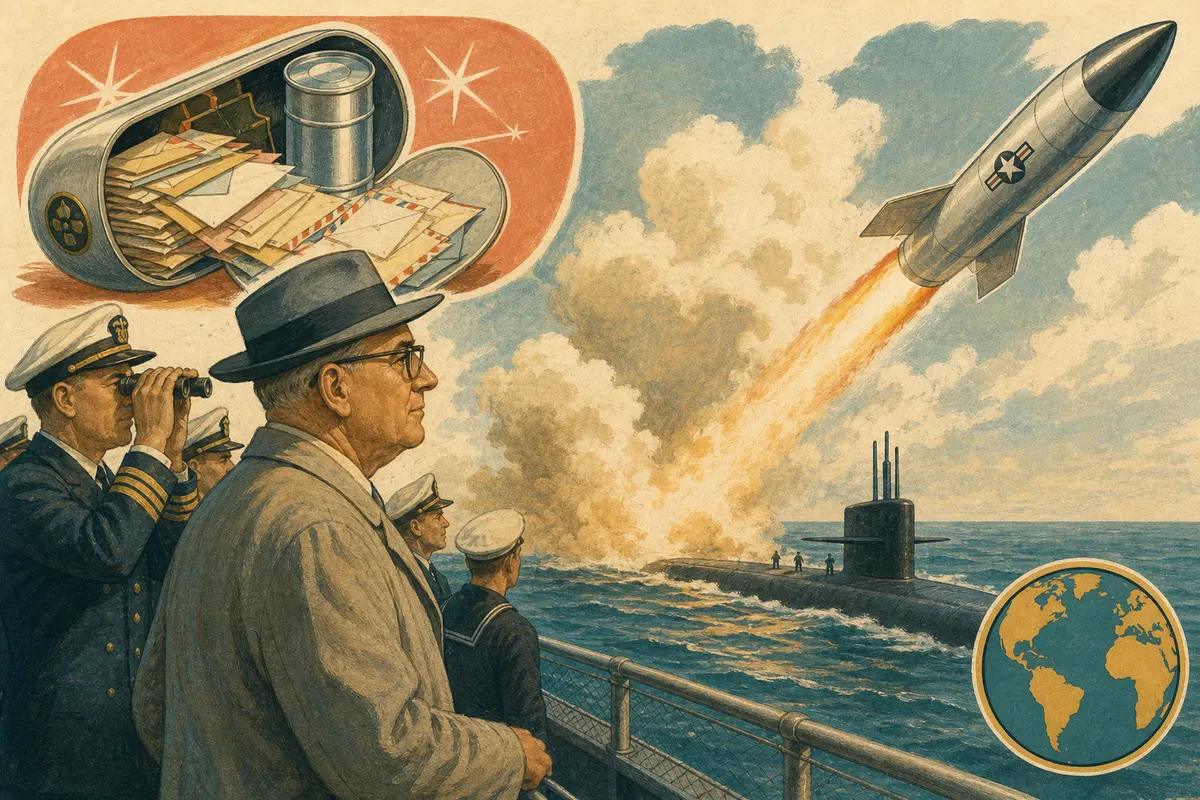
If you ever bemoan late post, spare a thought for the era when mail delivery was attempted by missile. Yes, you read that right. On 8 June 1959, the United States Navy launched a Regulus cruise missile from the submarine USS Barbero, with three thousand letters onboard. This Cold War caper, known as ‘Missile Mail’, was more than just pushing the envelope—it was launching it.

Postmaster General Arthur Summerfield was the mastermind behind this peculiar postal pursuit. Watching the missile soar from the Florida coast, he declared it a moment of historic significance, envisioning a future where mail zipped across continents in the sleek confines of a cruise missile. The missile travelled approximately one hundred miles and touched down at Naval Air Station Mayport, where the letters were retrieved, stamped with a special ‘MISSILE MAIL’ postmark, and sent on their way.

Despite Summerfield’s keen enthusiasm, the world never did see the advent of intercontinental missile mail routes. Perhaps unsurprisingly, the programme was immediately shelved, settling comfortably into the annals of history as a curious footnote in Cold War innovation.

Historically Speaking…

While the missile mail experiment took centre stage that day, it wasn’t the only significant event to land on 8 June. In 1794, Maximilien Robespierre presided over the Festival of the Supreme Being in Paris, a festival with a lasting mark as Robespierre himself was executed weeks later. Scotland’s financial world shook on this date in 1772 when banker Alexander Fordyce fled to France, sparking a credit crisis. The day also saw a tragedy in 1966 with the collision of an F-104 Starfighter and an XB-70 Valkyrie, which resulted in the loss of two pilots.

And in the Pacific, the descendants of the mutiny on the HMS Bounty made their way to Norfolk Island in 1856 to start anew.

Though the idea of missile mail might seem outlandish today, it’s a keen reminder of the audacious spirit of an era willing to try anything at least once. Tune into the full episode to hear more: from missile post to maritime mutineers.

In this episode

  • Missile Mail and Cold War Postal Ambitions On 8 June 1959, the USS Barbero fired a Regulus cruise missile containing three thousand letters, landing at Naval Air Station Mayport in Florida. Postmaster General Arthur Summerfield believed missile mail was the future, envisioning transcontinental delivery routes. The programme was never pursued further, but the letters were delivered and postmarked, some ending up in museums.
  • Robespierre’s Festival, Fordyce’s Flight, and Other Events Robespierre presided over the Festival of the Supreme Being in Paris on 8 June 1794, weeks before his arrest and execution. Scottish banker Alexander Fordyce fled to France on 8 June 1772, triggering a major credit crisis. On 8 June 1966, an F-104 Starfighter collided with an XB-70 Valkyrie near Edwards Air Force Base, killing two pilots. On 8 June 1856, descendants of the Bounty mutineers arrived at Norfolk Island to establish a new settlement.

Sources

More from the archive

Episode 3 8 min

Carrie Nation's Hatchet and the Day of the Tiles

On 7 June 1899, Carrie Nation walked into a saloon in Kiowa, Kansas, carrying rocks, and smashed the bottles. She was not making a point. She was enforcing the law. Kansas was a dry state, but the saloons were open, and local officials were looking elsewhere. Nation, a committed temperance campaigner whose first husband had been an alcoholic, decided that if the system would not fix the problem, she would. Her direct action, which later became synonymous with her trademark hatchet, made her one of the most recognisable women in turn-of-the-century America. She was arrested repeatedly, welcomed the platform, and argued that if laws existed and were not enforced, citizens had a right to enforce them. Also on this date: Graceland opened to the public in 1982, turning Elvis Presley’s private Memphis home into one of America’s most visited sites. In 1971, the US Supreme Court ruled in Cohen v. California that offensive speech is constitutionally protected. And in 1788, during the Day of the Tiles in Grenoble, French citizens threw roof tiles at royal troops, marking an early spark of the French Revolution. Each story shares a common thread: people who stopped waiting politely for change.

Read & listen →
Episode 2 10 min

The Man With the Window in His Stomach

On 6 June 1822, a musket accident at Fort Mackinac left French-Canadian fur trader Alexis St. Martin with a permanent hole in his stomach. Against all expectation, he survived, and US Army surgeon William Beaumont recognised the opportunity: for the first time in history, a living human stomach could be observed directly at work. What followed was years of groundbreaking research that transformed our understanding of digestion, but also a deeply unequal relationship between researcher and subject. This episode examines the accidental experiment that founded modern gastric physiology, alongside other events from 6 June: a near-Earth asteroid explosion over the Mediterranean in 2002 that went almost unnoticed, the 1985 exhumation that confirmed the death of Josef Mengele, and the 1933 opening of the world’s first drive-in cinema in New Jersey. A day of survival, improvisation, and the things that weren’t supposed to happen.

Read & listen →
Episode 5 9 min

The Last Transit of Venus and the Stories of 5 June

On 5 June 2012, millions watched Venus cross the face of the Sun for the last time in any living person’s lifetime. The next transit won’t occur until 2117. This rare celestial event once sent Captain Cook to Tahiti in 1769 and helped unlock the true scale of the solar system. But the fifth of June holds other remarkable stories: in 1983, the Soviet cruise ship Aleksandr Suvorov collided catastrophically with a railway bridge on the Volga River, killing over a hundred passengers. In 1995, physicists at the University of Colorado created the first Bose-Einstein condensate, a state of matter predicted by Einstein seventy years earlier. In 1956, Elvis Presley’s hip-swivelling performance of Hound Dog on The Milton Berle Show scandalised critics and ignited rock and roll on primetime television. And in 1949, Orapin Chaiyakan became the first woman elected to Thailand’s Parliament. From planetary mechanics to cultural flashpoints, this episode explores the moments that still resonate from a single day in history.

Read & listen →