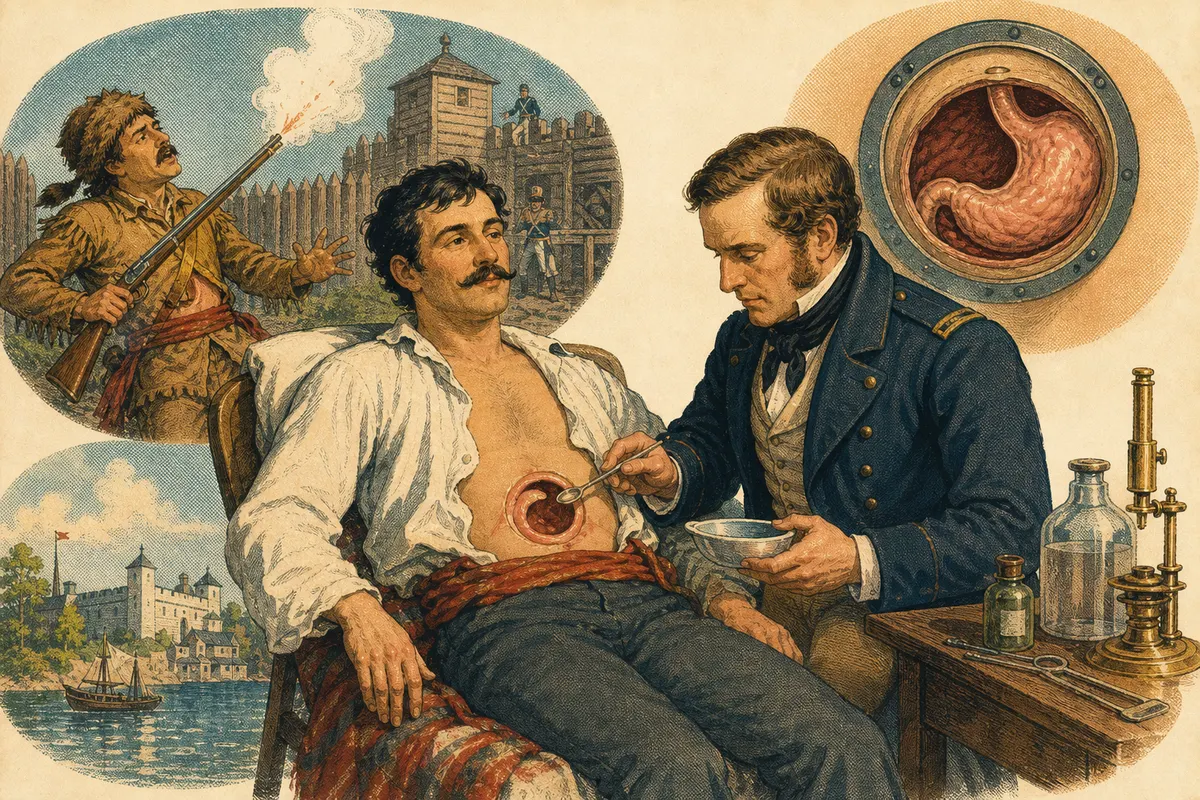
Beaumont's experiments with St. Martin founded modern gastric physiology, and the research still informs how we understand digestion today. The story also asks a question that hasn't gone away: what do we owe the people whose bodies made the science possible?
In 1822, a musket misfired at Fort Mackinac, and a French-Canadian fur trader named Alexis St. Martin ended up with a hole in his stomach that never healed. His surgeon, US Army doctor William Beaumont, recognised an extraordinary opportunity. St. Martin, one suspects, saw something rather less appealing.
The wound left a permanent gastric fistula: a direct, lasting opening into the living stomach. For the first time in history, a human digestive system could be observed at work, in real time, without any of the inconveniences that normally come with access to someone’s internal organs. Beaumont spent years conducting experiments through the opening, watching digestion happen from the outside.
The science that followed was genuinely revolutionary. Beaumont’s work transformed our understanding of gastric physiology, and the research he produced helped lay the groundwork for modern digestive science.
The less comfortable part of the story is the relationship between the two men. St. Martin was not a willing volunteer in any uncomplicated sense. A working-class fur trader and a military surgeon do not come to an experiment as equals, and the episode does not pretend they did. The knowledge was real, and the imbalance was real, and both things matter.
The Rest of 6 June
The date has form for the unexpected. In 2002, a near-Earth asteroid exploded over the Mediterranean and went almost entirely unnoticed. These events happen more often than is comfortable to think about.
On 6 June 1985, an exhumation in Brazil confirmed that Josef Mengele had died there. Not a tidy conclusion, as conclusions go, but a conclusion.
And in 1933, New Jersey opened the world’s first drive-in cinema. Someone had to do it first, and it turned out to be New Jersey.
Why Listen?
Today’s episode is about survival, improvisation, and the things that were never supposed to happen. It asks, quietly, what we owe the people whose bodies made the science possible. That question has not gone away, and ten minutes in the morning seems a reasonable amount of time to sit with it.