On this day · 3 June 2026

The Last Great Auks and the Collectors Who Killed Them

Episode 3 · 9 min

The Last Great Auks and the Collectors Who Killed Them

Listen to this episode

9 min

The great auk's extinction is a case study in how markets can accelerate disaster even when everyone involved knows exactly what is happening. That particular dynamic has not gone out of fashion.

There is a particular kind of human logic that manages to be both rational and catastrophic. In the 1840s, everyone with a serious interest in natural history knew the great auk was nearly gone. The sensible response would have been to leave the remaining birds alone. Instead, the rarity made specimens more valuable, which made collectors more eager, which made the birds more dead.

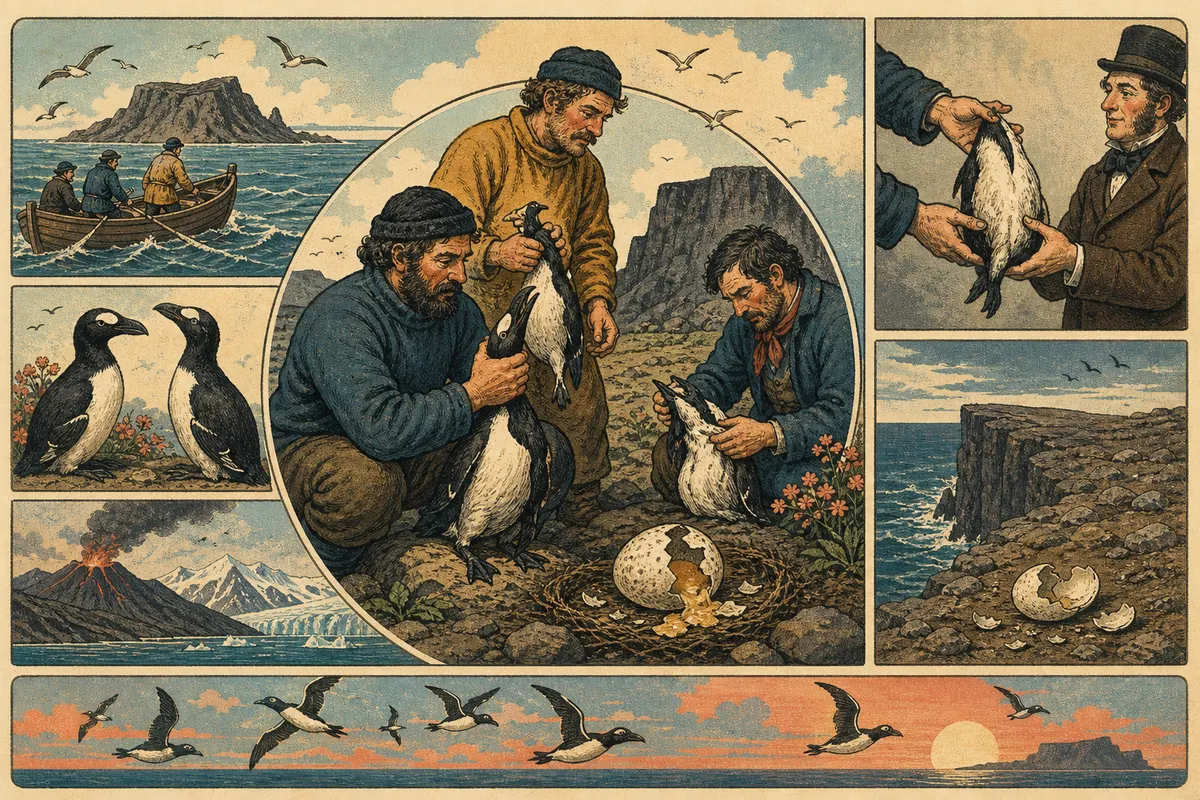
On 3 June 1844, three Icelandic fishermen landed on Eldey, a remote volcanic island, and killed the last confirmed breeding pair of great auks. The birds were strangled, their skins sold to a museum collector. The egg was cracked in the process and abandoned.

The great auk had survived ice ages and geological upheaval. Centuries of sustained human contact finished them off.

A Market for Rarity

What makes the story genuinely unsettling is the absence of ignorance as an excuse. Naturalists and hunters alike were aware that the species was nearly gone. That awareness did not slow things down; it accelerated them. The rarer the bird, the higher the price a skin or egg would fetch, and so the market created a direct incentive to push the species over the edge.

This was not a tragedy of confusion. It was a tragedy of incentives, which is a different and considerably more uncomfortable thing.

Also on 3 June

The episode is not entirely bleak, though it does not get dramatically cheerful either. In 1839, Chinese official Lin Zexu oversaw the destruction of over a million kilograms of British opium, a confrontation that sits at the centre of the Opium Wars. In 1969, the Australian aircraft carrier HMAS Melbourne collided with the American destroyer USS Frank E. Evans during exercises, killing 74 American sailors. And in 1700, Barcelona saw the founding of the Academy of the Distrustful, a scholarly society built on intellectual scepticism, which feels like the most quietly correct institution in this entire list.

The ten-minute episode covers all four, including why a bird that outlasted the ice ages could not outlast a collector’s catalogue. It is not comfortable listening, but it is honest, and the Academy of the Distrustful would probably approve.

In this episode

  • The Last Two The extinction of the great auk on Eldey Island, Iceland, 3 June 1844. Three fishermen killed the last confirmed breeding pair for a museum collector. The species had survived ice ages but vanished within centuries of human contact, driven not by necessity but by the market value of rare specimens. Also covered: Lin Zexu’s destruction of British opium in China (1839), the HMAS Melbourne and USS Frank E. Evans collision (1969), and the founding of Barcelona’s Academy of the Distrustful (1700).

Sources

More from the archive

Episode 4 9 min

The Day the US Postal Service Tried Missile Mail

On 8 June 1959, the United States Navy fired a Regulus cruise missile from the submarine USS Barbero off the coast of Florida. Inside, replacing the nuclear warhead, was a postal canister containing three thousand letters. Postmaster General Arthur Summerfield watched the launch and declared it of historic significance to the peoples of the entire world. The missile travelled roughly one hundred miles, landed at Naval Air Station Mayport, and the mail was retrieved and stamped with a special ‘MISSILE MAIL’ postmark. Summerfield genuinely believed this was the future of postal delivery, envisioning coast-to-coast routes by cruise missile. The programme was never repeated. Also on this date: Robespierre presided over the Festival of the Supreme Being in 1794, weeks before his own execution; banker Alexander Fordyce fled to France in 1772, triggering a credit crisis across Britain and the Dutch Republic; two pilots died when an F-104 Starfighter collided with an XB-70 Valkyrie in 1966; and the descendants of the Bounty mutineers arrived at Norfolk Island in 1856 to begin a new settlement.

Read & listen →
Episode 3 8 min

Carrie Nation's Hatchet and the Day of the Tiles

On 7 June 1899, Carrie Nation walked into a saloon in Kiowa, Kansas, carrying rocks, and smashed the bottles. She was not making a point. She was enforcing the law. Kansas was a dry state, but the saloons were open, and local officials were looking elsewhere. Nation, a committed temperance campaigner whose first husband had been an alcoholic, decided that if the system would not fix the problem, she would. Her direct action, which later became synonymous with her trademark hatchet, made her one of the most recognisable women in turn-of-the-century America. She was arrested repeatedly, welcomed the platform, and argued that if laws existed and were not enforced, citizens had a right to enforce them. Also on this date: Graceland opened to the public in 1982, turning Elvis Presley’s private Memphis home into one of America’s most visited sites. In 1971, the US Supreme Court ruled in Cohen v. California that offensive speech is constitutionally protected. And in 1788, during the Day of the Tiles in Grenoble, French citizens threw roof tiles at royal troops, marking an early spark of the French Revolution. Each story shares a common thread: people who stopped waiting politely for change.

Read & listen →
Episode 2 10 min

The Man With the Window in His Stomach

On 6 June 1822, a musket accident at Fort Mackinac left French-Canadian fur trader Alexis St. Martin with a permanent hole in his stomach. Against all expectation, he survived, and US Army surgeon William Beaumont recognised the opportunity: for the first time in history, a living human stomach could be observed directly at work. What followed was years of groundbreaking research that transformed our understanding of digestion, but also a deeply unequal relationship between researcher and subject. This episode examines the accidental experiment that founded modern gastric physiology, alongside other events from 6 June: a near-Earth asteroid explosion over the Mediterranean in 2002 that went almost unnoticed, the 1985 exhumation that confirmed the death of Josef Mengele, and the 1933 opening of the world’s first drive-in cinema in New Jersey. A day of survival, improvisation, and the things that weren’t supposed to happen.

Read & listen →