On this day · 2 June 2026

A Lacrosse Match That Took a Fort, and the First Double Channel Crossing

Episode 2 · 8 min

A Lacrosse Match That Took a Fort, and the First Double Channel Crossing

Listen to this episode

8 min

These stories remind us of the ingenuity and courage in facing overwhelming odds, whether on the lacrosse field or in the sky.

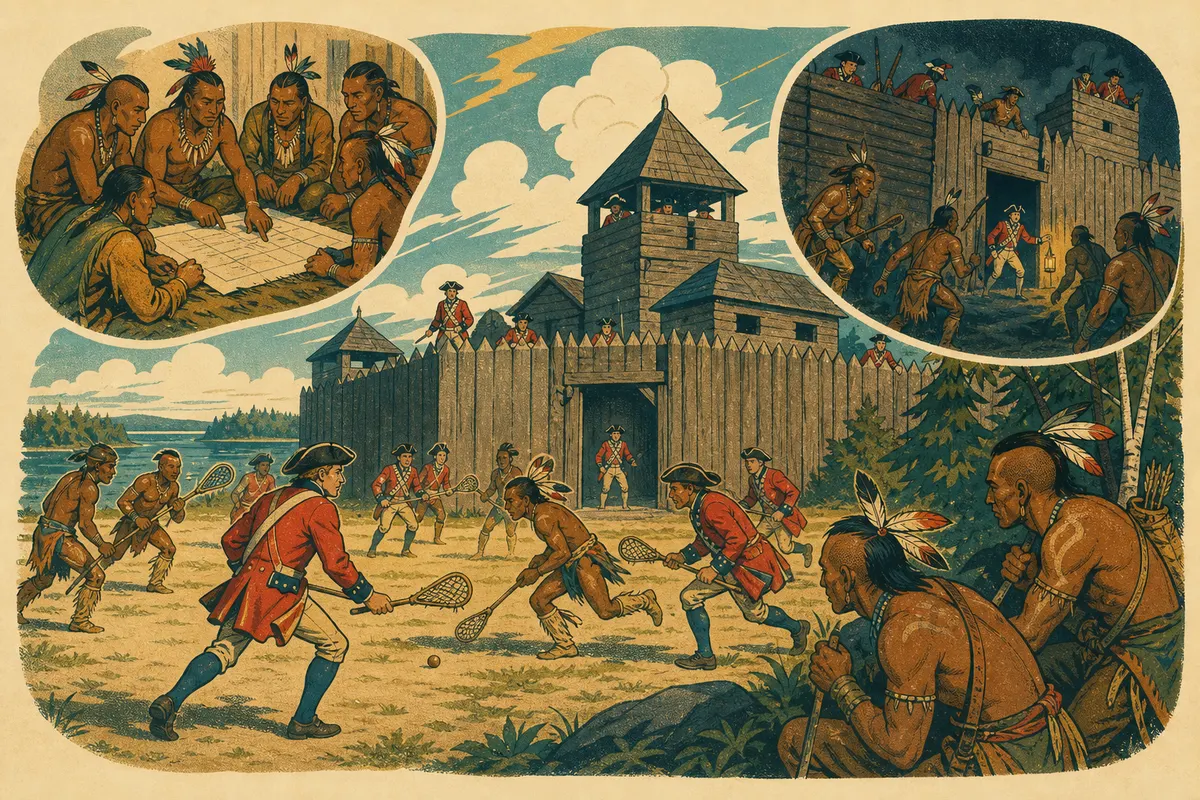
Ready for a game of lacrosse? Keep an eye on your fort. On 2 June 1763, the Ojibwe nation brilliantly disguised their military intentions as a sports event, capturing Fort Michilimackinac. Pontiac’s War, a formidable Indigenous resistance, saw its most extraordinary victory through this daring tactic. While British forces might have anticipated a direct assault, the last thing they expected was to be overrun by warriors armed with… sticks.

The Lacrosse Gambit

Pontiac’s War wasn’t merely a series of uprisings; it was a carefully organised campaign against British colonial arrogance. After the Seven Years’ War, the British, rather smug in their victory, decided that Indigenous concerns were trivial. This asinine oversight led to the capture of eight forts, Fort Michilimackinac among them, using a lacrosse match as a tactical diversion. As Ojibwe warriors retrieved what the colonists disregarded—their sovereignty—British authorities were left to reconsider their policies, culminating in the Royal Proclamation of 1763.

Fast forward nearly 150 years to the same date, 1910: Charles Rolls wrote his chapter of audacious exploits. The co-founder of Rolls-Royce didn’t need a lacrosse stick to make history; he had a Wright biplane with a mere 35 horsepower. Despite the engine’s modest power, his ambition soared as he traversed the English Channel twice without touching ground. Rolls completed the unprecedented round-trip journey in just 95 minutes.

A Tale of Two Bold Feats

This double-take on daring tells us something profound about history. The Ojibwe’s ambush and Rolls’ aeronautical achievement both reflect the sheer audacity required to confront odds. Whether it’s transforming a lacrosse match into a battlefield or piloting a flimsy machine across one of the world’s busiest waterways, these acts continue to inspire us to look beyond conventional thinking, daring to imagine the impossible as possible.

These stories remind us that the most audacious plans, often looked at skeptically, can result in groundbreaking victories or pioneering successes. So, for a refreshing dive into history that values ingenuity over orthodoxy, have a listen to today’s episode of “The Daily Time Drop.”

In this episode

  • The Lacrosse Gambit On 2 June 1763, Ojibwe warriors captured Fort Michilimackinac using a lacrosse match as cover during Pontiac’s War. The coordinated Indigenous resistance against British colonial power resulted in the fall of eight forts across the Great Lakes. The event was not random violence but a carefully planned act of sovereignty defence following Britain’s dismissive treatment of Native nations after the Seven Years’ War. The conflict eventually forced British policymakers to issue the Royal Proclamation of 1763. On the same date in 1910, Charles Rolls completed the first non-stop double crossing of the English Channel by air, a 95-minute flight that ended tragically when he died in a flying accident weeks later.

Sources

More from the archive

Episode 4 9 min

The Day the US Postal Service Tried Missile Mail

On 8 June 1959, the United States Navy fired a Regulus cruise missile from the submarine USS Barbero off the coast of Florida. Inside, replacing the nuclear warhead, was a postal canister containing three thousand letters. Postmaster General Arthur Summerfield watched the launch and declared it of historic significance to the peoples of the entire world. The missile travelled roughly one hundred miles, landed at Naval Air Station Mayport, and the mail was retrieved and stamped with a special ‘MISSILE MAIL’ postmark. Summerfield genuinely believed this was the future of postal delivery, envisioning coast-to-coast routes by cruise missile. The programme was never repeated. Also on this date: Robespierre presided over the Festival of the Supreme Being in 1794, weeks before his own execution; banker Alexander Fordyce fled to France in 1772, triggering a credit crisis across Britain and the Dutch Republic; two pilots died when an F-104 Starfighter collided with an XB-70 Valkyrie in 1966; and the descendants of the Bounty mutineers arrived at Norfolk Island in 1856 to begin a new settlement.

Read & listen →
Episode 3 8 min

Carrie Nation's Hatchet and the Day of the Tiles

On 7 June 1899, Carrie Nation walked into a saloon in Kiowa, Kansas, carrying rocks, and smashed the bottles. She was not making a point. She was enforcing the law. Kansas was a dry state, but the saloons were open, and local officials were looking elsewhere. Nation, a committed temperance campaigner whose first husband had been an alcoholic, decided that if the system would not fix the problem, she would. Her direct action, which later became synonymous with her trademark hatchet, made her one of the most recognisable women in turn-of-the-century America. She was arrested repeatedly, welcomed the platform, and argued that if laws existed and were not enforced, citizens had a right to enforce them. Also on this date: Graceland opened to the public in 1982, turning Elvis Presley’s private Memphis home into one of America’s most visited sites. In 1971, the US Supreme Court ruled in Cohen v. California that offensive speech is constitutionally protected. And in 1788, during the Day of the Tiles in Grenoble, French citizens threw roof tiles at royal troops, marking an early spark of the French Revolution. Each story shares a common thread: people who stopped waiting politely for change.

Read & listen →
Episode 2 10 min

The Man With the Window in His Stomach

On 6 June 1822, a musket accident at Fort Mackinac left French-Canadian fur trader Alexis St. Martin with a permanent hole in his stomach. Against all expectation, he survived, and US Army surgeon William Beaumont recognised the opportunity: for the first time in history, a living human stomach could be observed directly at work. What followed was years of groundbreaking research that transformed our understanding of digestion, but also a deeply unequal relationship between researcher and subject. This episode examines the accidental experiment that founded modern gastric physiology, alongside other events from 6 June: a near-Earth asteroid explosion over the Mediterranean in 2002 that went almost unnoticed, the 1985 exhumation that confirmed the death of Josef Mengele, and the 1933 opening of the world’s first drive-in cinema in New Jersey. A day of survival, improvisation, and the things that weren’t supposed to happen.

Read & listen →