On this day · 1 June 2026

The Monk, the Malt, and the First Written Record of Scotch Whisky

Episode 1 · 9 min

The Monk, the Malt, and the First Written Record of Scotch Whisky

Listen to this episode

9 min

The earliest written record of Scotch whisky is a routine accounting entry, which is a reminder that the things we celebrate most often began without any ceremony whatsoever. Lindores Abbey, where that original order was placed, is distilling again today, making it one of the more satisfying full-circle moments in British history.

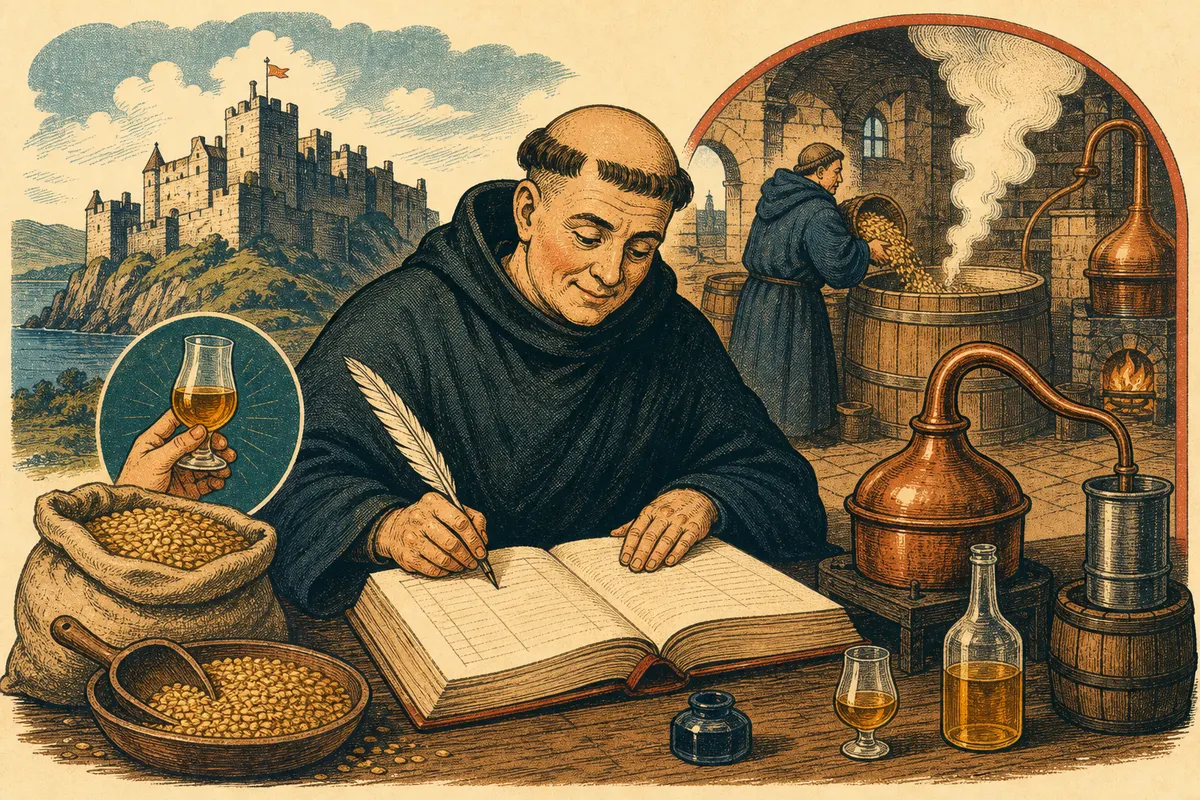
The year is 1494. A Scottish monk picks up his quill, records an order for eight bolls of malt, and unknowingly writes his way into every whisky distillery brochure for the next five centuries.

That monk was Friar John Cor. The document was the Exchequer Rolls of Scotland. And those eight bolls of malt were destined to become aqua vitae, the Latin term for distilled spirits, which we now know rather more affectionately as Scotch whisky.

A Monk With a Purpose

It would be tempting to imagine Friar Cor as a jolly medieval figure sneaking a dram behind the cloister, but the reality is both more interesting and more mundane. Medieval monasteries were genuine centres of medical and scientific knowledge, and distillation was a practical skill with recognised medicinal applications. This was not a monk having a cheeky Friday afternoon; this was a monk doing his job.

The entry itself was entirely unremarkable at the time. It sits in a royal accounts book as a routine transaction, the kind of thing nobody was meant to find significant. History has a habit of disguising its most consequential moments as paperwork.

Lindores Abbey, where Cor worked, now operates as a distillery once again. Which is, depending on your outlook, either a lovely piece of continuity or a very good reason to take a day trip to Fife.

Also on 1 June

History rarely schedules its events tidily around a theme, so alongside Scotland’s oldest dram, this episode also covers three other 1 June moments that refuse to be boring.

In 1943, BOAC Flight 777 was shot down, killing the actor Leslie Howard and sparking conspiracy theories that have never entirely quietened. In 1974, Dr Henry Heimlich published the choking intervention that bears his name, and which he would later use personally to save a life at the age of ninety-six. And in 2008, a fire at Universal Studios destroyed a vault of irreplaceable master recordings, a loss whose full scale took years to become clear.

Four stories. One date. Proof that history rarely announces itself with a fanfare.

Why This Episode Is Worth Ten Minutes of Your Day

The episode unpacks why monks were distilling spirits in the first place, what aqua vitae actually meant in a medieval medical context, and how a routine shopping list became the founding document of a global industry. It is ten minutes, it is free, and you almost certainly deserve a sit-down.

In this episode

  • A Wee Dram of History The earliest written record of Scotch whisky appears in the Exchequer Rolls of Scotland on 1 June 1494, when Friar John Cor ordered eight bolls of malt to make aqua vitae. Medieval monasteries were centres of medical and scientific knowledge, and distillation was a practical skill with genuine medicinal applications. Lindores Abbey, where Cor worked, now operates as a distillery again. Also covered: the 2008 Universal Studios fire that destroyed a vault of master recordings, the mysterious 1943 downing of BOAC Flight 777 carrying actor Leslie Howard, and the 1974 publication of the Heimlich manoeuvre by Dr Henry Heimlich, who would later use his own technique to save a life at age ninety-six.

Sources

More from the archive

Episode 4 9 min

The Day the US Postal Service Tried Missile Mail

On 8 June 1959, the United States Navy fired a Regulus cruise missile from the submarine USS Barbero off the coast of Florida. Inside, replacing the nuclear warhead, was a postal canister containing three thousand letters. Postmaster General Arthur Summerfield watched the launch and declared it of historic significance to the peoples of the entire world. The missile travelled roughly one hundred miles, landed at Naval Air Station Mayport, and the mail was retrieved and stamped with a special ‘MISSILE MAIL’ postmark. Summerfield genuinely believed this was the future of postal delivery, envisioning coast-to-coast routes by cruise missile. The programme was never repeated. Also on this date: Robespierre presided over the Festival of the Supreme Being in 1794, weeks before his own execution; banker Alexander Fordyce fled to France in 1772, triggering a credit crisis across Britain and the Dutch Republic; two pilots died when an F-104 Starfighter collided with an XB-70 Valkyrie in 1966; and the descendants of the Bounty mutineers arrived at Norfolk Island in 1856 to begin a new settlement.

Read & listen →
Episode 3 8 min

Carrie Nation's Hatchet and the Day of the Tiles

On 7 June 1899, Carrie Nation walked into a saloon in Kiowa, Kansas, carrying rocks, and smashed the bottles. She was not making a point. She was enforcing the law. Kansas was a dry state, but the saloons were open, and local officials were looking elsewhere. Nation, a committed temperance campaigner whose first husband had been an alcoholic, decided that if the system would not fix the problem, she would. Her direct action, which later became synonymous with her trademark hatchet, made her one of the most recognisable women in turn-of-the-century America. She was arrested repeatedly, welcomed the platform, and argued that if laws existed and were not enforced, citizens had a right to enforce them. Also on this date: Graceland opened to the public in 1982, turning Elvis Presley’s private Memphis home into one of America’s most visited sites. In 1971, the US Supreme Court ruled in Cohen v. California that offensive speech is constitutionally protected. And in 1788, during the Day of the Tiles in Grenoble, French citizens threw roof tiles at royal troops, marking an early spark of the French Revolution. Each story shares a common thread: people who stopped waiting politely for change.

Read & listen →
Episode 2 10 min

The Man With the Window in His Stomach

On 6 June 1822, a musket accident at Fort Mackinac left French-Canadian fur trader Alexis St. Martin with a permanent hole in his stomach. Against all expectation, he survived, and US Army surgeon William Beaumont recognised the opportunity: for the first time in history, a living human stomach could be observed directly at work. What followed was years of groundbreaking research that transformed our understanding of digestion, but also a deeply unequal relationship between researcher and subject. This episode examines the accidental experiment that founded modern gastric physiology, alongside other events from 6 June: a near-Earth asteroid explosion over the Mediterranean in 2002 that went almost unnoticed, the 1985 exhumation that confirmed the death of Josef Mengele, and the 1933 opening of the world’s first drive-in cinema in New Jersey. A day of survival, improvisation, and the things that weren’t supposed to happen.

Read & listen →